

Disclosure: This guide contains recommendations for ergonomic equipment available in our store. These suggestions are based on internal product testing, customer feedback from student users, and established ergonomic standards. Our goal is to provide practical solutions for common dorm-room challenges.
The "Answer-First" Strategy for Finals Week
To maintain peak focus during finals, the most effective ergonomic adjustment is the 20-8-2 Rule: Sit for 20 minutes, stand for 8 minutes, and move for 2 minutes. This rhythm prevents "static load"—the silent buildup of muscle tension that leads to neck pain and cognitive fatigue.
3 Quick Actions for Your Dorm Desk:
- Raise your monitor: The top third of the screen should be at eye level to stop "text neck."
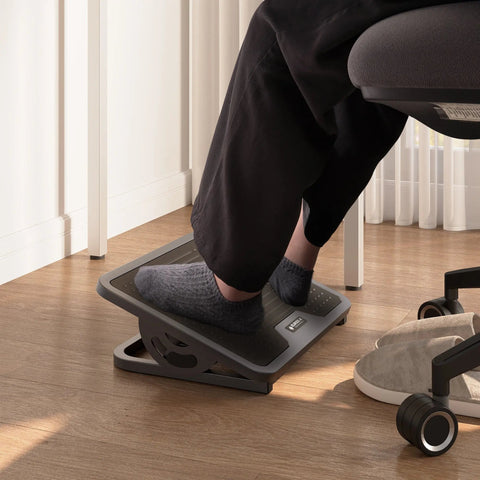
- Ground your feet: If your chair is too high for your desk, use a footrest so your knees stay at 90 degrees.
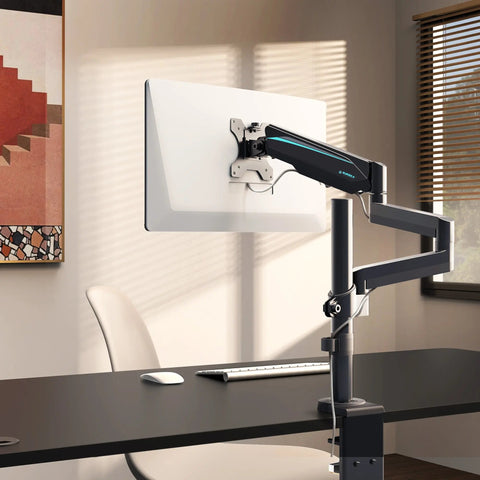
- Clear the "Visual Depth": Use a monitor arm to push your screen back to arm's length, reducing eye strain in cramped quarters.
The Physiological Cost of the Finals Week "Grind"
During the final weeks of the semester, students often adopt a "grind" mentality, characterized by 12-hour study sessions and minimal physical movement. However, based on common patterns we see in student support and ergonomic assessments, this sedentary intensity frequently leads to a sharp increase in reports of lower back discomfort, neck strain, and cognitive fatigue.
The common misconception is that physical stillness equals mental focus. In reality, prolonged static sitting acts as a physiological stressor. When the body remains seated for extended periods, blood circulation slows. This affects the metabolic rate at which the brain receives oxygenated blood and glucose.
According to the World Health Organization (WHO) 2020 Guidelines, adults should limit sedentary time. For a student, the "static load"—the effort required by muscles to maintain a single posture—accumulates, potentially leading to Musculoskeletal Disorders (MSDs) that can persist long after the exam period ends.
Logic Summary: The transition from acute discomfort to chronic MSDs is often triggered by "static loading." This analysis assumes a standard student study pattern of 4+ hours of continuous sitting without postural shifts.
The Science of Static Load and Cognitive Decline
The relationship between posture and the brain is deeper than most realize. Research suggests that excessive sitting may have neurological implications. A study highlighted by StudyFinds indicates that prolonged sedentary behavior is associated with thinning in the medial temporal lobe, a region essential for memory formation.
Physiologically, the body is designed for "neutral positions" where joints are not stressed. In a standard dorm setup, students often hunch over laptops, leading to "Forward Head Posture." This adds significant weight to the cervical spine; for every inch the head moves forward, it can add roughly 10 pounds of effective weight to the neck muscles.
Integrating sit-stand intervals addresses this by utilizing "Engineering Controls." As defined by OSHA, engineering controls involve designing the environment to fit the user. A height-adjustable workstation allows for frequent micro-postural shifts that facilitate blood flow and reduce the risk of tissue adaptation to poor positions.
The 20-8-2 Heuristic: A Blueprint for Academic Endurance
While standing is beneficial, standing for too long is a common mistake. Moving from eight hours of sitting to four hours of continuous standing often results in foot fatigue and lower back arching.
To maximize both health and focus, we recommend the 20-8-2 Rule, a practical heuristic derived from ergonomics research at Cornell University.
The 20-8-2 Breakdown:
- 20 Minutes Sitting: Use this for deep work. Ensure your chair provides lumbar support.
- 8 Minutes Standing: Transition to standing to re-engage your core and increase heart rate slightly.
- 2 Minutes Moving: Walk or stretch. This encourages full-body circulation and provides a mental "reset."
This rhythm aligns with natural attention spans. According to a Cochrane systematic review, sit-stand desks can reduce sitting time by 84 to 116 minutes per day, providing a significant buffer against sedentary risks.

The Dorm Room Paradox: Space vs. Ergonomics
Implementing a professional routine in a dormitory presents unique challenges. Dorm furniture is typically a "one-size-fits-all" solution. In tight quarters, a wobbly desk is a distraction that breaks the "flow state."
While desk converters are popular, they often lack the depth required for proper visual ergonomics. The OSHA eTools for Monitors suggest a viewing distance that allows you to read clearly without leaning forward. In a 24-inch deep dorm desk, a large monitor can feel overwhelming.
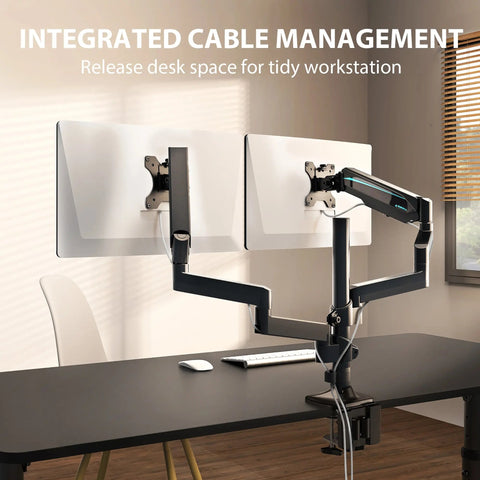
To solve this, a Dual Monitor Arm is an essential accessory. By lifting monitors off the desk, you regain "real estate" for textbooks while allowing for precise viewing angles. This is vital when transitioning between sitting and standing, as the ideal monitor height changes relative to your eye level.
Modeling the Student Scenario: The Tall Female Student
To demonstrate these principles, we modeled a scenario: a Tall Female Student (180cm / 5'11"). This persona faces a "double disadvantage": standard 29-inch dorm desks are often too high for her to sit comfortably without shrugging, yet too low to serve as a standing surface.
Scenario Analysis: The Ergonomic Gap
| Variable | Sitting Requirement | Standing Requirement | Dorm Standard | Deficit/Gap |
|---|---|---|---|---|
| Desk Height | ~71.5 cm (28.1 in) | ~113.5 cm (44.7 in) | 73.7 cm (29 in) | 1.6 in (Sitting) |
| Viewing Distance | 84 cm (33 in) | 84 cm (33 in) | 61 cm (24 in) | 9 in (Depth) |
| Motor Load | N/A | ~46 kg (101 lbs) | N/A | 38% Capacity* |
Methodology Note: This scenario uses ANSI/HFES 100-2007 anthropometric ratios. Calculations assume a 27-inch monitor and standard dorm furniture. *Motor load capacity is calculated based on a 120kg (265lb) dual-motor limit (46kg load / 120kg capacity ≈ 38%). This is an illustrative model, not a clinical study.
For this student, the 1.6-inch sitting deficit forces a compensatory posture. To correct this, a Footstool with Wheels is essential. It allows her to raise the chair to match the desk height while keeping her feet flat, preventing lower back arching.

Engineering for Stability and Safety
When a setup involves multiple monitors and heavy textbooks, stability is paramount. In small dorms, "anti-collision" technology is a critical safety feature to prevent the desk from crushing items like chair arms during descent.
For those with space, a dual-motor system, such as the Zen Pro Series Executive Standing Desk, provides higher weight capacity and smoother transitions. A dual-motor desk typically utilizes only about 38-40% of its motor capacity in a student setup (Dual monitors + PC), which ensures longevity and a wobble-free experience at full standing height.
Managing cables is also a safety requirement. Loose cables can snag during transitions. Utilizing a Magnetic Cable Tie ensures that the power and data cables move cleanly with the desk.
Practical Recommendations for Finals Week
To transition your dorm room into a study hub, follow this checklist based on HSE guidelines:
- Find Your Neutral: Adjust your chair so thighs are horizontal and feet are flat. Your elbows should be at a 90-degree angle when typing.
- Top of Screen at Eye Level: Use a Dual Monitor Arm to achieve this without stacking books.
- Implement the 20-8-2 Rhythm: Set a timer. Movement is a proactive strategy, not a reactive remedy for pain.
- Mind the Viewing Distance: Ensure your monitor is roughly an arm’s length away.
- Lighting and Glare: Position your desk to avoid window glare, which can lead to "Computer Vision Syndrome" and secondary neck pain.
Logic Summary: These recommendations align with BIFMA G1-2013 dimensions intended to fit the 5th to 95th percentile of the population.
Academic ROI: The Impact of Movement
Beyond physical benefits, the "ROI" (Return on Investment) of sit-stand intervals is measured in cognitive clarity. By following the 20-8-2 rule during an 8-hour study day, a student can burn an estimated 50–60 extra calories compared to static sitting.
Calculation Note: This estimate is based on the MET (Metabolic Equivalent of Task) difference between sitting (1.3 MET) and standing (1.5-1.8 MET) for a 70kg individual over a cumulative 2-hour standing period.
The real value, however, lies in the "context shift." Changing your physical state can act as a mental reset, helping to segment study blocks and improve memory retention. As discussed in our 2026 Workstation White Paper, the future of productivity lies in "dynamic working." By investing in a setup that supports circulation, you are engineered for academic endurance.
Disclaimer: This article is for informational purposes only and does not constitute professional medical advice. If you have pre-existing musculoskeletal conditions or chronic pain, please consult a qualified healthcare professional before making significant changes to your workstation.
References
- BIFMA G1-2013 Ergonomics Guideline for Furniture
- CCOHS: Office Ergonomics - Sit/Stand Desk
- Cornell University Ergonomics Web — Workstation Guides
- OSHA eTools: Computer Workstations - Monitors
- WHO 2020 Guidelines on Physical Activity & Sedentary Behaviour
- HSE: Working safely with display screen equipment (DSE)
- Cochrane: Workplace interventions for reducing sitting at work




Leave a comment