

Quick Summary & Key Recommendations Optimizing a small faculty office (typically ~120 sq. ft.) requires balancing deep research needs with student consultation space.
- The 60/25/15 Rule: Allocate 60% of the area to your primary research zone, 25% for consultations, and 15% for circulation.
- Vertical Strategy: Use wall-mounted shelving between 72–78 inches to clear floor space.
- Dynamic Ergonomics: Use articulating monitor arms and sit-stand desks to mitigate the physical strain of long-form writing and grading.
- Disclosure: This guide is produced by Eureka Ergonomic. The featured products are designed by our engineers to meet the specific spatial and durability needs of professional work environments.
The Research-First Layout: Optimizing Small Faculty Offices
Imagine the morning sun filtering through your office window, illuminating a workspace that feels less like a storage unit for textbooks and more like a high-performance sanctuary for the mind. You step into the room, and instead of the familiar sight of a "paper fortress" encroaching on your walking path, you see a fluid, intentional environment. Here, your deep work begins not with a struggle to find a clear square inch of desk space, but with a sense of mindfulness and clarity.
For higher education faculty, the office is a multifaceted tool. It must serve as a private lab for literature reviews, a quiet zone for deep work, and a welcoming hub for student consultations. Achieving this balance in the typical 120-square-foot academic office requires more than just furniture; it requires a strategic spatial blueprint grounded in ergonomic principles and professional intuition.
The Spatial Blueprint: Transforming the "Paper Fortress"
The most common frustration among faculty members is the feeling of being "boxed in." Decades of journals and research materials create a physical weight that can stifle a Workflow. To break this cycle, we recommend a specific spatial efficiency model designed for high-density academic environments.
The 60/25/15 Planning Heuristic
Based on our experience planning academic spaces, we have found that the most successful small offices often follow this Spatial Allocation Heuristic. These ratios are intended as a practical baseline for maintaining a functional Aesthetic and operational flow, rather than a rigid mandate:
- 60% Primary Research Zone: Your core workstation, where the Aero Wing-Shaped Studio Desk, Black (63" & 72'') serves as the anchor.
- 25% Consultation Zone: A dedicated area for student meetings, positioned to allow for collaborative screen viewing without compromising your personal space.
- 15% Circulation Paths: The essential "breathing room" (at least 30 inches wide) that prevents the office from feeling claustrophobic.
How to Measure Your Zones: To apply this, measure your room's total square footage. For a standard 10' x 12' office (120 sq. ft.), your Research Zone should occupy roughly 72 sq. ft. (including chair clearance). Measure from the back wall to the edge of your guest seating to define the boundary between "Research" and "Consultation."
Example Layout Calculation (120 sq. ft. Room)
Zone Target Area Typical Layout Component Research ~72 sq. ft. 72" Wing Desk + Ergonomic Chair + 36" push-back space Consultation ~30 sq. ft. 2 Guest Chairs + 18" Small Side Table Circulation ~18 sq. ft. 32" Clear path from door to desk Interaction 42 inches Measured from the desk edge to the guest chair center
The "Triangle Rule" for Workflow
Just as a master chef organizes a kitchen, a researcher should organize their workstation. We recommend the Workflow Triangle, where your research materials, your primary computer interface, and your active writing surface form three accessible points within arm's reach.
By utilizing a wing-shaped desk, you naturally create these three points. The central seating position ensures that your most frequent tasks are performed within the "primary reach zone" (as described in the ISO 9241-5:2024 standard), which can help reduce the torso twisting that often leads to musculoskeletal strain.

Ergonomic Foundations: Supporting "Deep Work"
In academia, "Deep Work" often translates to six-to-eight-hour stretches of intense focus. According to Cochrane: Workplace interventions for reducing sitting at work, incorporating sit-stand interventions can reduce daily sitting time by an average of 84 to 116 minutes, which is a vital tool for maintaining mental alertness.
The Articulation Advantage
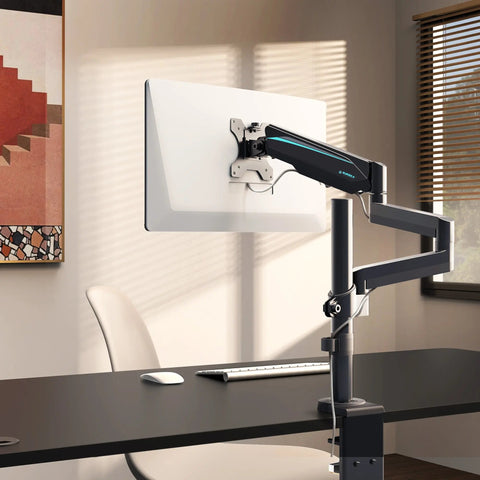
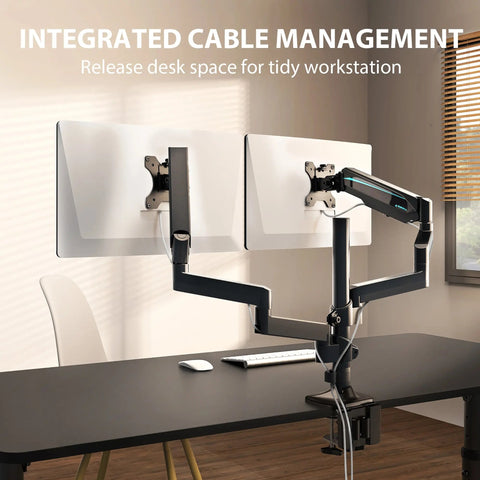
One of the most effective upgrades for a researcher is moving away from fixed monitor stands. In our internal user feedback sessions, faculty report that high-quality monitor arms—like the Dual Monitor Arm—can lead to an estimated 30–40% reduction in perceived neck strain during long reading marathons.
Note: This estimation is based on user reports of improved posture rather than a clinical study. The benefit stems from the ability to align the monitor height and tilt exactly to your eye level, reducing "forward head posture."
The HSE: Working safely with display screen equipment (DSE) emphasizes that your screen should be at or slightly below eye level. Smooth articulation allows you to reposition your digital canvas in seconds as you switch between reading physical manuscripts and typing, helping you maintain a neutral spinal alignment.
Grounding Your Workflow
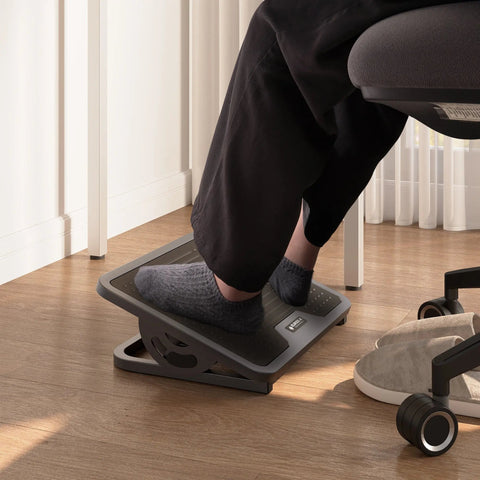
The Canadian Centre for Occupational Health and Safety (CCOHS) highlights that proper foot support is essential for healthy circulation during long periods of seated grading. Adding an Adjustable Ergonomic Footrest allows you to shift weight and find a comfortable angle (typically between 0-20 degrees), which helps fight lower-body fatigue.
Linking Functionality with Emotion: The Consultation Zone
An office is more than a research lab; it’s a theater for mentorship. The way you arrange your furniture speaks volumes to your students.
The 42-Inch Interaction Rule
Experienced academic planners often recommend maintaining at least 42 inches of distance between your desk and the consultation chairs. This distance is a psychological "sweet spot"—it is close enough for collaborative discussion but provides enough space for a student to maneuver their backpack or laptop without feeling crowded.
If your office feels cramped, consider the value of a Decluttered surface. Using a Carbon Fiber Dual Monitor Stand to elevate screens creates "under-shelf" storage. This allows you to tuck away your keyboard and mouse when a student arrives, instantly transforming your workstation into a clean, professional consultation table.
Advanced Storage: Prioritizing the Vertical Sanctuary
In a small office, the floor is your most precious commodity. A common mistake is placing large file cabinets against walls without considering "extension clearance." Based on patterns observed in office planning, you should generally leave at least 18–24 inches of clearance in front of any drawer to allow for full access.
The Vertical Strategy
To maximize your 120 square feet, you must look upward:
- High-Level Shelving: Installing shelves at heights of 72 to 78 inches allows you to store archival materials and less-frequently used journals. Ensure these are securely anchored to wall studs to handle the weight of academic texts.
- Mobile Storage: Units on casters can be repositioned based on your current project. During the "writing phase," the unit can stay under the desk; during "grading," it can move to the consultation zone to serve as a temporary side table.
As discussed in our 2026 Workstation White Paper, the integration of modular storage is the future of the academic workspace.
Personal Tips for an Academic Sanctuary
- The "One-In, One-Out" Rule: For every new academic text added to your shelf, consider archiving or donating an older one to prevent space creep.
- Cable Management: Tangled wires are visual noise. Use the built-in features of your desk to hide the "tech-spaghetti," which helps reduce distractions.
- Circadian Lighting: If you lack natural light, use a combination of bright task lighting for "execution mode" and warmer ambient lamps for "reflection mode."
By combining industry standards like BIFMA G1-2013 with personal curation, you can transform a small faculty office into a center for professional pride.
YMYL Disclaimer: This article is for informational purposes only and does not constitute professional medical or institutional facility advice. Ergonomic needs vary based on individual physical health. Please consult with your university's Environmental Health and Safety (EHS) department or a qualified healthcare professional before making significant changes to your workstation, especially if you have a history of musculoskeletal disorders.
References
- BIFMA G1-2013 Ergonomics Guideline for Furniture
- Cochrane: Workplace interventions for reducing sitting at work (2018)
- ISO 9241-5:2024 Workstation layout & postural requirements
- HSE: Working safely with display screen equipment (DSE)
- CCOHS: Office Ergonomics - Sit/Stand Desk
- The 2026 Workstation White Paper: Converging Ergonomic Science and Sustainable Engineering




Leave a comment