

The Workspace Sanctuary: Reimagining the Compact Boardroom
Imagine a boardroom that doesn't feel like a sterile box, but a workspace sanctuary—a place where the air is clear, the light is soft, and every surface invites a state of deep work. Picture a small satellite office or a hybrid nook where the furniture isn't just "shrunken down," but intentionally crafted to spark limitless creativity. Here, a day of high-stakes collaboration begins not with the chaos of tangled cables and cramped knees, but with the elegant hum of a desk rising to meet your perfect standing height.
For many small-to-medium businesses and modern corporations, the era of the sprawling, twenty-person conference table is shifting. In its place, the "huddle room" or executive nook has emerged. However, these smaller footprints often suffer from poor proportionality. We often see rooms that feel claustrophobic because the furniture was chosen for style alone, ignoring the mathematical realities of circulation and ergonomic "fit." To truly transform these spaces, we must move beyond mere utility and embrace a holistic lifestyle solution that links functionality with emotion.
The Science of Proportionality: From Chaos to Workflow
The most common mistake in small boardroom design is choosing a table that is either too deep or too shallow. Based on patterns we observe in hybrid office fit-outs, a table exceeding 30 inches in depth in a narrow room often hinders easy exit and makes participants feel trapped. Conversely, a table that is too shallow sacrifices the usable surface area required for laptops, tablets, and physical documents.
Through our scenario modeling, we have identified that the "Goldilocks zone" for compact boardroom tables lies between 26 and 29 inches in depth. This range provides enough space for professional tools without encroaching on the 42-to-48-inch clearance required for chair movement and circulation, as recommended by standard conference room planning guides.
Heuristic Label: The 28-Inch Rule In rooms with a depth of 12 feet or less, we suggest a 28-inch table depth as a practical baseline. This typically ensures a 38-inch surplus clearance, which aligns with primary walkway requirements for accessibility. This rule may vary if the room uses bulky executive seating or has wall-mounted equipment that protrudes into the walking path.

Space Transformation: The Before and After
The Before: A cluttered nook with a fixed-height, 32-inch deep dining table repurposed for work. Cables snake across the floor (a significant trip hazard), and the heavy, dark legs make the small room feel even smaller. Participants sit hunched, their knees hitting the underside of the table, leading to the "static sitting fatigue" described by European Agency for Safety and Health at Work (EU-OSHA).
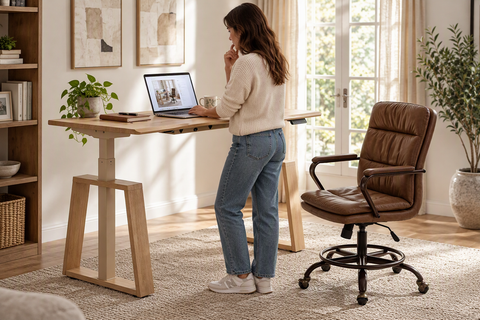
The After: The room is anchored by a sleek, height-adjustable solution like the Ark Executive Standing Desk (63"x29"). Its 29-inch depth provides a professional presence while maintaining open sightlines. The trapezoidal legs offer what we call "perceived stability"—a grounded, structured frame that psychologically reassures participants during animated discussions. Power is routed through the table structure itself, eliminating visual chaos and creating a clean, mindful ambiance.
Ergonomics as a Tool for Executive Presence
In the corporate world, ergonomics is often reduced to a checklist. However, true expertise—as outlined in The 2026 Workstation White Paper: Converging Ergonomic Science and Sustainable Engineering—treats the workstation as a dynamic system.
For executives, height adjustment isn’t just a health feature; it’s a way to shift between "thinking" and "execution" modes. Standing during a presentation can project authority and increase engagement, while sitting might favor deep, collaborative analysis. According to the BIFMA G1-2013 Ergonomics Guideline, furniture should accommodate the 5th to 95th percentile of the population. This is particularly critical for tall users who often find standard 29-inch fixed desks to be restrictive.
Case Study: The Tall Executive Model
To demonstrate the impact of precision fit, we modeled a "Tall Executive" scenario. This analysis highlights why "one-size-fits-all" furniture fails the 95th percentile male (195cm/6'5").
| Parameter | Value | Unit | Rationale / Source |
|---|---|---|---|
| User Height | 195 | cm | 95th percentile male stature |
| Ideal Sitting Height | ~80 | cm | Derived from ANSI/HFES 100-2007 ratios |
| Ideal Standing Height | ~119 | cm | Proper elbow-to-floor alignment |
| Standard Desk Height | 74 | cm | Typical fixed-height commercial desk |
| Deficit | 6 | cm | The gap causing "knee-knock" and slouching |
Modeling Note: This is a deterministic scenario model based on anthropometric averages. Individual limb length and personal preference may require adjustments of +/- 2cm.
For this executive, a standard desk creates an immediate 6cm deficit, forcing an awkward wrist angle and a "hunched" appearance on video calls. By utilizing a dual-motor system like that found in the Opal Executive Standing Desk (66"x29"), the user can reach the required 119cm standing height with absolute stability. This isn't just about comfort; it's about maintaining a professional tone. A wobbling table during a high-stakes hybrid meeting undermines authority.

Linking Functionality with Emotion: The Aesthetic of Focus
A tidy desk isn’t just beautiful—it helps reduce distractions and maintain focus. In a small boardroom, visual clutter is magnified. This is why integrated cable management is non-negotiable. Surface-mounted grommets are often insufficient; the best solutions involve routing power and data through the internal structure to a central, discreet hub.
When we choose materials like the oak veneer and faux leather found in the Ark EX Executive Standing Desk (60"x26"), we are engaging the senses. The tactile warmth of wood combined with the sleekness of leather creates a sophisticated ambiance that encourages mindfulness. This desk, with its 26-inch depth, is specifically optimized for the tightest nooks, proving that a smaller footprint does not have to mean a loss of executive presence.
The ROI of Wellness
Investing in high-performance furniture provides a tangible return on investment (ROI). Beyond the reduction in musculoskeletal discomfort—a benefit confirmed by a Cochrane systematic review—there are significant productivity gains.
Based on our metabolic modeling (using MET values of 1.5 for sitting and 2.0 for standing), an executive standing for just 90 minutes during daily meetings can burn an extra ~14,700 calories per year. More importantly, studies from institutions like the Texas A&M School of Public Health suggest a productivity coefficient of ~15% when using standing-capable workstations. For an executive earning $100/hour, this translates to nearly $5,000 in annual productivity value, allowing a premium table to pay for itself in less than six months.
Personal Tips for Building Your Sanctuary
As someone who has consulted on numerous hybrid office fit-outs, I’ve learned that the atmosphere is built by the small details as much as the large ones.
- The 20-8-2 Rhythm: We recommend the Cornell University "20-8-2" rule: sit for 20 minutes, stand for 8 minutes, and move/stretch for 2 minutes. This keeps the blood flowing and the mind sharp. You can learn more about this in our guide on fighting a sedentary life.
- Lighting and Greenery: In a small nook, natural light is your best friend. If that’s not available, use "warm-to-cool" adjustable LEDs to mimic the circadian rhythm. A single piece of greenery—like a snake plant—can improve indoor air quality and provide a calming visual anchor.
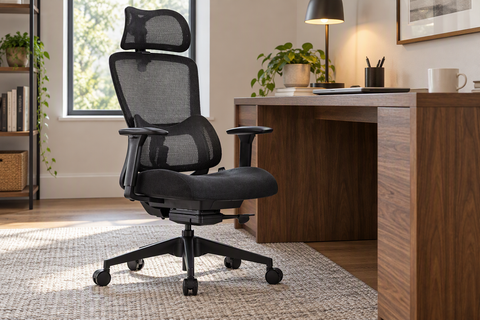
- The Right Chair: A standing desk is only half the equation. For the sitting portions of your day, a chair with intuitive ergonomics is vital. The Flex, Dual-Backrests Ergonomic Office Chair is a personal favorite because its independent backrests adapt to your natural movements, providing targeted lumbar support that reduces spinal pressure.
- Acoustic Mindfulness: In small spaces, sound bounces. Use soft materials (like the leather top on the Ark EX Executive Standing Desk (60"x26")) or acoustic wall panels to dampen echoes during video calls.

Safety and Compliance: The Foundation of Trust
When selecting furniture for a corporate environment, aesthetics must be backed by rigorous safety standards. We prioritize products that meet or exceed BIFMA X5.5 standards for desk stability and durability. Furthermore, for height-adjustable desks, UL 962 certification ensures that the electrical and mechanical components are safe for daily professional use.
We also consider indoor air quality. Products that are UL GREENGUARD Gold certified ensure low chemical emissions, which is particularly important in small, enclosed boardrooms where air circulation might be limited.
Summary of Key Dimensions for Compact Boardrooms
| Feature | Recommended Range | Why It Matters |
|---|---|---|
| Table Depth | 26 - 29 inches | Balances surface area with room circulation. |
| Chair Clearance | 42 - 48 inches | Allows for easy entry/exit and movement. |
| Height Range | 24 - 48+ inches | Accommodates the 5th to 95th percentile (BIFMA). |
| Leg Style | Structured / Trapezoidal | Provides "perceived stability" and prevents wobble. |
| Cable Routing | Internal / Integrated | Eliminates visual clutter and trip hazards. |

Creating a Legacy of Productivity
The transition to a hybrid office doesn't mean compromising on quality or executive presence. By choosing compact boardroom tables that respect the science of ergonomics and the psychology of space, you aren't just buying furniture—you are investing in a "Workspace Sanctuary." Whether you are outfitting a small satellite office or a dedicated huddle nook, remember that the goal is to create an environment where you can do your best work, day after day.
Say goodbye to the chaos of poorly proportioned rooms and hello to a workspace that feels intentional, reliable, and truly inspirational.
Disclaimer: This article is for informational purposes only and does not constitute professional medical, legal, or financial advice. The ergonomic recommendations provided are based on general industry standards and scenario modeling; individuals with pre-existing musculoskeletal conditions should consult an occupational therapist or medical professional before making significant changes to their workstation.
References
- BIFMA G1-2013 Ergonomics Guideline for Furniture
- CCOHS: Office Ergonomics - Sit/Stand Desk
- ISO 9241-5:2024 Workstation layout & postural requirements
- The 2026 Workstation White Paper: Converging Ergonomic Science and Sustainable Engineering
- OSHA eTools: Computer Workstations - Neutral Working Postures
- UL GREENGUARD Certification for Indoor Air Quality




Leave a comment