

Matching standing desk and chair choices starts with fit, not finish. The best pairing is the one that keeps your elbows, keyboard height, seat height, and legroom working together for your body and your work pattern. If the measurements miss, the set is not a real match no matter how coordinated it looks.

Start With Height Fit
A standing desk and chair should work as one system. The seated position has to support relaxed shoulders and usable keyboard height, while the desk still adjusts high enough for standing work without forcing awkward reach. OSHA's elbow and keyboard alignment guidance is a practical place to start.
For a first pass, compare three things: the desk's working-height range, the chair's seat-height range, and the clearance under the desk. Cornell's feet-flat seated posture heuristic is a useful reminder that your feet should stay planted and your thighs should not feel jammed upward just to make the desk work.

Measure Desk and Seat Height Together
The desk and chair need overlapping adjustment ranges. If the desk's lowest working height is still too high for relaxed typing, or the chair must be raised so far that your feet lose contact with the floor, the pairing breaks down. That is why a wider adjustment range matters in a matching standing desk and chair setup.
BIFMA's ergonomics guidance also matters here because office furniture should cover a broad user range, not just one body type. In plain terms, a good pairing should leave room for different seated heights without making the standing position awkward.
Check Armrests, Thigh Clearance, and Legroom
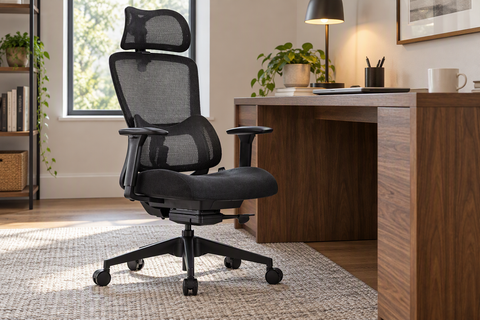
Armrests are useful only if they do not stop the chair from sliding under the desk when needed. Check the underside of the desktop, drawer fronts, crossbars, and any center support before you buy. If the chair only fits when the armrests are raised awkwardly, the set will feel cramped in daily use.
The other common miss is knee pressure. LA County's ergonomics bulletin recommends about two inches of knee clearance behind the front edge of the seat pan, which is a useful check when the desk has an apron or the chair has a thick cushion.
Match the Pair to Your Body Height Range
Do not judge the desk or chair by spec sheet alone. Judge the pairing against your seated height, seat depth, and how much you move during the day. A desk that looks generous on paper can still feel wrong if the chair's seat pan is too deep or the armrests sit too high.
A simple rule: if the desk height, chair height, and clearance only work for one exact position, the setup is too tight for normal home-office use. If they overlap comfortably across a small range, the pair is much more likely to stay usable after the first week.
Design for Seated and Standing Workflow
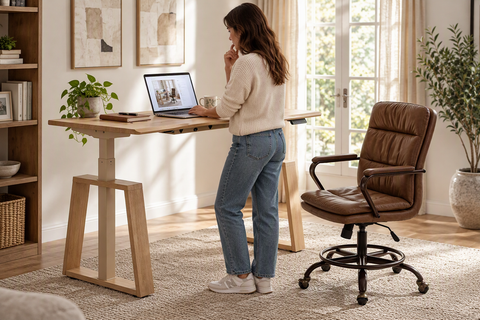
The next question is not just whether the desk and chair fit, but whether they fit your day. A good standing desk pair should handle seated typing, quick stand-up tasks, calls, and longer focus blocks without turning every switch into a reset. WELL's alternating sitting and standing framework supports that idea: compatibility is about transition friction as much as posture.
What this means in practice is simple. If you change posture often, the setup needs to be easy to move through. If you stay seated for most of the day, the chair carries more of the comfort load, and the desk mainly needs to clear the seated setup cleanly.
A desk that wobbles at full height is a separate fail point. Even a coordinated set is not a good buy if the desk feels unstable when raised, because that affects monitor use, typing comfort, and trust in the setup.
Typing and Mouse Position
For seated work, the chair should let your forearms rest naturally while the desk stays at a usable height. If typing makes your shoulders creep up, the desk is too high for that chair height. If your wrists feel forced downward, the desktop or keyboard position is too low for the rest of the setup.
This is also where accessories can help. A monitor arm or desktop riser can smooth the switch between sitting and standing, but only if the base desk-chair pairing already clears the height and legroom checks. Accessories should clean up a good setup, not rescue a bad one.
Monitor Height and Multi-Screen Layouts
Once the desk rises, screen placement changes too. If you use one monitor, the transition is easier. If you use two or more screens, a deeper desk surface and better cable management matter more because the whole workspace has to move together.
A sit-stand desk position guide can help with the desk side of that setup, but the key decision is still whether the chair leaves enough space for the desk to do its job in both modes. In a mixed workflow, a small layout problem often feels bigger than a spec sheet advantage.
Meetings, Calls, and Long Focus Blocks
The best desk-chair pairing for a home office depends on what you do longest, not what you do occasionally. If you spend hours on calls and typing, more chair adjustability matters. If you stand often and only sit for short sessions, a simpler chair may still work if it clears the desk well and does not block transitions.
Compare Chair Features That Affect Compatibility
Chair features matter differently once the desk is adjustable. The features below do not make a chair better in the abstract. They matter because they change how well the chair fits under the desk, how comfortable seated typing feels, and how easy it is to switch postures.
| Chair feature | What it answers | Typical fit check | Failure sign | Best for |
|---|---|---|---|---|
| Seat height range | Can your feet stay planted while the desk still works? | Enough range to keep elbows near desk level without lifting shoulders | Feet dangle or the desk feels too high when seated | Most home office users |
| Seat depth | Does the seat support your thighs without crowding the knees? | Small gap behind the knees, roughly around the clearance check noted earlier | Front edge presses into the knees | Taller users, longer sessions |
| Armrests | Can the chair clear the desk when needed? | Arms slide under the desktop without forcing a bad posture | Armrests hit the apron or drawer front | Tight spaces, smaller desks |
| Lumbar support | Does the backrest still feel supportive during longer seated work? | Support lands in the lower-back curve without pushing you forward | You keep sliding or slouching | Long seated focus blocks |
| Recline | Can the chair handle calls and breaks comfortably? | Enough movement for non-typing tasks without feeling loose | The chair feels stuck or overly relaxed | Mixed workdays |
| Weight capacity | Is the chair sized for the user and daily use? | Rating fits the user and the chair still feels stable in motion | Flex or discomfort at normal use | Any buyer checking durability |
In a compact home office, armrest clearance and seat depth often matter more than a long feature list. In a larger executive setup, lumbar support, recline, and finish may matter more because the room can absorb a bigger chair profile. If you want a broader starting point, ergonomic office chairs are a practical place to compare fit before styling.
Choose a Coordinated Look Without Losing Function
Once the measurements pass, style can do its job. A coordinated standing desk and office chair should look intentional, but the visual match should never hide a clearance problem or a poor seated fit. Finish, tone, and silhouette are the final layer, not the starting point.
A simple way to choose the look: match visual weight, then match tone, then decide whether the pair should blend into the room or anchor it. Light oak, walnut, off-white, and black each create a different feel, but none of them improve ergonomics on their own.
If you want a faster path through bundle shopping, office furniture bundles can help narrow the options. The right bundle is the one that already clears your fit checks and also fits the room you actually use every day.
Final Compatibility Checklist
Before you add a matching standing desk and chair to cart, run one last pass in order. Measure the user, confirm the desk height range, verify chair seat height and seat depth, check armrest clearance, and make sure the desk still feels stable when raised. Then confirm the monitor and keyboard setup, compare the finish to the room, and review shipping, returns, and warranty so the purchase feels low-risk.
If you want a shorter path, compare our standing desk and chair set options only after those checks pass. A coordinated set is worth it when it saves time, clears the measurements, and still supports your actual workflow.
FAQs
How Do I Measure Chair and Desk Height for a Good Fit?
Start with your seated setup, then match the chair seat height to the desk's usable low point. Your feet should stay grounded, your shoulders should stay relaxed, and the keyboard should not force you to reach upward. If those three things do not line up, the pairing is not a good fit yet.
What Chair Features Matter Most With a Standing Desk?
Seat height range and armrest clearance usually matter first, followed by seat depth and lumbar support. Those features decide whether the chair can slide under the desk, support seated typing, and still feel usable after several posture changes. Recline and finish matter too, but they are secondary to fit.
Can a Standing Desk Work With a Fixed-Arm Office Chair?
Yes, if the chair can clear the desk and still leave enough room for seated typing. Fixed arms are not automatically a problem, but they reduce margin for error. If the desk has a thick apron, drawers, or a low crossbar, the chair needs careful measuring before you buy.
What If I Split My Day Between Sitting and Standing?
Then transition friction becomes part of the buying decision. You want a setup that lets you change posture without constantly moving accessories or reworking the keyboard and monitor. In mixed-use days, a chair with better adjustability usually earns its keep more than a chair chosen only for looks.
How Do I Choose a Coordinated Desk and Chair Set for a Home Office?
Check the measurements first, then look at finish, silhouette, and storage. A coordinated set is useful when it saves time and already fits your space, but it should not replace the height and clearance checks. If the pair passes those checks, style becomes a real bonus instead of a gamble.




Leave a comment