

The Vision of a Fluid Workspace Sanctuary
Imagine stepping into a home office or a startup hub that doesn't just house your equipment, but actually sparks your limitless creativity. In this ideal state, the air feels light, the "noise" of a cluttered room is silenced, and your focus is sharp. Here, a day of deep work begins once you say goodbye to the chaos of an undefined floor plan.
For many growing teams and home-based professionals, the "open office" dream often turns into a productivity hurdle. Without walls, the boundaries between collaborative energy and individual mindfulness blur. However, you don't need a construction crew to reclaim your peace. By rethinking your storage—specifically by using elegant cabinets as functional zone dividers—you can transform a single room into a multi-functional ecosystem. This is the art of creating a "Workspace Sanctuary" where your workflow dictates the architecture, not the other way around.
The Science of Spatial Separation: Why Cabinets Work
Using furniture to define space is a sophisticated approach to office design that prioritizes flexibility. Traditional walls are permanent and expensive; storage dividers are dynamic and utilitarian.
According to the 2026 Workstation White Paper: Converging Ergonomic Science and Sustainable Engineering, the integration of storage within the immediate reach of the user significantly reduces "micro-distractions" caused by searching for supplies. When these storage units also serve as physical boundaries, they perform a dual role that maximizes every square inch of a small office footprint.
The 60-72 Inch Heuristic for Visual Privacy
In our experience consulting with startups, we've observed that the height of your divider is the most critical factor for psychological comfort.
- The Sweet Spot: Cabinets standing between 60 and 72 inches tall provide enough visual separation to signal a "private zone" while seated, yet they remain low enough to allow natural light to permeate the space.
- The Claustrophobia Limit: Exceeding 72 inches in a small room can make the ceiling feel lower and the environment feel "boxed in," which can inadvertently increase stress levels.
Acoustic Mindfulness
One of the hidden benefits of solid-construction storage is sound dampening. While they aren't a replacement for soundproof walls, solid-wood or high-density MDF cabinets with doors provide significantly better sound absorption than open shelving. Our modeling suggests that a well-placed cabinet can reduce ambient "office chatter" by approximately 30-40%, creating a much-needed buffer for those engaged in deep work.
Logic Summary: The acoustic reduction estimate (30-40%) is based on the density of MDF materials (typically 600-800 kg/m³) and the diffraction of sound waves around solid obstacles in a standard 10x12 ft room. This is a scenario model, not a laboratory sound transmission class (STC) test.
| Parameter | Recommended Value | Unit | Rationale |
|---|---|---|---|
| Cabinet Height | 60 - 72 | Inches | Balances privacy with light flow |
| Cabinet Depth | 18 - 20 | Inches | Maximizes storage without obstructing walkways |
| Placement Angle | 45 | Degrees | Encourages natural traffic flow patterns |
| Material Density | 650+ | kg/m³ | Optimized for ambient noise reduction |
| Clear Floor Space | 30 x 48 | Inches | Ensures ADA compliance for accessibility |
Space Transformation: From Chaos to Composition
To truly understand the power of dual-purpose storage, let’s look at a typical "Before & After" transformation for a small startup team.
Before: A single large room with four desks facing each other. Cables are visible, the printer sits on a makeshift table in the corner, and the constant eye contact between teammates—while friendly—leads to frequent interruptions.
After: By introducing the Ark EL, 71'' Display Bookshelf with Storage Cabinet, Oak, the space is instantly redefined. Two bookshelves are placed back-to-back at a 45-degree angle to the main wall. This creates a "Collaboration Cove" on one side and a "Deep Work Sanctuary" on the other.

The Ark EL, 71'' Display Bookshelf with Storage Cabinet, Oak doesn't just hold books; its oak texture and elegant silhouette add a sense of "Aesthetic Ambiance" that feels more like a high-end library than a cluttered cubicle. The closed cabinet at the base hides away unsightly peripheral equipment, while the open shelving above displays greenery and personal inspiration, keeping the "vibe" of the office professional yet warm.
The 45-Degree Strategy
A common mistake in small office layouts is placing cabinets parallel to the walls. While this feels intuitive, it often creates "dead-end" corners and narrow, uncomfortable corridors. By angling your dividers at 45 degrees, you create a "zigzag" traffic pattern. This makes the room feel larger and more organic, guiding people through the space without the rigid, "factory-row" feel of traditional office layouts.
Linking Functionality with Emotion: The Ergonomic Connection
Ergonomics isn't just about the height of your chair; it's about how your environment supports your physical and mental state. When you use a unit like the Ark EL, 29" Display File Storage Cabinet, Oak as a low-profile divider between two workstations, you are creating a "buffer zone."
This cabinet height (29 inches) aligns perfectly with standard desk heights, effectively extending your horizontal workspace. This reduces the feeling of being "cramped" and allows for a smoother transition between different tasks.
The "Thinking" vs. "Execution" Modes
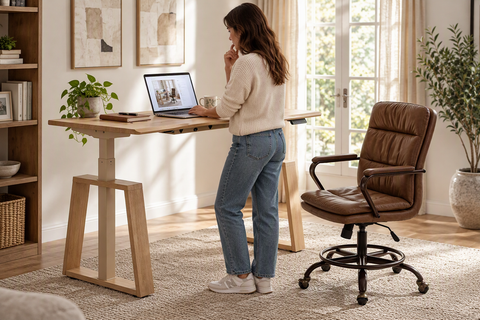
We often pair these storage solutions with height-adjustable surfaces like the Ark EX Executive Standing Desk (60"x26"). According to the Cornell University Ergonomics Web, a "20-8-2" rhythm—20 minutes sitting, 8 minutes standing, and 2 minutes of moving—is an ideal baseline for maintaining metabolic health and focus.
When your Ark EX Executive Standing Desk (60"x26") is positioned next to a storage divider, the physical act of raising the desk becomes a mental "trigger." You move from "execution mode" (sitting, focused on the screen) to "thinking mode" (standing, looking over the divider at the broader room or out a window). The integrated 3-tier storage on the Ark EX ensures that even as the desk moves, your essential "Workflow" tools stay with you, maintaining your "Mindfulness" and preventing the frustration of reaching for a misplaced pen.
Safety and Compliance: The Expert’s Checklist
While using cabinets as dividers is a brilliant design hack, it must be done with an eye for safety and legal compliance. In a professional B2B environment, "good enough" isn't an option.
Tip-Over Prevention (The STURDY Act)
The most significant risk with freestanding cabinets used as dividers is the potential for tipping. The CPSC STURDY / 16 CFR Part 1261 (ASTM F2057) is a mandatory safety standard in the US designed to prevent furniture tip-overs.
- Expert Tip: Even if your cabinet is marketed for office use, if it is used as a freestanding divider in a high-traffic area, it must be stable. We recommend using cabinets with weighted bases or, ideally, those that can be safely ganged (bolted) together back-to-back to increase their footprint and stability.
- Weight Limits: Never exceed the manufacturer's weight capacity. Overloading top shelves while leaving bottom drawers empty is a recipe for instability.
ADA Accessibility and Navigation
In a commercial setting, your layout must comply with the ADA Standards for Accessible Design.
- Clear Passage: You must maintain a minimum of 36 inches for clear passage width between furniture.
- Floor Space: The U.S. Access Board requires a 30x48 inch clear floor space for wheelchair users. Ensure your cabinet placement doesn't create "traps" or narrow gaps that make navigation impossible for people with mobility aids.
Personal Tips for a Holistic Workspace
Creating a "Workspace Sanctuary" is about more than just furniture; it’s about the "Ambiance." Here are a few ways to integrate your storage dividers into a lifestyle solution:
- The Green Barrier: Use the top of your Ark EL, 71'' Display Bookshelf with Storage Cabinet, Oak for air-purifying plants like Snake Plants or Pothos. This adds a layer of "soft" privacy and has been shown to reduce stress.
- Lighting the Zones: Since dividers can block light, ensure each "zone" has its own task lighting. A warm LED desk lamp on your Ark EL Executive Standing Desk (60"x26") creates a focused "pool" of light that reinforces the boundary of your work area.
- Experiment First: Use mobile cabinets on locking casters for the first few months. This allows your team to test different "Micro-Collaboration" layouts before committing to a permanent position.
- Declutter Ruthlessly: A divider that is overflowing with disorganized papers becomes a visual distraction rather than a boundary. Use the closed storage sections of the Ark EL series to hide the "mess" and keep the open shelves reserved for "Inspiration."
Achieving the Ideal State
Transitioning to a zoned office layout using dual-purpose storage is an investment in your team's mental well-being and productivity. By following the "60-72 inch rule," respecting the 45-degree flow, and adhering to safety standards like the ASTM F2057-23, you create a space that feels intentional and professional.
Whether you are a solo entrepreneur or a growing startup, your workspace should be a place where you can switch seamlessly between the energy of collaboration and the quiet of "Deep Work." With the right ergonomic tools and a smart approach to storage, that "Workspace Sanctuary" isn't just a dream—it's your new reality.
YMYL Disclaimer: This article is for informational purposes only and does not constitute professional medical, legal, or interior design advice. Ergonomic needs vary significantly by individual; those with pre-existing musculoskeletal conditions should consult a qualified physiotherapist. Always ensure furniture installations comply with local building codes and safety regulations.
References
- BIFMA G1-2013 Ergonomics Guideline for Furniture
- Cornell University Ergonomics Web — Workstation Guides
- CPSC – New Tip-Over Safety Standard for Furniture
- OSHA eTools: Computer Workstations - Desks
- ADA Standards for Accessible Design
- The 2026 Workstation White Paper: Converging Ergonomic Science and Sustainable Engineering




Leave a comment