

Your Chair On Camera: A Streamer's Style Guide
Let’s be real for a second: for a professional streamer, a chair isn't just a place to park your backside for eight hours. It’s a core piece of your set design. It is often the second most visible "character" on your broadcast after your own face. Whether you’re grinding ranked ladders or hosting a deep-dive video essay, your chair communicates your brand’s build quality and professional level before you even say "Hello, chat."
But choosing the right throne can be a challenge. You need something that looks sharp under studio lights, minimizes noise during shifts, and supports your spine during marathon sessions. In this guide, we’re diving into the aesthetics, acoustics, and ergonomics of the modern streaming setup. We’ll look at how to balance that "pro-gamer" vibe with the practical requirements of long-session health.
1. Unboxing and Assembly: First Impressions Matter
When you invest in a high-end piece of gear like the HyperX Python II Gaming Chair, the experience starts at the front door. Based on our experience unboxing dozens of chairs, you can usually distinguish premium builds from budget alternatives by the weight and internal organization of the packaging.
The packaging for a premium chair typically uses high-density, custom-cut foam to protect the base and backrest. Assembly usually takes about 20 to 30 minutes. A practical tip from our workshop: Look for chairs that use pre-installed bolts or high-density polymer components. In our experience, a chair that feels rigid during assembly is less likely to develop significant structural play or "creaks" after several months of use.

2. Deep Dive: Aesthetics, Acoustics, and the 'Wobble Test'
The 60-30-10 Rule for Your Frame
Streamers often struggle with color balance. We recommend the 60-30-10 color heuristic as a starting point: your background/walls take up 60% of the visual space, your primary desk setup 30%, and your chair acts as a 10% accent or a neutral base.
If your overlay is neon blue, a chair like the HyperX Python II Gaming Chair with its subtle blue accents provides visual harmony. Conversely, for a "Variety Streamer" or professional look, the Royal Slim Executive Office Chair in cream leather offers a minimalist aesthetic that performs well under warm key lights.
Studio Lighting and Material Choice
One common mistake is choosing high-gloss leather or reflective plastics. Under studio lights, these can create "specular highlights"—bright, blown-out white spots that can distract the viewer and challenge your camera's auto-exposure. Matte fabrics and soft-touch plastics are often more camera-friendly. The HyperX Python II features NanoAir™ threading (a manufacturer-proprietary textile), which provides a matte, breathable surface designed to reduce harsh reflections while maintaining airflow.
The Silent Operation Factor (Mic Check)
In streaming, mechanical noise can be an issue. Sensitive condenser mics (e.g., Shure SM7B) can pick up the "pop" of a lower-quality gas lift.
- Subjective Mic Check: Set your mic gain to your standard streaming level. Sit roughly 12 inches from the capsule. Adjust your height and tilt. If your monitor levels peak above -40dB from chair noise alone, the mechanism may be audible to your audience.
The 'Wobble Test'
Stability is critical for precision. We use a simple Lateral Stability Protocol to check for "play":
- The Test: Apply approximately 5–10 lbs of lateral force to the top of the backrest while the base is stationary.
- The Threshold: A high-quality build should ideally exhibit less than 5mm of lateral displacement at the connection points. Stability isn't just about comfort; it helps maintain consistent posture during high-energy gameplay.
Modeling note (illustrative parameters): This model represents typical creator scenarios used in our practical evaluations.
Parameter Value/Range Rationale Session Duration 4–8 Hours Standard streaming window Mic Sensitivity -36dB to -42dB Common condenser mic gain range User Weight 150–250 lbs 5th to 95th percentile coverage Light Intensity 500–1000 Lux Typical 3-point studio lighting Movement Frequency 12–15 shifts/hr High-energy gaming behavior
3. Performance vs. Perception: Examining the Data
Does a specialized chair actually impact performance? While often debated, preliminary data suggests potential benefits. A 2024 preprint study (not yet peer-reviewed) conducted with a small cohort of esports players indicated that participants using a specialized gaming chair (GC) showed higher win rates in League of Legends compared to those in standard office chairs.
Note on Study Limitations: As a preprint with a specific sample size, these results should be viewed as preliminary rather than a universal guarantee. The observed performance boost was attributed primarily to reduced muscle fatigue. The study found that gaming chairs could help reduce muscle stiffness in the thoracic and lumbar regions (observed at -4.4% compared to a 0.32% increase in standard chairs), potentially allowing for better focus over long periods.
Adaptive Support
During intense sessions, arm and lumbar support become vital. The HyperX Python II utilizes 4D Gyro-Tech™ (a proprietary self-adaptive lumbar mechanism). This system is designed to adjust as you shift between a "lean-in" gaming posture and a relaxed "Just Chatting" position.
As noted in the OSHA eTools on Computer Workstations, maintaining a "neutral posture" is a key recommendation for preventing long-term strain. A chair that dynamically follows your movement can help facilitate this neutral alignment.
4. The Science of the "Sit-Stand" Rhythm
Even the most ergonomic chair is not a substitute for movement. The World Health Organization (WHO) emphasizes reducing sedentary time and interrupting long periods of static sitting.
For creators, we suggest the "20-8-2" rhythm (a heuristic popularized by researchers at Cornell University):
- 20 Minutes of sitting in a neutral posture.
- 8 Minutes of standing.
- 2 Minutes of moving or stretching.
Integrating this into a stream can help manage energy levels. For example, use a standing desk for your "Intro" and "Outro" and sit for core gameplay. This helps mitigate the risks of "prolonged static sitting" highlighted by EU-OSHA.
To facilitate these transitions, a Dual Monitor Arm can be helpful. It allows you to adjust screen height so that your eye level remains aligned with the top third of the screen—a standard recommendation from the CCOHS.
5. Pros & Cons: A Balanced View
| Feature | Pros | Cons |
|---|---|---|
| Gaming Aesthetics | High visual impact; aligns with RGB ecosystems. | May appear too aggressive for some corporate/professional contexts. |
| Adaptive Lumbar Support | Dynamically follows movement; can reduce muscle stiffness. | Proprietary mechanisms may feel "unusual" to users accustomed to fixed backs. |
| Matte Fabric (NanoAir™) | Breathable; minimizes camera glare. | May require more specific cleaning compared to standard PU leather. |
| 4D Armrests | Supports various grip styles (claw/palm); can reduce shoulder strain. | Multiple adjustment points may result in minor mechanical "play" in some models. |
6. Building Your Setup
To harmonize ergonomic principles with your brand, consider the workstation as a whole. As discussed in the Eureka Ergonomic 2026 Workstation White Paper (a company-published guide), the trend in creator spaces is moving toward "visual harmony and silent adjustability."
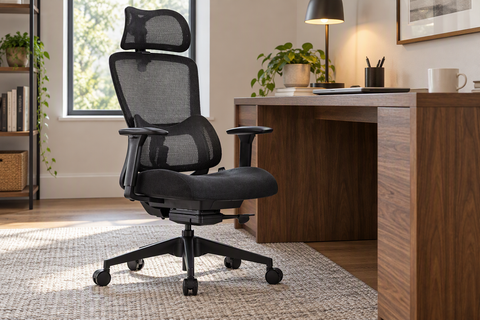
For those starting out, the Onyx Ergonomic Office Chair provides a breathable mesh back and follows BIFMA G1-2013 Ergonomics Guidelines for adjustability, making it a solid entry-level choice.
Final Verdict: Look Good, Feel Better
Your chair is an investment in both your physical well-being and your brand's production value. By prioritizing silent operation, matte materials, and verified ergonomic standards, you are building a professional studio environment.
While "standing is not exercise," as the WHO points out, alternating between a high-performance chair and a standing position can help reduce the discomfort associated with prolonged sedentary behavior. Choose a chair that supports your physical needs as effectively as it supports your aesthetic.
YMYL Disclaimer: This article is for informational purposes only and does not constitute professional medical advice. Ergonomic needs vary based on individual physical conditions. If you experience chronic pain or musculoskeletal issues, please consult a qualified healthcare professional or ergonomic specialist.
Sources & Citations
- BIFMA G1-2013 Ergonomics Guideline for Furniture
- CCOHS: Office Ergonomics - Sit/Stand Desk
- WHO 2020 Guidelines on Physical Activity & Sedentary Behaviour
- Aeron vs. Gaming Chair - Performance, Perception and Muscle Stiffness (2024 Preprint)
- OSHA eTools: Computer Workstations - Neutral Working Postures
- Eureka Ergonomic: The 2026 Workstation White Paper




Leave a comment