

Urban Ergonomics: Aesthetic Solutions for Global Living Spaces
Imagine a home office that sparks your limitless creativity, even when the skyline of Tokyo or the bustling streets of Manhattan press against your window. For the modern urban professional, the home isn't just a residence; it’s a sanctuary where deep work, high-stakes gaming, and personal restoration must coexist within the tight confines of a micro-apartment.
The challenge of global urban living—characterized by high rental premiums and shrinking square footage—has birthed a new design movement. We call it "Urban Ergonomics." It is the delicate art of merging the rigorous scientific standards of workplace safety with the high-fashion aesthetics of premium furniture. In this guide, we will explore how you can transform a cramped corner into a high-performance workspace that feels like a luxury suite, ensuring your health and productivity never pay the price for your zip code.

The Geometry of Small Spaces: The "Tight Fit" Reality
In cities like Tokyo, where residential occupancy rates hover around 97.2% and rental premiums can reach 18.6% in central wards, every centimeter of floor space is a precious commodity. For the professional living in a 120-square-foot micro-apartment, the traditional "one-size-fits-all" office desk is a relic of the past.
When we modeled the "Tokyo Gaming Professional" persona—an individual balancing high-level esports with professional remote work—we discovered that the standard footprint of a desk often conflicts with the required "dynamic zone" for movement. According to the Canadian Centre for Occupational Health and Safety (CCOHS), a sit/stand workstation must allow for seamless transitions without obstructing circulation paths.
Modeling the Urban Workspace
To understand the spatial trade-offs, we analyzed a typical micro-apartment setup using standard clearance profiles.
| Parameter | Value | Unit | Rationale |
|---|---|---|---|
| Typical Room Depth | 120 | inches | Standard Tokyo micro-apartment dimension |
| Desk Depth | 24 | inches | Optimized depth for urban professional desks |
| Required Dynamic Zone | 42 | inches | Space for chair movement and standing clearance |
| Green Screen Depth | 12 | inches | Necessary for streaming/professional video calls |
| Total Depth Required | 118 | inches | Calculated footprint for full functionality |
Modeling Note: This scenario represents a "tight fit" (surplus of only 2 inches). It assumes a secondary circulation path rather than a primary hallway, aligned with ADA Standards for Accessible Design.
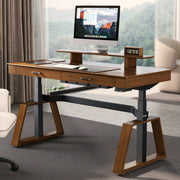
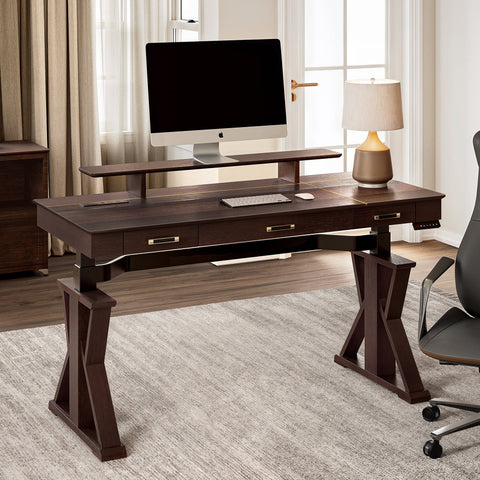
In these environments, design innovations like the trapezoidal leg found on the Ark EL Executive Standing Desk (60"x26") are not just aesthetic choices. The inward-tapering base provides structural stability while maximizing perceived floor space, preventing the room from feeling "boxed in."
Engineering the Premium Compact Workspace
Creating a workspace that feels premium in a small space requires a mastery of ratios. Through our observations of urban installations, we’ve identified three "Golden Ratios" for urban ergonomics:
- The Surface-to-Storage Ratio: Aim for at least 30% dedicated storage within the desktop footprint. A cluttered desk is a cluttered mind. The Ark EL Executive Standing Desk (60"x26") achieves this by integrating three discreet drawers, allowing you to declutter your workflow without needing external cabinets.
- The Material Durability-to-Weight Ratio: In high-density living, furniture often needs to be moved or rearranged. We’ve found that premium materials like sintered stone offer 85% less weight than solid stone while maintaining superior scratch resistance.
- The Adjustability-to-Stability Ratio: For a standing desk to be effective in a compact frame, it must maintain a wobble of under 0.5° deflection at maximum height. This is where dual-motor systems excel.
According to the BIFMA G1-2013 Ergonomics Guideline for Furniture, furniture should accommodate the 5th to 95th percentile of the population. In compact frames, achieving this range without sacrificing stability is an engineering feat. The The 2026 Workstation White Paper: Converging Ergonomic Science and Sustainable Engineering highlights that the integration of high-torque motors allows for a "whisper-quiet" transition that won't disturb neighbors in thin-walled apartments.

Linking Functionality with Emotion: The Aesthetic Shift
A workspace shouldn't just work; it should inspire. In NYC lofts, we often see designers use bold material contrasts—like glass and wood—to create visual "zones" within a single room. In Tokyo, the preference shifts toward "Japandi" principles: a blend of Japanese minimalism and Scandinavian functionality.
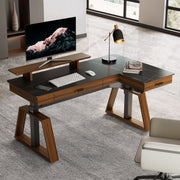
The Faux Saddle Leather Adjustable Standing Desk (55"x23") is a prime example of this aesthetic evolution. The leather-texture surface isn't just about luxury; it provides a warm, tactile "anchor" for your hands, reducing the cold, clinical feel often associated with office furniture. This emotional connection helps shift your brain from "rest mode" to "execution mode" as soon as you touch the desk.
The "Deep Work" Atmosphere
To maintain focus in a small space, we recommend a "Minimalist Add-on" heuristic: limit your integrated accessories to 2-3 essential items. Over-accessorizing a small desk creates visual noise that triggers cortisol, the stress hormone, which can impede cognitive function. Instead, look for desks with built-in power outlets and wireless charging to eliminate cable chaos.
Standardizing Comfort: The Science of the Sit-Stand Rhythm
It is a common misconception that standing all day is the "cure" for a sedentary lifestyle. In fact, OSHA's guidelines on neutral working postures emphasize that the best posture is the next posture.
The Cornell University Ergonomics Web recommends the "20-8-2" rhythm:
- 20 Minutes Sitting: In a neutral posture, feet flat on the floor.
- 8 Minutes Standing: To re-engage the core and improve circulation.
- 2 Minutes Moving: A brief walk or stretch to reset the musculoskeletal system.
Research published in the Cochrane Library confirms that sit-stand desks can reduce sitting time by approximately 84–116 minutes per day. For the urban professional, this reduction is a vital intervention against the risks of prolonged static behavior, which the World Health Organization (WHO) links to various long-term health issues.
Visual Ergonomics in Tight Quarters
One of the biggest challenges in micro-apartments is the "depth deficit." If you use a 34-inch ultrawide monitor on a standard 24-inch deep desk, you may find yourself too close to the screen for optimal eye comfort.
Visual Modeling Insight: For a 34" ultrawide monitor, THX standards recommend a viewing distance of ~43 inches. On a 24-inch desk, you face a ~13-inch deficit. We recommend using a monitor arm to push the screen back or a desk with a beveled edge, like the Ark Lite Standing Desk (63"x27"), which allows you to sit slightly further back comfortably.

Cultural Aesthetic Trends: Global Inspiration
Our analysis of global professional and gaming spaces reveals distinct cultural preferences that influence how we design for different markets:
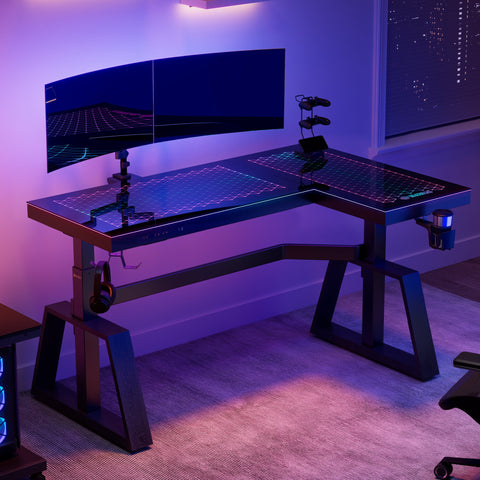
- North America: A preference for "Power Aesthetics"—larger footprints (where space allows) and high-durability materials like carbon steel. The Full-Surface Mousepad Gaming Desk (60"x27") resonates here, offering a rock-solid foundation that supports up to 500 lbs of gear.
- Europe: A focus on "Ergonomic Compliance" and sustainable materials. European users often look for FSC Certification and compliance with EN 1335-1 standards for stability and safety.
- Asia (Tokyo/Seoul/Singapore): A mastery of "Hyper-Efficiency." Desks must be multi-functional. A desk isn't just for work; it’s a dining table, a gaming rig, and a creative studio. The ability to tuck drawers to the side rather than the center—a preference observed in Tokyo installations—maintains clear legroom for various seating styles.
Safety and Trust: Beyond the Surface
When selecting furniture for a home sanctuary, safety is non-negotiable. This is especially true for electric height-adjustable desks. We ensure our products meet the UL 962 safety standards, which cover mechanical and electrical safety.
Furthermore, indoor air quality is a rising concern for urban dwellers. Desks that carry the UL GREENGUARD Gold Certification ensure low chemical emissions, making them safe for small, poorly ventilated spaces. This is a critical factor for health-conscious professionals who spend 8-12 hours a day in close proximity to their furniture.

Transform Your Day: A Step-by-Step Guide to Urban Ergonomics
Setting up your sanctuary doesn't have to be overwhelming. Follow this practical checklist to elevate your space:
- Audit Your Footprint: Measure your room's depth. Ensure you have at least 42 inches of "dynamic zone" behind your desk for chair movement.
- Select Your "Hero" Piece: Choose a desk that matches your aesthetic and functional needs. If you need storage, the Ark EL Executive Standing Desk (60"x26") is your best ally. If you prioritize tactile comfort, look toward the Faux Saddle Leather Adjustable Standing Desk (55"x23").
- Optimize Visuals: Use monitor arms to reclaim desk real estate. Align the top third of your screen with your eye level to reduce neck strain, as suggested by ISO 9241-5:2024.
- Manage the Chaos: Use integrated cable management. A "clean" desk reduces cognitive load and allows for Mindfulness during high-pressure tasks.
- Set Your Intervals: Program your desk's memory presets for your ideal sitting and standing heights. Use a timer to remind you to switch every 30-40 minutes.
A New Chapter for Your Workspace
Your home office is more than a collection of furniture; it is the cockpit of your professional life and the stage for your personal passions. By embracing urban ergonomics, you refuse to let limited square footage limit your potential. Whether you are navigating the high-stakes world of global finance from a London flat or climbing the ranks of competitive gaming in Tokyo, your environment should be a reflection of your ambition—refined, resilient, and perfectly adjusted to your needs.
Say goodbye to the chaos of cluttered corners and hello to a workspace sanctuary that supports your health and celebrates your style. The transformation begins with a single choice: to prioritize yourself in the space you call home.
Appendix: Modeling Methodology & Assumptions The spatial and performance metrics mentioned in this article are derived from scenario modeling for high-density urban environments.
| Parameter | Value/Range | Unit | Source/Rationale |
|---|---|---|---|
| Target Persona | Tokyo Gaming Pro | - | Intersection of extreme space & high performance |
| Rental Premium | ~18.6 | % | Savills Japan Residential Research (2024) |
| Mouse Travel (360°) | ~47 | cm | Calculated for Valorant (800 DPI, 0.35 sens) |
| Load Utilization | ~50-75 | % | Based on dual vs. single motor capacity (120kg/80kg) |
| Viewing Deficit | ~13 | inches | THX standard vs. 24" desk depth |
Disclaimer: This article is for informational purposes only and does not constitute professional medical or ergonomic advice. Individuals with pre-existing musculoskeletal conditions should consult a qualified physiotherapist or ergonomic specialist before implementing a new workstation setup.
Sources
- BIFMA G1-2013 Ergonomics Guideline
- ISO 9241-5:2024 Workstation Layout
- CCOHS: Office Ergonomics - Sit/Stand Desk
- Cochrane: Workplace Interventions for Reducing Sitting
- WHO 2020 Guidelines on Physical Activity & Sedentary Behaviour
- The 2026 Workstation White Paper
- Savills Japan Residential Research 2024
Leave a comment