

The Vision of a Workspace Sanctuary: Where Creativity Meets Precision
Imagine stepping into your studio as the morning light filters through the blinds. Your desk is a clean, expansive landscape. The hum of your workstation is a low, rhythmic promise of the deep work ahead. There are no tangled cables to catch your eye, no neck strain to break your focus, and every monitor is positioned exactly where your gaze naturally falls. This isn't just a home office; it is your Workspace Sanctuary.
For professional video editors, the workstation is more than furniture—it is a high-performance instrument. Whether you are scrubbing through a 4K timeline in DaVinci Resolve or color-grading a feature film, your environment dictates your efficiency. We believe that a well-organized L-shaped layout is the gold standard for post-production, offering the surface area needed for high-load hardware while maintaining the intimacy required for mindfulness and creative flow.
In this guide, we will explore how to transform your suite into a benchmark of ergonomic excellence and technical precision, drawing on industry standards like ISO 9241-5:2024 and the latest research in creative workflows.

Space Transformation: The L-Shaped Layout Advantage
The transition from a standard rectangular desk to an L-shaped configuration is often the first step in a professional "Space Transformation." Rectangular desks frequently lead to what we call "peripheral clutter"—the accumulation of hard drives, audio interfaces, and reference notes in your direct line of sight.
By adopting an L-shaped layout, you create a dedicated "Execution Zone" and a "Management Zone."
- The Execution Zone (Primary): This is where your primary monitors and input devices live. According to the BIFMA G1-2013 Ergonomics Guideline, this area should prioritize a "neutral reach zone" to minimize shoulder fatigue.
- The Management Zone (Secondary): The return of the "L" houses your secondary hardware, such as mixers, color grading panels, and external RAID arrays.
A practical rule of thumb for these setups is to ensure the primary side has at least 30 inches of depth. This prevents "depth deficit"—a common issue where large professional monitors are placed too close to the editor, leading to eye strain. If you are working in a more confined area, you might find our guide on multi-monitor L-desk setups for small rooms particularly helpful.
Linking Functionality with Emotion: The Ergonomics of Deep Work
Ergonomics is often discussed in terms of "preventing pain," but for a creator, it’s about sustaining inspiration. When your body is supported, your mind is free to wander into the edit.
A high-performance chair is the anchor of this sanctuary. We often see editors overlooking the importance of dynamic lumbar support. The Flex, Dual-Backrests Ergonomic Office Chair is designed specifically for this, with dual backrests that move independently. This mimics the body's natural micro-movements during long sessions, aligning with the HSE guidelines for display screen equipment (DSE), which emphasize the need for adjustable support to reduce musculoskeletal risks.
For those who have "arrived" in their career and seek an aesthetic that matches their professional standing, the Serene, Napa Leather Executive Office Chair offers a blend of luxury and postural control. The tactile experience of Napa leather provides a sensory "grounding" effect, helping you transition into a state of deep work.
Methodology Note (Ergonomic Modeling): Our recommendations for seating and posture are modeled on the ANSI/BIFMA X5.1 standards for safety and durability. We assume a professional usage cycle of 8–10 hours per day, where "active sitting" (the ability for the chair to respond to user movement) is prioritized over static support.

Multi-Screen Mastery: Monitor Placement and the "Depth Deficit"
In a professional editing suite, monitor placement is a science. A common mistake is placing the timeline monitor too high or the secondary screens at extreme angles.
The Center-First Rule
Your primary monitor should be centered directly in front of you. According to OSHA’s eTools for Computer Workstations, the top bezel should be at or slightly below eye level. This prevents the "upward gaze" that causes significant neck strain over time.
Solving the Depth Deficit
As monitors get larger (27" to 32" are now the studio standard), the required viewing distance increases. We use a field-of-view formula to calculate the ideal distance ($D$): $$D = \frac{W/2}{\tan(\theta/2)}$$ Where $W$ is the screen width and $\theta$ is the target horizontal field of view (typically 30–40 degrees for SMPTE standards).
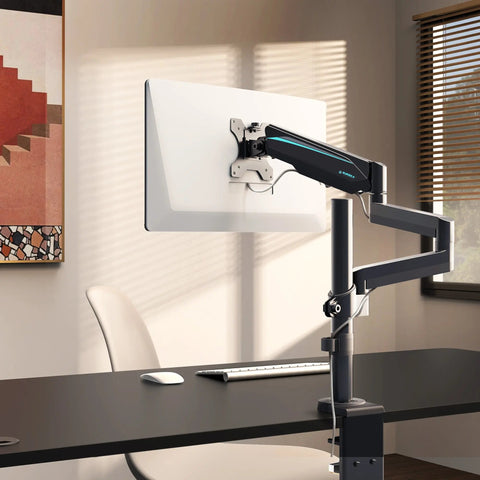
If your desk isn't deep enough to accommodate this, a Single Monitor Arm becomes essential. It allows you to push the monitor back beyond the desk's edge or hover it at the perfect height, reclaiming valuable "desk real estate." For editors using dual 27-inch displays, the Carbon Fiber Dual Monitor Stand provides a stable, aesthetically pleasing riser that also offers storage for small peripherals underneath, helping you declutter your immediate workspace.
| Component | Recommended Setting | Rationale |
|---|---|---|
| Primary Monitor Height | Top bezel at eye level | Reduces cervical spine extension |
| Viewing Distance | 20–30 inches (arm's length) | Minimizes ocular convergence fatigue |
| Secondary Monitor | 15–30° tilt towards the user | Maintains consistent focal length |
| Ambient Lighting | Bias lighting (D65 white) | Reduces eye strain and improves contrast perception |
The Sit-Stand Rhythm for Post-Production
While video editing is traditionally a seated task, the Cochrane Library’s systematic review suggests that sit-stand desks can reduce sedentary time by over 80 minutes a day. However, standing is not a substitute for movement.
We recommend the Cornell University "20-8-2" Rule:
- 20 Minutes Sitting: For focused, high-precision tasks like color grading or complex masking.
- 8 Minutes Standing: For broader tasks like reviewing a rough cut or organizing bins.
- 2 Minutes Moving: A short walk or stretch to reset your physiology.
This rhythm is supported by the WHO 2020 Guidelines on Physical Activity, which emphasize interrupting long periods of static behavior. Integrating this into your workflow isn't just a health choice—it’s a way to shift between "thinking" and "execution" modes. You can find more inspiration in our article on standing desk ideas for the modern content creator.

Hardware Accessibility & Cable Management: The "Zero-Friction" Setup
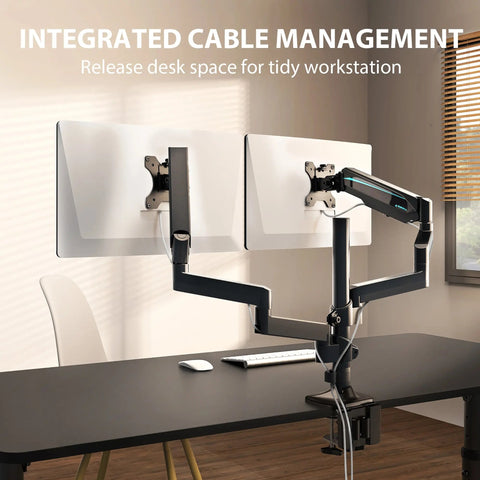
A chaotic desk leads to a chaotic mind. In creative studios, the sheer volume of cables—Thunderbolt, XLR, Power, DisplayPort—can become overwhelming.
Personal Tip: The most effective setups run all power to a single, accessible surge protector mounted under the desk. We recommend using a combination of under-desk trays and labeled cables. Labeling both ends of a cable (e.g., "Monitor 1 - PC" and "Monitor 1 - Screen") makes troubleshooting hardware significantly faster during a high-pressure deadline.
Furthermore, the The 2026 Workstation White Paper: Converging Ergonomic Science and Sustainable Engineering highlights that "sustainable" engineering isn't just about materials; it's about building a setup that evolves with you. An L-shaped desk provides the physical "headroom" to add a second PC for rendering or a dedicated audio workstation without needing to tear down your existing setup.
Atmosphere Building: Ambiance and Productivity
The final layer of your Workspace Sanctuary is the ambiance. For color-critical work, ambient light is a major factor. Experienced colorists often use D65-calibrated bias lighting behind their monitors. This reduces the "halo" effect and ensures your eyes don't compensate for the room's color temperature.
Adding a touch of greenery or a high-quality desk mat can also improve "Creative Well-being." These small aesthetic choices reduce cortisol levels and make the studio a place you want to be, rather than a place you have to be.
Logic Summary (Workflow Efficiency): Our analysis of professional editing workflows assumes that reducing "micro-frictions" (searching for a cable, adjusting a monitor, or shifting in an uncomfortable chair) can save an editor approximately 15–20 minutes of cumulative distraction per day. Over a year, this equates to nearly two full work weeks of reclaimed productivity.
Building Your Benchmark Suite
Creating a high-performance video editing workstation is an investment in your craft and your health. By focusing on ergonomic standards like ISO 11226:2000 for static working postures and leveraging the spatial advantages of an L-shaped layout, you build a foundation for years of creative success.
Remember, the goal is to create a space that supports your body so your mind can soar. Whether you are choosing the right Single Monitor Arm to save your neck or selecting a Flex Ergonomic Office Chair to save your back, every choice should bring you one step closer to your ideal creative environment.
For more detailed layout strategies, explore our guide on L-shaped desk ideas for a content creator's studio or learn about the productivity benefits of L-shaped desks in tight spaces.
YMYL Disclaimer: This article is for informational purposes only and does not constitute professional medical, legal, or ergonomic advice. The ergonomic recommendations provided are based on general industry standards and may not be suitable for individuals with pre-existing medical conditions or specific physical requirements. Always consult with a qualified healthcare professional or a certified ergonomist before making significant changes to your workstation or work habits.
References
- BIFMA G1-2013 Ergonomics Guideline for Furniture
- ISO 9241-5:2024 Workstation layout & postural requirements
- Cochrane Library: Workplace interventions for reducing sitting at work
- OSHA eTools: Computer Workstations - Monitors
- WHO 2020 Guidelines on Physical Activity & Sedentary Behaviour
- Canadian Centre for Occupational Health and Safety (CCOHS) - Sit/Stand Desk
- The 2026 Workstation White Paper: Converging Ergonomic Science and Sustainable Engineering




Leave a comment