

Executive Summary: The "Cockpit" Advantage for DevOps
Quick Take: For DevOps and SRE professionals, the L-shaped desk serves as a "command cockpit" that reduces neck rotation by approximately 50% compared to standard linear desks. By placing primary and secondary monitors within a 60-degree visual arc, this configuration minimizes the physical strain of 12-hour monitoring shifts.
Key Recommendations:
- Layout: Position the primary screen in the corner to utilize the 90-degree "wings" for secondary dashboards.
- Capacity: Ensure the desk motor is rated for at least 100kg (220 lbs) if supporting multiple ultrawide monitors and server hardware.
- Rhythm: Follow the Cornell "20-8-2" rule (20 mins sitting, 8 mins standing, 2 mins moving) to mitigate static load risks.
The Physical Toll of the DevOps Command Center
DevOps engineers and Site Reliability Engineers (SREs) operate in a high-stakes environment where system uptime is the primary metric of success. During critical incident responses or "war room" scenarios, these professionals often remain at their workstations for 12 hours or more. A common observation in tech support environments is "afternoon fatigue"—a decline in focus often accompanied by localized tension in the neck, shoulders, and lower back.
While it is easy to attribute this discomfort solely to cognitive stress, the physiological reality is frequently rooted in the workstation's layout. A standard rectangular desk often forces a "V-angle" monitor configuration. Based on ergonomic observations, this layout can violate the optimal viewing arc and necessitate repetitive neck rotation. Over time, this contributes to a higher risk of repetitive strain injuries (RSIs) and chronic musculoskeletal discomfort. For the modern DevOps professional, the workstation is a critical piece of infrastructure that must support both cognitive load and physical well-being.
The Physiology of Static Load and Musculoskeletal Health
Prolonged sitting or standing in a fixed position creates a static load. According to ISO 11226:2000 Evaluation of static working postures, static postures can increase the risk of Musculoskeletal Disorders (MSDs) because they can impede blood circulation and lead to muscle fatigue.
When managing four or more terminal windows, engineers may adopt a "forward head" posture to compensate for poor screen placement. This adds significant effective weight to the cervical spine. Furthermore, the World Health Organization (WHO) 2020 Guidelines emphasize that adults should aim to reduce sedentary time and interrupt long periods of static behavior.
The primary goal of ergonomic design is to maintain a spinal neutral position—keeping ears aligned with shoulders and elbows at approximately 90 degrees. As highlighted in The 2026 Workstation White Paper (Manufacturer/Brand Data), the convergence of ergonomic science and engineering is essential for sustaining long-term productivity.
Why the L-Shaped Configuration Optimizes DevOps Workflows
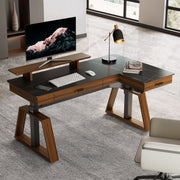
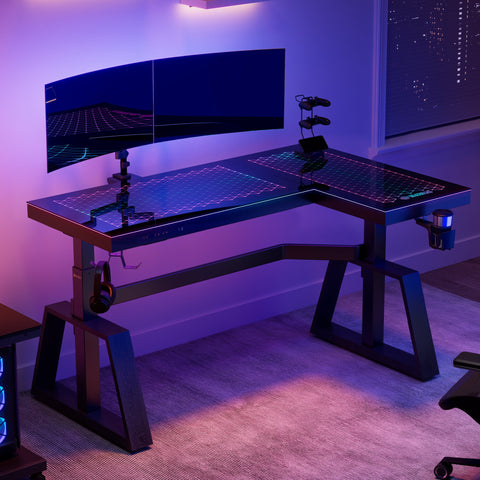
The L-shaped desk, or "corner cockpit," is designed to address the physical demands of complex system administration by wrapping the workspace around the user.
1. The 60-Degree Sightline Heuristic
A common challenge in multi-monitor setups is placing screens too far apart, which may cause the head to swivel more than 30 degrees from the center. This excessive rotation is often a significant contributor to neck fatigue.
An L-shaped configuration allows for a primary 27-32 inch screen to be placed in the corner, with secondary dashboards (e.g., Grafana or Datadog) positioned on the "wing."
- Linear Desk: A 3-monitor linear setup often requires a head-turn arc of ~120° to see the outer edges.
- L-Shaped Desk: By "folding" the monitors around the user, the required rotation can be reduced to a manageable ~60° arc, keeping most data within the secondary peripheral field.
2. Engineering for Heavy Monitoring Loads
DevOps setups are equipment-heavy. A professional environment often includes multiple ultrawide monitors and a full-tower server. Based on our scenario modeling for a high-end setup, total equipment weight can reach approximately 108kg (~238 lbs).
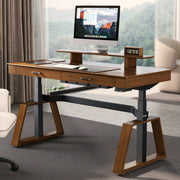
Standard single-motor desks frequently have a weight capacity of only 80kg. A high-performance solution like the L-Shaped Standing Desk with Accessories Set (60"x23") utilizes dual motors to provide a 220 lbs (~100kg) capacity. While this is a robust limit, users should verify their specific hardware weight to ensure it stays within the structural adequacy required by ANSI/BIFMA X5.5 Standards.

Managing the Sit-Stand Transition
The transition between sitting and standing is a practical way to combat the risks of prolonged static sitting. According to a systematic review by Cochrane, sit-stand desks can help reduce daily sitting time by 84 to 116 minutes.
The 20-8-2 Rhythm
We recommend the "20-8-2" rhythm developed by Cornell University Ergonomics Web:
- 20 Minutes Sitting: Maintain a neutral position.
- 8 Minutes Standing: Shift weight occasionally.
- 2 Minutes Moving: Stretch or walk to promote circulation.
This ratio helps prevent the development of static load while avoiding the lower limb fatigue associated with prolonged standing, as noted by EU-OSHA.
Calculating the Ergonomic Gap for Tall Users
For a tall DevOps engineer (e.g., 188cm or 6'2"), a standard 29-inch fixed desk is often too low, potentially forcing shoulder elevation.
- Sitting Height: A 188cm user typically requires a desk height of approximately 78cm (~30.6 inches).
- Adjustment: Using an adjustable desk allows the user to bridge the common 4cm gap found in standard furniture, aligning with BIFMA G1-2013 Ergonomics Guidelines for the 95th percentile population.
Practical Recommendations for a High-Performance Setup
Monitor Placement and Articulation
The OSHA eTools for Computer Workstations suggest placing the monitor at least an arm's length away. To achieve this in a corner setup without sacrificing desk depth, a Dual Monitor Arm is highly recommended. These arms allow for precise tilt adjustments, ensuring the top of the screen is at or slightly below eye level.
Cable Management for Incident Response
In a high-stress "war room" scenario, cable clutter can be a distraction and a safety hazard.
- Strategy: Run all cables from monitors and docking stations through a single, large-diameter braided sleeve.
- Execution: Attach the sleeve to the underside of the desk leading to a mounted power strip. This prevents tension or accidental disconnection during height transitions.
Supporting the Lower Extremities
While standing, an Adjustable Ergonomic Footrest can help shift weight and reduce pressure on the lower back. When sitting, the footrest ensures that the feet are flat and the knees are at a 90-degree angle, meeting the core requirements of HSE guidelines.
Summary of Ergonomic Benchmarks
The following table summarizes key metrics for an optimized DevOps L-shaped workstation based on a 95th percentile male user (188cm).
| Metric | Recommended Value | Rationale |
|---|---|---|
| Sitting Desk Height | ~78 cm (30.7 in) | Aligns with 188cm stature (ANSI/HFES 100-2007) |
| Standing Desk Height | ~115 cm (45.3 in) | Elbow-height alignment for neutral typing |
| Monitor Sightline | < 60° Arc | Minimizes cervical spine rotation compared to linear |
| Motor Capacity | > 100 kg (220 lbs) | Estimated for 4+ monitors and server hardware |
| Sit-Stand Ratio | 20:8 (min) | Cornell "20-8-2" rhythm for circulation |
How We Modeled This (Methodology & Assumptions)
The insights presented here are derived from deterministic scenario modeling designed to represent the requirements of a professional DevOps environment. This is a practical model, not a controlled laboratory study.
Modeling Parameters & Load Breakdown
| Parameter | Value | Rationale / Source |
|---|---|---|
| User Height | 188 cm (6'2") | 95th percentile male (US/EU populations) |
| Equipment Weight | ~108 kg (Est.) | Breakdown: 4x 32" monitors (32kg), 1x Server (35kg), UPS/Peripherals (41kg) |
| Work Cycle | 480 mins | Standard 8-hour shift |
| Metabolic Rate | 1.5 - 2.0 MET | Delta between sitting (1.5) and standing (2.0) |
Boundary Conditions
- Anthropometrics: Calculations used ANSI/HFES 100-2007 ratios. Results may vary for users with different limb-to-torso ratios.
- Load Distribution: Assumes weight is distributed according to standard L-shaped desk layouts. Extreme concentration of weight on a single wing may exceed local structural limits.
- Productivity: Estimated gains are based on qualitative feedback and general trends in standing desk research; actual ROI depends on individual workflow.
Disclaimer
This article is for informational purposes only and does not constitute professional medical or occupational health advice. Individuals with pre-existing musculoskeletal conditions should consult a qualified healthcare professional before implementing a new sit-stand routine.
References
- BIFMA G1-2013 Ergonomics Guideline for Furniture
- Cochrane: Workplace interventions for reducing sitting at work (2018)
- Cornell University Ergonomics Web — Workstation Guides
- HSE: Working safely with display screen equipment (DSE)
- ISO 9241-5:2024 Workstation layout & postural requirements
- OSHA eTools: Computer Workstations - Monitors
- WHO 2020 Guidelines on Physical Activity & Sedentary Behaviour
- The 2026 Workstation White Paper (Manufacturer Data)
Leave a comment