

Imagine a home office that sparks your limitless creativity—a sanctuary where every square inch is intentional, every texture is soothing, and the transition into deep work feels like a breath of fresh air. In the heart of a bustling city or within the cozy confines of a studio apartment, your workspace doesn't need vast acreage to be productive. It needs clarity. It needs a design that respects the boundaries of your room while expanding the boundaries of your focus.
Here’s how a day of deep work begins once you say goodbye to the chaos of oversized, clunky furniture. You step into a nook that feels open and airy, centered around a chair that offers the embrace of a lounge but the footprint of a whisper. This is the magic of the armless lounge chair—a solution that proves style and functional efficiency are not mutually exclusive, but rather two sides of the same elegant coin.
The Geometry of a Workspace Sanctuary
When we design for small spaces, we often focus on width and height. However, as an expert troubleshooter of compact environments, I’ve observed that the most common mistake is ignoring the "sweep"—the total floor area a chair occupies throughout its full range of motion. Traditional lounge chairs with wide armrests often demand a footprint of 28 to 40 inches in width, according to standard furniture dimensions. In contrast, a well-engineered armless design typically maintains a sleek profile of 24 to 26.5 inches.
This difference of 4 to 14 inches might seem minor on paper, but in a narrow room, it is the difference between a fluid workflow and a constant physical struggle. A critical rule of thumb for any compact home office is to allocate a minimum clearance of 24 inches in front of the chair. This ensures comfortable entry and exit and prevents that "caged-in" feeling that kills creativity.

The Marco, Soft Padded Cozy Lounge Chair, Blue exemplifies this spatial intelligence. By removing the armrests, the chair achieves a significantly smaller physical footprint without sacrificing the "sink-in" comfort we crave. Its armless silhouette allows you to pivot between your desk and a side table without needing extra lateral space to push back. It’s about creating a "Workspace Sanctuary" that feels expansive, regardless of the actual square footage.
Space Transformation: The "Before & After" Logic
To truly understand the impact of an armless design, we must look at the "Dynamic Zone"—the space required for the chair to move, swivel, and for the user to navigate.
The Experiment: The 94-Inch Nook Challenge In a simulated setup for a typical urban apartment with an 8-foot (96-inch) deep office nook, we tested the viability of different seating configurations. Using a desk with a 24-inch depth and a secondary circulation path of 30 inches, the math becomes clear:
- With a Traditional Armed Chair: The dynamic zone often exceeds 44-48 inches to allow the chair to be pushed back and the user to stand up around the armrests. This creates a total depth requirement of ~100 inches. Result: A 4-inch deficit. The space feels cramped and the chair hits the back wall.
- With an Armless Lounge Chair: The dynamic zone is reduced to 40 inches because the user can exit from the side or swivel with less clearance. Total depth requirement: 94 inches. Result: A 2-inch surplus.
This 2-inch surplus is the "breathing room" that makes a small space feel intentional rather than accidental. This quantitative validation is a cornerstone of The 2026 Workstation White Paper: Converging Ergonomic Science and Sustainable Engineering, which emphasizes that spatial efficiency is a primary driver of long-term user satisfaction.
Linking Functionality with Emotion: Why Armless Feels Better
There is a profound psychological benefit to a decluttered physical path. When your chair doesn't have arms, it removes a visual and physical barrier between you and your work. It encourages "Micro-Movements"—the small shifts in posture that keep your body engaged.
According to the World Health Organization (WHO) 2020 Guidelines, adults should reduce sedentary time and interrupt long periods of static behavior. An armless lounge chair facilitates this by making it easier to stand up, stretch, and return to work. It supports the "Lives Chair" principle, a hybrid ergonomic approach where the backrest supports an upright spine and neck for focus, while the armless lower section allows the legs and hips to move freely.
| Feature | Armless Lounge Chair (e.g., Marco) | Traditional Armed Lounge Chair |
|---|---|---|
| Typical Width | 24" - 26.5" | 28" - 40" |
| Entry/Exit | Lateral & Forward (Flexible) | Forward Only (Restricted) |
| Visual Weight | Minimalist/Light | Heavy/Dominant |
| Best Use Case | Compact Nooks, Multi-tasking | Large Dens, Static Lounging |
| Sweep Area | Compact (approx. 40" depth) | Wide (approx. 48" depth) |
When you pair a versatile chair like the Marco, Soft Padded Cozy Lounge Chair, Blue with a high-performance desk like the Ark EX Executive Standing Desk (60"x26"), you create a workflow that shifts with your mood. Height adjustment isn’t just a health feature; it’s a way to shift between "thinking" mode (seated, relaxed in the Marco) and "execution" mode (standing, focused).

The Ark EX Executive Standing Desk (60"x26") features an integrated storage system, which is essential for maintaining an "Aesthetic" of calm. By keeping essentials in the side cabinet, your desktop remains a clean slate for inspiration.
Ergonomic Integrity and Standards
While lounge chairs are often associated with relaxation, they must still adhere to rigorous standards to protect your health. For a chair to be truly supportive for work, it should align with the ISO 9241-5:2024 standard, which specifies postural requirements for office workstations. This includes providing a backrest angle that supports the lumbar spine without causing "slumping."
Research from Cochrane (2018) suggests that while sit-stand desks reduce sitting time, the quality of the sitting period is just as vital. A lounge chair used for work should offer a seat height of 16–18 inches to allow your feet to rest flat on the floor, maintaining a 90–100° knee angle. This prevents pressure on the underside of your thighs and promotes healthy circulation.
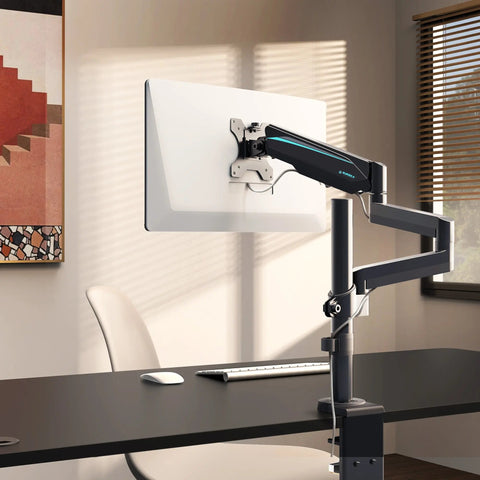
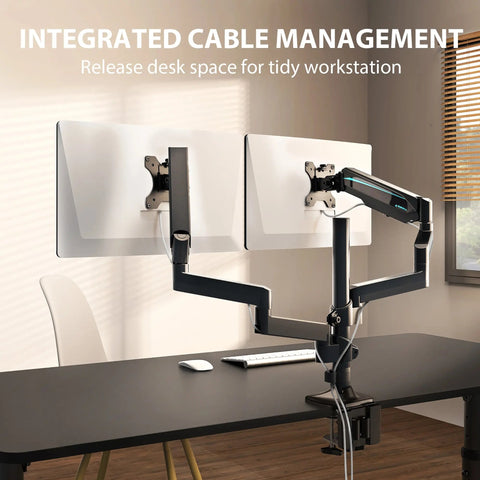
For those using a dual-monitor setup in a small space, the Dual Monitor Arm is a non-negotiable accessory. By lifting the monitors off the desk, you reclaim valuable surface area, further contributing to the "Declutter" philosophy. According to the Canadian Centre for Occupational Health and Safety (CCOHS), the top line of text on your monitor should be at or slightly below eye level to minimize neck strain. A monitor arm allows you to achieve this perfect alignment regardless of whether you are sitting in a lounge chair or standing at your desk.
Scenario Analysis: The Power of Choice
Scenario A: The Creative Freelancer in a Studio In a 400-square-foot studio, every piece of furniture must "earn its keep." The freelancer uses the Marco, Soft Padded Cozy Lounge Chair, Blue as their primary work seat during the day and their reading chair in the evening. Because it’s armless, it slides partially under the Ark EX Executive Standing Desk (60"x26") when not in use, opening up the floor for a morning yoga flow.
Scenario B: The Executive with a "Nook" Office Even in larger homes, "clozices" (closet offices) are trending. Here, an armed chair is physically impossible—the arms would strike the door frame. The armless lounge chair provides executive-level comfort in a 30-inch wide space. Combined with the Ark EL, 71'' Display Bookshelf with Storage Cabinet, Oak, the executive can store sensitive documents behind closed doors while displaying awards and inspiration on the open shelves, maintaining a professional yet personal "Ambiance."

Personal Tips for a Holistic Workspace
Creating a sanctuary goes beyond the furniture. It’s about the atmosphere you curate.
- Mindful Lighting: Position your desk and lounge chair near natural light to boost serotonin. For late-night deep work, use a warm-toned task lamp to maintain a cozy "Ambiance" without the harshness of overhead lights.
- Performance Fabrics: In small spaces, your chair is often close to your kitchen or dining area. Choose materials like the blue terry cloth found on the Marco, Soft Padded Cozy Lounge Chair, Blue. These performance fabrics are breathable and more forgiving than leather or velvet, which require diligent maintenance in high-traffic, compact homes.
- The 20-8-2 Rhythm: Follow the Cornell University Ergonomics recommendation: sit for 20 minutes, stand for 8 minutes, and move/stretch for 2 minutes. The ease of getting in and out of an armless chair makes this rhythm second nature.
- Greenery and Air Quality: A single potted plant can reduce stress and improve air quality. If you’re concerned about indoor pollutants, look for furniture that meets safety standards like the UL GREENGUARD Certification, which ensures low chemical emissions.
Maintaining Your Sanctuary
A tidy desk isn’t just beautiful—it helps reduce distractions and maintain focus. In a compact office, clutter accumulates quickly. Use the integrated storage of the Ark EL, 71'' Display Bookshelf with Storage Cabinet, Oak to hide away cables, chargers, and stationery. When your physical environment is "Decluttered," your mind is free to engage in "Deep Work."

The Dual Monitor Arm also plays a role here. By managing your cables through its integrated channels, you eliminate the "spaghetti" of wires that often plagues small desks.
Final Thoughts on Space and Comfort
Your home office should be a place of "Inspiration," not a source of spatial frustration. By choosing an armless lounge chair, you aren't compromising; you are optimizing. You are choosing a path that prioritizes movement, respects your environment, and elevates your daily ritual.
Whether you are pivoting to take a call, reclining to read a brief, or standing to power through a deadline, your furniture should support you without getting in your way. Embrace the armless design, measure your "sweep," and transform your small corner into a premier workspace sanctuary.
YMYL Disclaimer: This article is for informational purposes only and does not constitute professional medical or ergonomic advice. While ergonomic furniture can help reduce the risk of musculoskeletal disorders (MSDs), it is not a cure for pre-existing conditions. Always consult with a qualified healthcare professional or physical therapist before making significant changes to your workstation setup, especially if you experience chronic pain.
References
- BIFMA G1-2013 Ergonomics Guideline for Furniture
- Canadian Centre for Occupational Health and Safety (CCOHS) - Sit/Stand Desks
- Cochrane Library: Workplace interventions for reducing sitting at work
- Cornell University Ergonomics Web — Workstation Guides
- ISO 9241-5:2024 Workstation layout & postural requirements
- World Health Organization (WHO) 2020 Guidelines on Physical Activity & Sedentary Behaviour
- The 2026 Workstation White Paper: Converging Ergonomic Science and Sustainable Engineering




Leave a comment