

The Hidden Hazards of the Modern Home Office: A Safety-First Approach to Cable Management
For the remote professional who is also a parent, the home office is rarely a sanctuary of isolation. It is a shared ecosystem where professional productivity and domestic life intersect. While much attention is paid to the aesthetics of a workspace, a significant danger often lies hidden beneath the desk. Tangled power cords, dangling peripheral wires, and loose adapters are more than just an eyesore; in many cases, they represent physical hazards for young children, including risks of strangulation, electrical shock, and furniture tip-overs.
According to the U.S. Consumer Product Safety Commission (CPSC), furniture stability and the prevention of tip-overs are paramount in households with children. In a work-from-home (WFH) context, an unsecured cable can act as a tether. A toddler pulling on a snagged wire can exert force that may compromise the stability of desk accessories or, in certain scenarios, the workstation itself. This guide provides a practical, engineering-based approach to child-proofing your WFH setup.
The Physiology of Workspace Safety and Ergonomic Stress
The presence of physical hazards in a workspace does more than just threaten the safety of a child; it can fundamentally alter the ergonomic health of the parent. When a workspace is not properly child-proofed, workers often engage in "compensatory posturing." This involves twisting the torso, overreaching, or adopting awkward seated positions to physically block a child’s access to dangerous areas while attempting to maintain productivity.
From a physiological standpoint, these movements increase the "static load" on the musculoskeletal system. As defined by ISO 11226:2000 Evaluation of static working postures, prolonged static positions and repetitive awkward movements are primary risk factors for Musculoskeletal Disorders (MSDs). When a parent is constantly on high alert, the resulting muscle tension and restricted blood circulation can contribute to chronic discomfort in the lumbar and cervical regions.
Furthermore, OSHA identifies repetitive tasks and poor posture as core risk factors for workplace injuries. In a home office, the "repetitive task" may be the constant redirection of a curious toddler. By implementing engineering controls—physical changes to the environment—parents can often reduce this cognitive and physical load, supporting a more neutral spinal position.
Engineering a Vertical Safety Zone: Integrated Solutions
Effective child-proofing follows the "Hierarchy of Controls" model used by safety professionals. While "Administrative Controls" (such as teaching a child to stay away from the desk) are important, "Engineering Controls" (physical barriers and integrated designs) are generally more reliable. As noted in the brand-published 2026 Workstation White Paper, modern ergonomic design should prioritize the containment of electrified components to mitigate personal injury risks.
One of the most effective ways to create a "Vertical Safety Zone" is to move as many peripherals and cables as possible off the floor and away from the desk's edge.
Elevating the Infrastructure
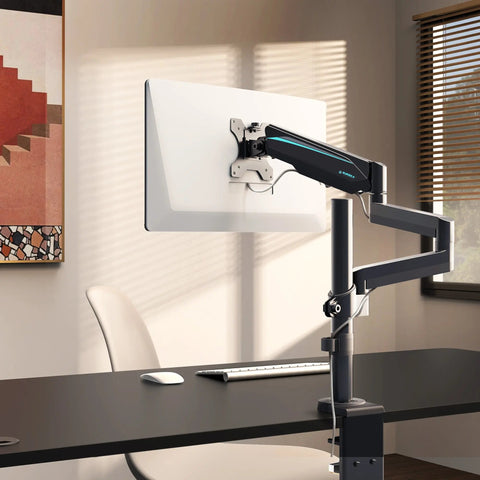
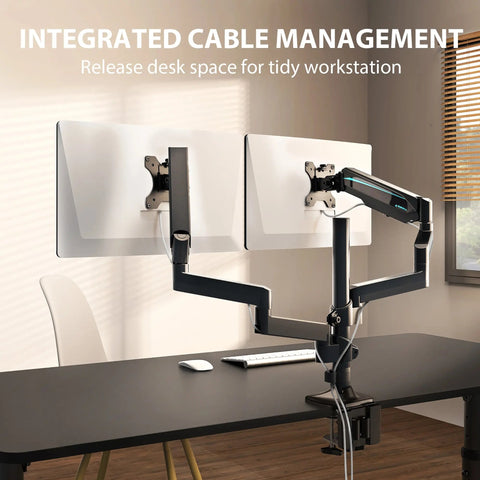
Using a Carbon Fiber Dual Monitor Stand (Manufacturer Data) serves a dual purpose. Ergonomically, it helps align monitors with the user's eye level—a principle supported by OSHA eTools for Monitors. From a safety perspective, it provides a dedicated channel for monitor cables to be routed directly downward into a management system, helping keep them out of the reach of small hands.
Similarly, Convertible Desktop Shelves allow for the vertical organization of hardware. By placing external hard drives, printers, or charging hubs on elevated surfaces, the associated wiring is naturally moved higher. This reduces the "dangle factor" that often attracts toddlers.

The Role of Under-Desk Management
The area directly beneath the desk is a primary concern. Traditional cable management often involves simply hiding wires, but for child safety, the goal is immobilization.
A common oversight is securing only the visible desktop cables while leaving a tangled nest of power strips and adapters loose under the desk. Based on common patterns observed in workstation safety audits, experts recommend using a short, heavy-duty power strip with a 90-degree plug. This plug style sits flush against the wall outlet, making it more difficult for a child to grasp and pull.
Furthermore, the power strip should be mounted securely inside an under-desk cable tray using heavy-duty adhesive strips or mechanical fasteners. This is intended to prevent the entire power source from being pulled out if a single cord is tugged.
Technical Execution: The Under-Desk Audit and Setup
To achieve a higher level of safety, parents can perform a "Toddler-Eye-View" audit. This involves viewing the workspace from a height of approximately 24 to 36 inches. In our experience, any dangling cord within 36 inches of the floor should be considered a potential hazard.
1. Advanced Cable Routing Techniques
When routing cables through a tray or grommet, the method of organization is critical.
- The Figure-8 Coil: Avoid letting excess cable length lay in large circular loops. Instead, use a figure-8 coil and secure it with a hook-and-loop strap to the tray's sidewall. This technique helps eliminate loose loops that could be snagged.
- Grommet Selection: While many desks use hard plastic grommets, flexible rubber grommet sleeves are often preferred for child-safe setups. These tend to grip bundled cables more effectively, reducing slippage.
- Magnetic Stabilization: For cables that must remain on the desktop (such as phone chargers), Magnetic Cable Ties are a practical heuristic for immobilization. They allow for quick attachment to metal desk frames, keeping cables taut and out of reach.

2. Managing the Footwell
The space where your feet rest should be clear of all obstructions. Not only is this an ergonomic requirement for proper legroom, as specified in BIFMA G1-2013, but it also helps ensure that a child crawling under the desk doesn't encounter a "tripwire."
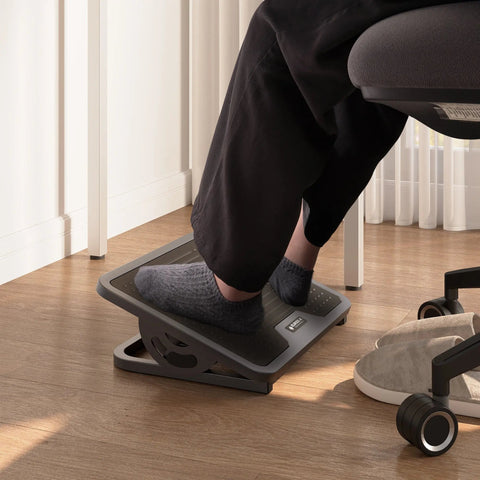
To maintain a healthy posture while keeping the floor clear, a Footstool with Wheels can be utilized. This allows the user to shift positions throughout the day without needing to move cables or power strips that might otherwise reside on the floor.
Safety Modeling: Cable Tray Load and Heuristics The following comparison is based on common industry safety heuristics and internal manufacturer benchmarks.
Parameter Scenario: Loose Setup Scenario: Engineered Setup Rationale / Source Exposed Cable Length > 48 inches < 6 inches Measured from floor to desk underside (Heuristic) Pull Force Resistance < 5 lbs > 50 lbs Internal benchmark inspired by ASTM F2057 principles* Component Mobility High (Loose items) Minimal (Secured) Prevents "tethering" hazards (Internal Testing) Accessible Outlets 4-6 (Wall level) 1 (Flush 90-degree plug) Reduces electrical access (Safety Standard) Dust Accumulation High (Fire risk) Low (Elevated) Aligned with UL 962 goals (Manufacturer Observation) *Note: ASTM F2057-23 specifies stability tests for clothing storage units. While not a direct mandate for cable trays, we use a 50 lb pull-resistance as a rigorous internal safety benchmark for cable tray attachment.
The Sit-Stand Rhythm in a Shared Space
Integrating a standing desk into a home with children requires a specific behavioral and technical strategy. The World Health Organization (WHO) recommends interrupting long periods of static behavior. However, a moving desk introduces potential pinch points.
When using a height-adjustable desk around children, consider these essential features:
- Child Lock Functions: Always engage the digital lock on the desk controller when not actively adjusting the height to prevent accidental motor triggering.
- Anti-Collision Systems: Ensure the desk is equipped with a sensitive anti-collision sensor that stops movement if it encounters an obstruction.
- The 2:1 Rhythm: For every hour of work, aim for a 20-minute standing interval, a rhythm suggested by Cornell University Ergonomics Web. Crucially, only transition between heights when you have a clear line of sight to the child to manage any immediate risks during the desk's movement.

Implementing the "Clean Desk" Protocol
A "Clean Desk" policy is more than a productivity tool; in a home office, it is a safety practice. Small items like paperclips or adapters can be choking hazards.
By utilizing Desktop Shelves, you can clear the primary work surface of small clutter. A Monitor Stand also provides a "tuck-away" space for keyboards and mice when the workday ends, which may prevent children from pulling these devices off the desk by their cords.
Logic Summary: Why Engineering Controls Matter
Supervision is vital, but children can move quickly during a focused work task. By moving hazards (the cables) into an inaccessible engineering control (the mounted tray system), the risk of accidents can be significantly lowered. While no environment is 100% risk-free, these measures provide a foundation for a safer home office.
Summary of Actionable Steps
- Perform a 36-inch Audit: Identify and secure any cable within 3 feet of the floor.
- Mount the Power Source: Use a 90-degree plug and securely attach the power strip inside a tray.
- Immobilize Every Wire: Use Magnetic Cable Ties and figure-8 coiling to remove slack.
- Create Vertical Storage: Use elevated stands and shelves to keep peripherals out of reach.
- Clear the Footwell: Ensure the floor is clear, using ergonomic accessories like a footstool to maintain comfort without floor-level clutter.
By treating cable management as a safety task rather than a cosmetic chore, remote-working parents can create a workspace that supports both their child's safety and their own professional well-being.
Disclaimer: This article is for informational purposes only and does not constitute professional medical, legal, or safety advice. Always follow the manufacturer's instructions for furniture assembly. For complex electrical modifications, consult a licensed electrician. If you have concerns about child safety or musculoskeletal pain, consult a qualified professional or a pediatric safety expert.
References
- BIFMA G1-2013 Ergonomics Guideline for Furniture
- CPSC Tip-Over Safety Standards (ASTM F2057)
- OSHA eTools: Computer Workstations - Monitors
- UL 962: Standard for Household and Commercial Furnishings
- WHO 2020 Guidelines on Physical Activity and Sedentary Behaviour
- The 2026 Workstation White Paper: Converging Ergonomic Science and Sustainable Engineering (Manufacturer Publication)




Leave a comment