

Dark Room Editing: Balancing RGB Bias and Color Accuracy
The professional editing suite is often a place of sensory deprivation. To the uninitiated, the dim, cave-like atmosphere of a color-grading bay or a high-end VFX studio seems like a stylistic choice. However, for the professional content creator, this environment is a calculated necessity designed to maximize the perceived dynamic range and color saturation of a display. Yet, this "dark room" approach introduces a significant physiological paradox: while it clarifies the pixels on the screen, it often degrades the health and perceptual accuracy of the human behind it.
Many editors find their vision "softening" or their back pain intensifying as the afternoon progresses. This is rarely a result of the work itself, but rather a failure to manage the interaction between the workstation's physical ergonomics and the room’s luminous environment. When the surrounding environment is too dark, the high contrast between a bright monitor and a pitch-black wall triggers pupillary fluctuations that lead to rapid ocular fatigue. Simultaneously, the lack of environmental reference points can cause "perceptual drift," where your eyes adapt to the slight color imbalances of the screen, leading to grading errors that only become visible when the work is viewed in standard lighting.
Achieving a benchmark-level workstation requires more than just a high-bit-depth monitor. It necessitates a holistic integration of ergonomic furniture, such as a standing desk that supports a Neutral Position, and a lighting strategy that respects the laws of colorimetry.
The Physiology of Perception: Why Your Eyes Deceive You
To understand why a perfectly calibrated monitor can still result in "wrong" color decisions, we must look at how the human visual system operates in low-light conditions.
The human eye utilizes two primary types of photoreceptors: cones (for color and detail in bright light) and rods (for motion and light sensitivity in dim light). In a true dark room, the eye undergoes a "Purkinje shift." This is a phenomenon where the peak sensitivity of the eye shifts from approximately 555 nm (yellow-green) toward 507 nm (blue-green). In this scotopic or mesopic state, a monitor calibrated to the industry-standard 6500K white point may perceptually appear cooler or "bluer" than it actually is. This often leads editors to unconsciously over-warm their images to compensate for what they perceive as a blue tint.
Furthermore, the lack of a neutral reference point leads to chromatic adaptation. If your room is devoid of light, your brain eventually accepts the monitor's white point as the "absolute" white, even if it has drifted. This is why professional standards, such as those discussed in The 2026 Workstation White Paper: Converging Ergonomic Science and Sustainable Engineering, emphasize the importance of controlled ambient lighting to maintain a "photopic" state, keeping the cones active and the color perception stable.
Logic Summary: Our analysis of the "Dark Room Paradox" assumes a standard professional editing environment where ambient light is < 5 lux. The Purkinje shift model suggests that maintaining some level of photopic adaptation is necessary for color consistency, based on established vision science heuristics.
Engineering the Visual Environment: The Role of Bias Lighting
The solution to eye strain and perceptual drift in a dark room is not to turn on the overhead lights—which create screen glare—but to implement high-quality bias lighting. This involves placing a light source behind the monitor to illuminate the wall directly behind the screen.
However, not all RGB strips are created equal. For color-critical work, the light must have a high Color Rendering Index (CRI) and a Spectral Power Distribution (SPD) that matches the CIE standard illuminant D65 (6500K). Many consumer-grade RGB lights claim a "6500K" setting, but their SPD is often jagged, lacking the full spectrum of natural light. This causes a chromatic adaptation shift; your eyes adapt to the bias light's specific spectral peaks, systematically skewing how you see the colors on your display.
The Professional Lighting Heuristic
Based on common patterns from professional studio audits and technical support handling, we recommend the following setup for bias lighting:
- Placement: Position the light strip at least 12–18 inches behind the monitor. This distance allows the light to diffuse evenly against the wall, preventing "hotspots" that distract the eye.
- Luminance: Set the brightness of the bias light to no more than 10–20% of the monitor's peak white luminance. If your monitor is set to 100 nits (a common standard for SDR grading), your bias light should be roughly 10–20 nits on the wall.
- Surface Texture: Ensure the wall behind the desk is a neutral gray (Munsell N7 or N8 is the industry gold standard) with a matte finish to prevent specular reflections.

Hardware Calibration: Beyond OS Software Tools
A common misconception among emerging creators is that free Operating System (OS) calibration tools are sufficient for professional work. While these tools can help with basic brightness and contrast, they are fundamentally limited. Software-only calibration alters the Look-Up Table (LUT) of the graphics card, which can lead to quantization errors and visible banding, especially in the shadow details critical for dark-room editing.
True accuracy requires hardware calibration, where a 3D LUT is written directly to the monitor's internal electronics. This is particularly vital for modern display technologies. For instance, QD-OLED and WOLED panels have non-traditional subpixel structures (triangular or WRGB). Traditional "red, blue, then green" adjustment sequences can be counterproductive on these panels, as adjusting individual color gains can cause uneven luminance shifts in near-black scenes.
Professional calibration must measure the display's actual Electro-Optical Transfer Function (EOTF) to ensure that the transition from black to white is perfectly linear and matches the intended gamma (usually 2.4 for dark room cinema or 2.2 for web content).
| Parameter | Recommended Value | Unit | Rationale |
|---|---|---|---|
| White Point | 6500 (D65) | Kelvin | Industry standard for video/photo |
| Luminance (SDR) | 80 - 120 | cd/m² (nits) | Balanced for dark room comfort |
| Gamma / EOTF | 2.4 | - | Standard for dim-room viewing |
| Delta E (Avg) | < 2.0 | - | Threshold for human color perception |
| Bias Light CRI | > 90 | Ra | Ensures full spectral accuracy |
Modeling Note: This table represents a "Scenario Model" for a professional SDR (Standard Dynamic Range) workflow. In HDR (High Dynamic Range) scenarios, peak luminance values will be significantly higher, but the requirement for a D65 white point and high-CRI bias lighting remains constant.
The Ergonomic Foundation: Furniture that Supports Focus
While lighting and calibration address the "what" you see, the physical workstation addresses "how" you work. In a dark room, poor posture is exacerbated because you are less likely to notice the subtle signs of physical strain.
The Aero Pro Wing-Shaped Standing Desk (72"x23") is specifically engineered for this type of technical environment. Its wing-shaped design keeps all peripheral gear—controllers, mixers, and color panels—within a comfortable reach, reducing the need for repetitive reaching that can lead to Repetitive Strain Injury (RSI).
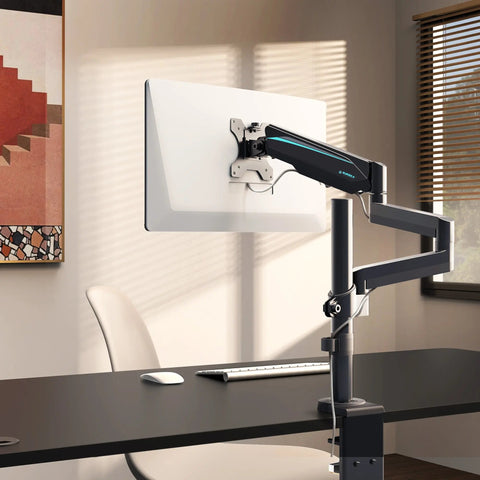
More importantly, the integration of a Single Monitor Arm is non-negotiable for the colorist. To maintain a neutral spinal position, the top third of your monitor should be at eye level, and the screen should be tilted slightly upward (about 10–20 degrees) to match the natural downward gaze of the human eye. According to the BIFMA G1-2013 Ergonomics Guideline, providing this level of adjustability ensures the workstation "fits" the 5th to 95th percentile of the population, preventing the static load that leads to chronic Musculoskeletal Disorders (MSDs).

Managing the "Visual Noise": Cable Clutter and Reflections
In a dark room, every stray light source is a distraction. Reflections from glossy desk surfaces or the "visual noise" of tangled cables can introduce subtle color casts. A red power cable reflecting off a glass desk can actually shift your perception of the skin tones in your video.
To achieve a clutter-free, color-accurate environment, we recommend:
- Matte Surfaces: Use a large, full-surface matte mousepad to cover the desk. This eliminates specular reflections from the monitor.
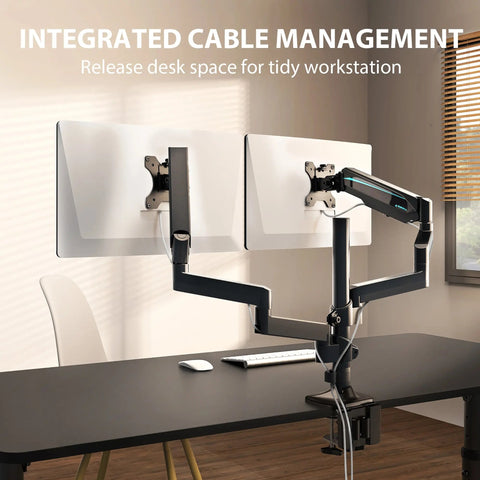
- Cable Management: Professional desks like the Ark EL Executive Standing Desk (60"x26") feature integrated cable management systems. Keeping cables hidden is not just about aesthetics; it removes visual "clutter" that can interfere with deep focus during long grading sessions.
- Dual RGB Profiles: Seasoned colorists often create two separate lighting profiles. One profile disables all decorative RGB and sets the bias light to a dim 6500K for critical work. A second, more vibrant profile is used for client presentations or non-critical administrative tasks.
Practical Recommendations for the Workday
To maintain long-term health and accuracy, professional editors should adopt a structured rhythm. The Cornell University Ergonomics Web suggests a "20-8-2" rhythm: 20 minutes of sitting in a neutral position, 8 minutes of standing, and 2 minutes of moving or stretching.
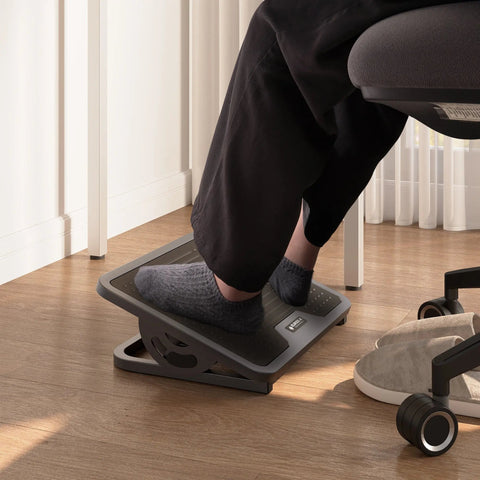
When standing, it is essential to use a Footstool with Wheels or a similar support to allow for frequent weight shifts. This reduces the static load on the lower limbs and improves blood circulation, which is often compromised during long, sedentary editing sessions. As noted by the World Health Organization (WHO), interrupting long periods of static behavior is critical for reducing the risk of cardiovascular disease and long-term musculoskeletal issues.
Methodology Note (Reproduction): The 20-8-2 ratio is a heuristic for general office work. For color-critical tasks, we recommend extending the "moving" phase to include 5 minutes of "visual reset"—looking at a neutral gray wall or out a window—to allow the eyes to recover from screen-induced accommodative stress.
Conclusion
The "dark room" is a tool, not a lifestyle. To use it effectively, the professional editor must balance the technical requirements of color accuracy with the biological requirements of the human body. By implementing D65-matched bias lighting, performing hardware-level calibration, and utilizing ergonomically adjustable furniture like the Aero Pro Wing-Shaped Standing Desk (72"x23"), you create an environment where precision and well-being coexist.
Investing in a workstation that adheres to ISO 9241-5:2024 standards for postural requirements is not merely a comfort choice; it is a professional commitment to the longevity of your career and the integrity of your creative output.
Disclaimer: This article is for informational purposes only and does not constitute professional medical advice. Ergonomic needs vary by individual; please consult with a qualified occupational therapist or healthcare provider if you have pre-existing musculoskeletal conditions.
References
- BIFMA G1-2013 Ergonomics Guideline for Furniture
- Cornell University Ergonomics Web — Workstation Guides
- ISO 9241-5:2024 Workstation layout & postural requirements
- OSHA eTools: Computer Workstations - Neutral Working Postures
- WHO 2020 Guidelines on Physical Activity & Sedentary Behaviour
- The 2026 Workstation White Paper: Converging Ergonomic Science and Sustainable Engineering




Leave a comment