

A desk fits your home only if it passes two separate checks. First, the shipping boxes have to travel from your entrance to the room. Second, the assembled desk has to fit the spot where you'll use it.
Space for the finished desk doesn't mean a long, flat box can get around your hallway corner. So before you check out this Black Friday, do a desk fit check with two sets of numbers. Use the package dimensions for the route and the assembled dimensions for the final spot.
Compare the package with the full delivery route
Start with the boxes, not the desk, and follow them all the way to the room. Your front door is only the first opening on that route.
Get the dimensions for every shipping package
Look on the product listing, spec sheet, or manual for that exact desk. You need the package dimensions and how the desk ships. Some desks come in more than one box, and each box needs its own route check. Don't use the assembled width and depth instead, because a box can be a very different shape from the finished desk. If you're comparing several desks in our Black Friday desk collection, write down the package numbers for each one on your shortlist.
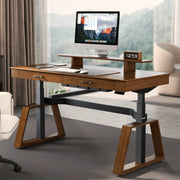
Our Norwood standing desk shows why this matters. Its catalog record lists two packages plus a separate assembled size:

| Measurement | Listed size (inches) | Use it for |
|---|---|---|
| Package 1 | 58.86 × 26.97 × 5.51 | Route check |
| Package 2 | 30.00 × 13.39 × 6.46 | Route check |
| Assembled desk | 55.12 W × 23.62 D × 29.53–48.03 H | Final spot check |
On this model, the larger box is longer and wider than the finished desktop. That makes it the box to check first. These numbers apply to this desk only, and your route still needs its own measurements.
Measure the route's clear constrained points
Walk the path the boxes will take, from the entrance to the room, and write down every tight spot. One furniture planning guide suggests using the packed size, then recording clear openings and turning space along with stair and landing limits. The same page also links separate tools for doors, stairs, elevators, and hallway corners.
- Entry door. Measure the clear opening, not the frame. For accessible swinging doors, the U.S. Access Board measures clear width at 90 degrees, from the door stop to the face of the open door. The door and its stop take up part of the frame, so this gap is the number to compare. Measure the clear height too.
- Hallways and narrow passages. Record the narrowest width, including handrails or anything mounted on the wall.
- Turns. At each corner, write down the width of both hallways and the open floor space where the box would pivot. A clear-opening number doesn't tell you whether a box can make the turn.
- Stairs and landings. Record stair width, headroom, and the length and width of each landing. Landing size alone doesn't show whether a box can turn there. Railings, overhead space, and how the box is carried matter too.
- Elevator, if your building has one. Measure the door opening and the inside of the car.
- The room's own door. Measure it the same way as the entry door.
Decide whether the full route is confirmed
You can settle a straight opening with a tape measure. Each box has to be narrower than the clear width and shorter than the clear height of every doorway it passes through. Check it only in a position the box can actually be carried in. If the product information says the box must stay flat, compare it flat.
Turns and stairs are harder. Corner calculators help, but every one has limits. One published model treats the item as a rigid box and assumes solid walls on both sides of a right-angle corner. It also does not check stairs or landings, and it doesn't check lifts either. Don't count on tilting the box, removing parts, or taking a door off its hinges unless the product information says the desk can be handled that way.
If you can't confirm a turn or stairway from your numbers, mark that exact spot as unresolved. Then ask for confirmation for your specific route before you order. For one of our desks, you can send the model name and your route measurements to our support team and ask how it ships.
Check the assembled desk against its final spot
The final spot needs the assembled dimensions, compared with the space you can actually use. This check is separate from the route check, so do it even if every doorway passed.
- Choose the orientation. Decide which wall the desk will face and which way its width will run.
- Measure usable width and depth. Measure in that orientation, from wall to wall or to the nearest thing that won't move, such as a radiator, a door's swing path, or a bookcase.
- Compare like with like. Use inches for both, and match width to width and depth to depth. For the Norwood desk above, that means the assembled row in the table, not either box. If you're weighing several adjustable desks, repeat this step with each model's assembled size. Still choosing a size? Our guide to desk dimension basics covers standard width, depth, and height.
- Check height only when something is above or beside the desk. Look at shelves, window sills, or a sloped ceiling. For a standing desk, compare those with the top of its height range.

Call the overall fit confirmed only when both checks pass on confirmed numbers. If one is incomplete, name exactly what's missing. It could be a box's dimensions, how the desk ships, a measurement at a certain turn or stair, or the usable size of the spot. That missing piece is the one thing to get before you order. Until you have it, your desk fit check is still open.
FAQs
What should I include when I ask someone to confirm a tight route?
Give the exact desk model and, if you know them, the size of each box. Then list each tight point in order from the entrance. Include door clear widths and heights, hallway widths on both sides of each turn, stair width and headroom, and landing size. Photos of corners and stairways help the person reviewing your route see things a list of numbers can miss.
What if a desk listing only shows the assembled dimensions?
Treat the route as unresolved. The assembled size can't stand in for the box size. Ask the seller for each box's length, width, and height, and ask whether the desk ships in one box or several. For our desks, check the spec details first. You can also look at our shipping and delivery page or contact us before checkout.
Can an online furniture fit calculator replace measuring?
No. A calculator can only work with the numbers you give it. It also builds in its own assumptions about walls, corners, and the shape of the item. The planning guide linked above calls its own tools a planning aid, not a delivery guarantee. Measure the route yourself, then use a calculator to help sort out a specific obstacle.
Does the same check work when ordering several desks for an office?
Yes, but run it for each model, since different desks may ship in different boxes. Measure the building's route once, then compare it with each model's packages. For a larger move, our office relocation furniture checklist can help you plan the move in phases.
Leave a comment