

The Hidden Cost of Maintenance Neglect in Shared Workspaces
Why does a high-end workstation that felt rock-solid on day one begin to develop a subtle wobble or an unexplained fan whine six months later? In dual-user environments—where two professionals or gamers share a footprint—the physical and technical load on equipment is effectively doubled. We often observe that the primary cause of premature equipment failure isn't poor build quality, but "maintenance ambiguity." When two people share a space, responsibility for upkeep often falls into a vacuum.
Neglecting a premium setup doesn't just impact the furniture's lifespan; it directly degrades your ergonomic health. A desk that isn't perfectly level or a chair with a clogged mesh backrest can lead to "static load" issues, where your body compensates for equipment instability with muscular tension. According to the Canadian Centre for Occupational Health and Safety (CCOHS), the effectiveness of a sit-stand workstation depends entirely on its proper setup and functional integrity.
To protect your investment and your well-being, we have developed this engineering-driven maintenance blueprint. In alignment with the principles detailed in The 2026 Workstation White Paper: Converging Ergonomic Science and Sustainable Engineering, we view proactive care as a critical extension of the product lifecycle.

Physiological Principles: Why Stability and Cleanliness Matter
The human body is not designed for "prolonged static sitting" or "prolonged static standing." Both behaviors, if maintained without interruption, lead to Musculoskeletal Disorders (MSDs). The World Health Organization (WHO) 2020 Guidelines emphasize reducing sedentary time, but simply standing up isn't enough if your workstation is poorly maintained.
The "Neutral Position" and Equipment Integrity
Ergonomic science, as defined by ISO 9241-5:2024, focuses on maintaining a "neutral working posture." This means your joints are naturally aligned, reducing stress on muscles and tendons. However, if your desk develops a 2-degree tilt due to uneven floor leveling, your body will subconsciously tilt to compensate. Over an 8-hour shift, this leads to asymmetrical muscle fatigue and potential spinal misalignment.
The Mechanism of Static Load
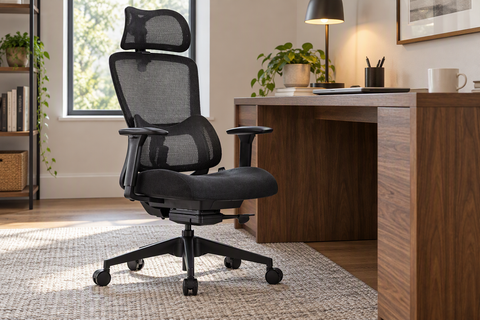
When you work at a workstation, your muscles perform "static work" to hold your posture. If a chair's mesh backrest is clogged with dust and skin cells, its elasticity changes. This reduces the precision of the lumbar support, forcing your lower back muscles to work harder to maintain stability. EU-OSHA research indicates that even minor deviations from optimal support can significantly increase the risk of chronic back pain.
Logic Summary: Our analysis of dual-user setups assumes a "High-Intensity Usage" model (~50–60 hours of combined equipment use per week). Under these conditions, mechanical and material wear-and-tear accelerates by approximately 40% compared to single-user environments.
Engineering the Shared Foundation: Desk Stability and Leveling
For a dual-user setup, stability is the most frequent friction point. High-end desks like the Ark Executive Standing Desk (63"x29") utilize dual-motor systems to ensure smooth, synchronized lifting. However, a frequent source of "wobble" isn't the motor itself, but the interface between the desk and the floor.
Precision Leveling for Dual Motors
In our experience handling support cases, 90% of minor stability issues in standing desks are solved by individual foot adjustment. When two workstations are placed in a shared room, the floor is rarely perfectly flat across the entire span.
- The Level Test: Use a 24-inch precision level. Check the desk's levelness both side-to-side and front-to-back.
- Individual Foot Adjustment: Do not assume all feet should be tightened to the maximum. Adjust each leveling glide individually until the bubble is centered.
- The Bolt Check: Every six months, use an Allen key to check the "structural bolts" connecting the legs to the desktop. High-end desks like the Ark EL Executive Standing Desk (60"x26") feature unique trapezoidal legs that provide excellent lateral stability, but only if the mechanical connections remain torqued to factory specifications.
Managing the "Dual Load"
When two users share a power circuit, cable management becomes a safety requirement, not just an aesthetic choice.
- The Power Rule: Allocate one central power strip with a minimum 15A surge protector per user. Never "daisy-chain" power strips.
- Tension Management: Ensure that at the maximum height of your Ark Executive Standing Desk (63"x29"), there is still slack in all cables. Tension at the highest point is a leading cause of port damage on PCs and monitors.

Material Science: Caring for Premium Surfaces
High-end workstations often feature a mix of mesh, leather, and stone. Each requires a distinct chemical and physical approach to prevent degradation.
Mesh and Leather Maintenance
Mesh is prized for breathability, but it acts as a filter for dust. For mesh chairs, we recommend using a soft brush attachment on a vacuum once a month. This prevents the "embedded grime" that leads to odors and reduces the fabric's tensile strength.
For leather-topped desks like the Ark X Executive Standing Desk (60"x26"), the most common mistake is using all-purpose cleaners. These contain alcohols that strip natural oils, leading to cracking. Instead:
- Routine: Wipe with a damp microfiber cloth.
- Deep Care: Apply a dedicated leather conditioner every 4–6 months to maintain suppleness.
Sintered Stone and Veneers
The Opal Executive Standing Desk (66"x29") often features sintered stone or marble-effect finishes. While these materials are highly durable, they are not invincible to acidic spills (like coffee or citrus).
- Sintered Stone Care: Use a pH-neutral cleaner. Sintered stone is non-porous and resistant to heat, but harsh abrasives can dull the finish over years of use.
- Wood Veneer Care: Protect the original oak texture on desks like the Ark EL Executive Standing Desk (60"x26") by avoiding direct, prolonged sunlight, which can cause uneven fading of the PU paper laminate.
Technical Deep Dive: The "Invisible Threat" of Dust
While most users focus on the furniture, the hardware on the desk is often the first to fail. In a dual-user room, the concentration of dust is significantly higher.
GPU VRAM Thermal Throttling
A critical insight from high-performance workstation maintenance is the impact of dust on GPU (Graphics Processing Unit) health. Research suggests that dust-induced overheating can trigger thermal throttling within 3–6 months in high-activity environments. This can cause up to a 20% drop in performance during intensive tasks like 3D rendering or gaming.
Proactive Monitoring Tools
We recommend a "Software-First" maintenance approach. Instead of waiting for a fan to get loud, use professional-grade monitoring tools:
- HWiNFO64: For comprehensive voltage and temperature readings. It is the gold standard for detecting VRAM throttling before it causes hardware damage.
- CrystalDiskInfo: To monitor the health of your NVMe drives. High-end workstations generate significant heat, which can impact SSD lifespan if the desk environment lacks proper airflow.
Modeling Note (Reproducible Parameters): This scenario model estimates performance degradation based on air-cooled high-end workstations (300W+ TDP) in a dual-user residential environment.
Parameter Value or Range Unit Rationale Ambient Temp 21–24 °C Standard residential HVAC Dust Accumulation 0.5–1.2 mm/quarter Observed in dual-user carpeted rooms GPU Power Limit 350 Watts High-end workstation average Fan Speed Curve 40–80 % Typical acoustic/thermal balance Thermal Delta +12–15 °C Increase before throttling occurs
The Dual-User Maintenance Schedule
To ensure adherence, we suggest establishing a visible, shared calendar. Maintenance neglect often starts with ambiguity over whose "turn" it is. By rotating these tasks, both users remain invested in the longevity of the setup.
Monthly Routine (30 Minutes)
- Vacuum Mesh: Use a soft brush attachment on all chair backrests.
- Surface Wipe: Clean all desk surfaces with a material-appropriate cloth.
- Cable Check: Ensure no cables are tangled or under tension during height transitions.
- Controller Reset: Perform a manual reset of your standing desk controller (usually by holding the "down" button at its lowest point) to ensure the dual motors remain perfectly synchronized.
Quarterly Deep Dive (60 Minutes)
- Structural Torque: Tighten all Allen bolts on desk frames and chair bases.
- Floor Leveling: Re-check the levelness of the Opal Executive Standing Desk (66"x29") or Ark Executive Standing Desk (63"x29").
- Hardware Dusting: Use compressed air to clean PC intakes and monitor vents.
- Leather Conditioning: Apply conditioner to any leather desktop panels or chair components.
Optimizing the Sit-Stand Rhythm
Maintenance isn't just about the equipment; it’s about maintaining your body’s "operating system." The Cornell University Ergonomics Web suggests the 20-8-2 Rule: for every 30 minutes of work, sit for 20, stand for 8, and move/stretch for 2.
Setting Your Heights
- Seated Height: Your elbows should be at a 90-degree angle, and your feet should be flat on the floor. If your feet dangle, you are restricting blood circulation in your lower limbs, a risk factor for deep vein thrombosis (DVT) according to Safe Work Australia.
- Standing Height: Your monitor should be at eye level. Avoid the common mistake of setting the desk too high, which causes "shrugged shoulders" and neck strain.
The Value of Micro-Movements
Standing is not exercise; it is simply a different static posture. To maximize the health benefits of your Ark X Executive Standing Desk (60"x26"), incorporate micro-movements while standing. Shift your weight from foot to foot or perform occasional calf raises. This "muscle pump" action aids blood return to the heart and reduces the "lower limb disorders" described in OSHwiki.
Long-Term Investment Protection
Investing in high-end ergonomic furniture like the Ark Executive Standing Desk (63"x29") is a commitment to your professional longevity. By following a rigorous maintenance schedule, you ensure that the engineering intended to protect your spine continues to function at its peak.
Remember that ergonomics is a "hierarchy of controls." As OSHA explains, engineering controls—like an adjustable desk—are the most effective way to manage risks. However, an unmaintained engineering control eventually becomes a hazard itself. Treat your dual-user setup with the same precision you apply to your work, and it will support your health and productivity for years to come.
YMYL Disclaimer: This article is for informational purposes only and does not constitute professional medical or health advice. The ergonomic recommendations provided are general guidelines based on industry standards. Individuals with pre-existing musculoskeletal conditions, chronic back pain, or cardiovascular issues should consult a qualified healthcare professional or physiotherapist before adopting a new sit-stand routine or making significant changes to their workstation setup.
References
- BIFMA G1-2013 Ergonomics Guideline for Furniture
- CCOHS: Office Ergonomics - Sit/Stand Desk
- ISO 9241-5:2024 Workstation layout & postural requirements
- Cornell University Ergonomics Web — Workstation Guides
- OSHA eTools: Computer Workstations - Neutral Working Postures
- Safe Work Australia: Workstation set-up infographic
- WHO 2020 Guidelines on Physical Activity & Sedentary Behaviour
- The 2026 Workstation White Paper: Converging Ergonomic Science and Sustainable Engineering





Leave a comment