

The Hidden Friction of Shared Workspaces: Why Ergonomics Matters for Couples
For remote-working couples, the "home office" is often a theater of micro-negotiations. The friction rarely stems from a lack of affection; instead, it frequently arises from the physical constraints of a shared environment. Why does your partner’s typing seem louder in the afternoon? Why do you find yourself readjusting your chair every time they leave the room? These are not merely behavioral quirks; they are often symptoms of an anthropometric mismatch.
At a Glance: Key Recommendations for Shared Offices
If you are looking for a quick setup guide to reduce workspace friction, prioritize these benchmarks:
- Minimum Desk Width: 60 inches (152 cm) per person for side-by-side setups to avoid "elbow interference."
- Height Range: Look for a desk with a vertical range of 22" to 48" (aligned with BIFMA G1-2013) to accommodate both partners in sitting and standing positions.
- The "20-8-2" Rule: Aim for 20 minutes sitting, 8 minutes standing, and 2 minutes of movement to mitigate static load.
- Essential Feature: Programmable memory presets are a "must-have" to allow instant transitions between users without manual measurement.
When two individuals with different physiological profiles attempt to inhabit a static workspace, the result is often "spatial conflict." Based on common patterns observed in workstation troubleshooting, a frequent mistake in shared setups is the assumption that a single desk height or chair setting can accommodate both partners. This leads to what we call the "20-minute rule" heuristic: if one person feels the need to readjust their workstation more than once every 20 minutes, the setup may not be adequately supporting their unique musculoskeletal needs.
Beyond immediate discomfort, poor ergonomics in a shared space can contribute to "relational ergonomics stress." When one partner is hunched over a desk that is too low, or straining to reach a keyboard that is too high, the resulting irritability can spill over into their interactions. General ergonomic principles suggest that poor posture can increase feelings of physical fatigue and irritability, creating a physiological baseline for potential conflict.
The Physiology of Static Load and Musculoskeletal Disorders (MSDs)
To understand why a shared workspace requires professional-grade solutions, one must understand the physiological cost of a "bad fit." Musculoskeletal Disorders (MSDs) are not always the result of sudden injury; more often, they are the consequence of prolonged static load.
As defined by the U.S. Occupational Safety and Health Administration (OSHA), core risk factors for MSDs include repetitive tasks, excessive force, and, most critically for office workers, awkward or static postures. When you sit in a fixed position for hours, your muscles remain in a state of constant, low-level contraction. This "static load" restricts blood circulation, which can lead to a buildup of metabolic waste products and a decrease in oxygen delivery to the tissues.
The ISO 11226:2000 standard provides a quantitative basis for evaluating these static working postures. It emphasizes that the duration and angle of a joint's position are the primary determinants of strain. For a couple, even a minor height discrepancy—such as a desk that is two inches too high for the shorter partner—can lead to chronic shoulder elevation. Over time, this triggers the pathophysiological mechanisms of MSDs, leading to tissue adaptation that may require professional intervention if not addressed through early setup adjustments.
The Problem of Anthropometric Divergence
The challenge for couples is rooted in "Anthropometrics"—the study of human body measurements. According to BIFMA G1-2013 Ergonomics Guidelines, furniture should ideally accommodate the 5th to 95th percentile of the population.
In a typical couple, the difference in seated elbow height can exceed 15 cm (approx. 6 inches). If a desk is fixed at a "standard" height of 29 inches, it may be ergonomic for a 5'10" individual but can be challenging for a 5'2" partner, potentially forcing them into a "shrugged" shoulder position to reach the keyboard. This mismatch is why professional-grade adjustability is a practical necessity for maintaining both physical health and a harmonious work environment.
Methodology Note: Our analysis of dual-user environments assumes a "High-Variance User Pair" (e.g., one partner in the 5th percentile height and one in the 95th). To accommodate the full range of sitting (lowest user) and standing (tallest user), a desk typically requires a vertical travel range of at least 20–26 inches (e.g., moving from 22" up to 48").
Engineering Harmony: Ergonomic Solutions for Two
The most effective way to address these physiological and relational stressors is through "Engineering Controls." As outlined in the OSHA hierarchy of controls, engineering solutions—such as adjustable furniture—are generally more effective than "Administrative Controls," like simply reminding yourself to take breaks.
1. Independent Height Adjustment: The Dual-Motor Advantage
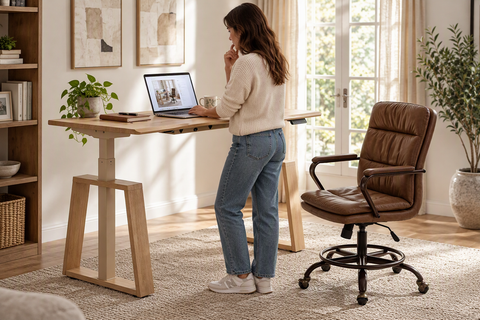
For couples who share a single desk or work in close proximity, a height-adjustable standing desk is the foundational tool. Desks like the Opal Executive Standing Desk (66"x29") or the Ark Executive Standing Desk (63"x29") utilize dual-motor systems to provide smooth transitions.

The Opal Executive Standing Desk (66"x29") is particularly effective for shared spaces due to its ample surface area and integrated storage, which helps define "personal zones." When each partner can save their preferred sitting and standing heights into memory presets, the friction of "resetting" the workspace is significantly reduced. This aligns with the CCOHS guide on sit/stand workstations, which emphasizes that the ability to change posture frequently is key to reducing sedentary time.
2. Specialized Support: The Role of the Executive Chair
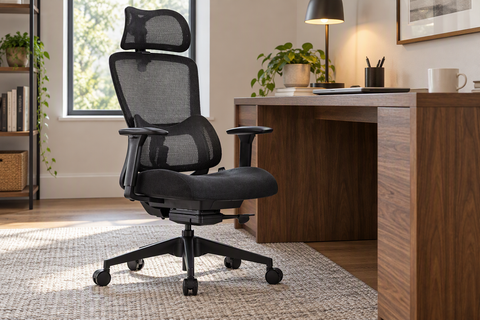
While the desk provides the platform, the chair provides the support. In a shared office, the chair is often the most contested piece of furniture. A high-performance executive chair, such as the Royal II, Silicone & Leather Executive Ergonomic Office Chair, addresses the need for personalized lumbar support and neutral spinal alignment.

The Royal II is designed to provide a "full-wrap" feeling, which is critical for maintaining a neutral working posture. According to ANSI/BIFMA X5.1 standards, an ergonomic chair must be durable enough to handle frequent adjustments. For couples, the ability to quickly modify seat depth and lumbar tension ensures the chair supports the unique spinal curvature of whoever is sitting in it.
3. Spatial Division with L-Shaped Configurations
When couples work side-by-side, "territorial disputes" over desk space can lead to elbow clashes and cable clutter. The L-Shaped Standing Desk (60"x23") offers a strategic solution by creating a natural corner boundary.

By using an L-shaped configuration, couples can maintain proximity while having a dedicated zone for their specific peripherals. This setup is highly effective when paired with monitor arms, which are essential for maintaining correct viewing geometry and reducing neck rotation.
Practical Recommendations: The Collaborative Workday
Investing in ergonomic furniture is the first step, but the "Human Factor" requires a shared protocol to improve well-being.
The 20-8-2 Rhythm
We recommend adopting the "20-8-2" rhythm developed by Cornell University’s Ergonomics Web. For every 30 minutes of work:
- 20 Minutes Sitting: Maintain a neutral posture in a chair with proper lumbar support.
- 8 Minutes Standing: Use a standing desk to interrupt static sitting.
- 2 Minutes Moving: Stretch or walk to stimulate blood circulation.
The 60-Inch Clearance Rule
To prevent physical interference, we suggest a minimum of 60 inches (152 cm) of contiguous desktop space per user in a side-by-side setup. This helps ensure that even with large monitors, partners are not invading each other's "ergonomic bubble."
| Parameter | Recommended Value | Rationale/Source |
|---|---|---|
| Desk Width (per user) | 60 inches (152 cm) | Prevents elbow clashes; allows for dual-monitor setups. |
| Sit-Stand Ratio | 3:1 (Sitting to Standing) | Based on Cochrane (2018) findings. |
| Monitor Distance | 20–30 inches | Aligned with OSHA guidelines. |
| Keyboard Height | Elbow height | Ensures neutral wrist posture (ANSI/HFES 100-2007). |
Managing "Cable Chaos"
Internal user feedback indicates that conflict over cable clutter is a primary source of frustration in shared offices. Dedicated cable management systems, like those found in the Ark Executive Standing Desk, help prevent "cable creep" into a partner's space and reduce the visual clutter that can contribute to cognitive load.

The Psychological Benefit of an Ergonomic Gift
Choosing an ergonomic setup for a partner is an act of "wellness-oriented gifting." It demonstrates an understanding of their daily frustrations and a commitment to their long-term health. When a shared office looks professional and feels comfortable, it can become a sanctuary of productivity rather than a source of stress.
Methodology Note: Modeling Shared Efficiency
Modeling Type: Deterministic Parameterized Scenario Model. Assumptions: Two users (User A: 5'4", User B: 6'1") sharing a 60-minute work cycle. Boundary Conditions: This model assumes standard office tasks (typing/mousing) and does not account for specialized hardware like oversized musical equipment.
Parameter Value/Range Unit Source Category Vertical Height Range 22 - 48 inches BIFMA G1-2013 Adjustment Speed 1.0 - 1.5 inch/sec Manufacturer Spec (Dual-Motor) Noise Threshold < 50 dB Internal Comfort Heuristic Desktop Depth 24 - 30 inches OSHA eTools Load Capacity 150 - 220 lbs ANSI/BIFMA X5.5
Summary of Best Practices for Couples
- Prioritize Individual Adjustability: Ensure both partners can achieve a neutral position regardless of their height.
- Use Memory Presets: Eliminate the need for manual measuring every time you switch positions.
- Define Boundaries: Use L-shaped desks or integrated storage to prevent "desk hogging."
- Synchronize Breaks: Use the WHO 2020 Guidelines as a baseline to reduce sedentary behavior together.
- Focus on Air Quality: Look for certifications like UL GREENGUARD Gold to ensure materials in your shared office have low chemical emissions.
By applying these principles and choosing professional-grade ergonomic solutions, remote-working couples can transform their shared office into a high-performance environment that fosters both professional success and personal well-being.
Disclaimer: This article is for informational purposes only and does not constitute professional medical advice. Individuals with pre-existing musculoskeletal conditions or chronic pain should consult a qualified healthcare professional or physical therapist before making significant changes to their workstation setup or work routine.
References
- BIFMA G1-2013 Ergonomics Guideline for Furniture
- OSHA eTools: Computer Workstations - Neutral Working Postures
- ISO 11226:2000 Evaluation of static working postures
- Cochrane: Workplace interventions for reducing sitting at work (2018)
- Cornell University Ergonomics Web — Workstation Guides
- The 2026 Workstation White Paper: Converging Ergonomic Science and Sustainable Engineering
- WHO 2020 Guidelines on Physical Activity & Sedentary Behaviour
- ANSI/BIFMA X5.1 General-Purpose Office Chairs




Leave a comment