

The Challenge of Gifting Health: Why "Standard" Isn't Enough
Choosing a gift intended to improve a loved one’s health is an act of profound care. However, when that gift is an ergonomic chair or a standing desk, the complexity increases significantly. Unlike a piece of art or a decorative lamp, ergonomic furniture is a functional interface between the human body and a digital workspace. If the interface does not align with the user’s unique physical dimensions, it can inadvertently introduce new stressors rather than alleviating existing ones.
The primary frustration for gift-givers is "fit anxiety." We worry that a premium chair will be too deep for a petite recipient or that a desk won’t rise high enough for a tall one. This concern is scientifically grounded. According to the Occupational Safety and Health Administration (OSHA), poor workstation fit is a leading contributor to Musculoskeletal Disorders (MSDs), which result from repetitive tasks, forceful exertions, and sustained awkward postures.
To give a gift that truly supports wellness, one must move beyond aesthetic appeal and focus on "anthropometric matching"—the science of ensuring equipment dimensions accommodate the user's body. As detailed in The 2026 Workstation White Paper: Converging Ergonomic Science and Sustainable Engineering, the future of workspace design lies in high-modularity systems that adapt to the individual, rather than forcing the individual to adapt to the furniture.
The Physiology of Posture: Beyond the Surface
To understand why adjustability is the most critical feature of an ergonomic gift, we must examine the physiological principles of the "Neutral Position." In ergonomics, the neutral position is the posture where the body is aligned and balanced, minimizing stress on the musculoskeletal system.
When a user sits in a chair that is too deep, they often experience "perched" sitting. This happens when the seat pan is so long that it hits the back of the knees before the user’s spine can reach the lumbar support. This leads to a rounded lower back, increasing pressure on the intervertebral discs. Conversely, a seat that is too shallow fails to support the thighs adequately, concentrating the user's weight on the ischial tuberosities (sit bones) and impeding blood circulation.
Logic Summary: The Mechanics of Static Load Our analysis of sedentary discomfort assumes that static loading—holding one position for too long—is the primary driver of fatigue. By providing equipment that allows for micro-movements and postural shifts, we transition the body from a static load to a dynamic state, which is aligned with World Health Organization (WHO) recommendations for reducing sedentary behavior.
For the gift-giver, the goal is to provide a "Universal Fit" through extreme adjustability. This ensures that even without the recipient’s exact measurements, the furniture can be tuned to their specific needs.

The "Gotchas" of Gifting: Seat Depth and Lumbar Precision
A common mistake when gifting chairs is focusing solely on seat height. While height is important, it is often the easiest variable to fix. The "silent killer" of comfort is often seat depth.
Experienced ergonomists note that for a chair to be a successful gift, it must accommodate the 5th to 95th percentile of the population. This is why we recommend prioritizing chairs with a seat depth adjustment range of at least 4 inches. For instance, a range of 16 to 20 inches allows the chair to fit a petite user (who needs a shorter pan to avoid knee pressure) and a tall user (who needs more thigh support).
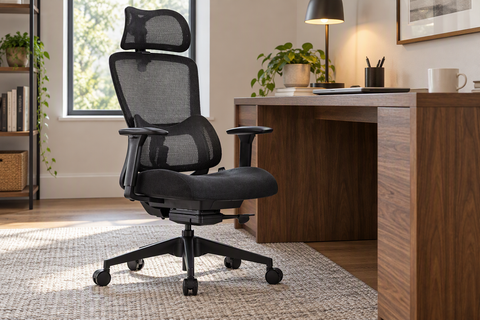
Furthermore, lumbar support must be more than just a "bump" in the chair. According to BIFMA G1-2013 Ergonomics Guideline for Furniture, effective lumbar support should offer both height and depth (protrusion) control. Because the natural inward curve of the lower back (lordosis) varies significantly between individuals, a fixed lumbar support is a gamble. An adjustable system, such as the one found in the Exis,Ergonomic Office Chair, allows the user to find the exact "sweet spot" for their spine.

Sizing Strategies for the Standing Desk
Gifting a standing desk requires a different set of considerations. While weight capacity is often marketed heavily, the adjustment range is far more critical for a gift.
To accommodate a wide variety of users—from a 5'0" individual to someone standing 6'5"—a desk should ideally have a height range between 25 inches and 50 inches. This ensures that in both the seated and standing positions, the user can maintain neutral elbow and wrist angles.
The Desk Height Model
To help the recipient set up their gift, you can provide them with this heuristic for calculating their ideal seated desk height: $$H_{desk,sit} \approx H_{seat} + H_{elbow} - H_{kbd} - \Delta_{wrist}$$
- H_seat: The height of the chair seat when the user's feet are flat on the floor.
- H_elbow: The distance from the seat to the user's elbow.
- H_kbd: The thickness of the keyboard.
- Delta_wrist: A small adjustment for a neutral wrist angle (typically 10–20 mm).
Methodology Note: Desk Height Modeling This formula is a scenario model used for quick workstation calibration. It assumes a standard 90-degree elbow angle and neutral wrist positioning.
Parameter Value/Range Unit Rationale Elbow Angle 90 - 110 Degrees ISO 9241-5 recommendation Wrist Angle 0 - 15 Degrees Minimize carpal tunnel pressure Foot Placement Flat on floor N/A Essential for kinetic chain stability Eye-to-Screen 20 - 30 Inches Reduce visual fatigue Monitor Tilt 10 - 20 Degrees Align with natural line of sight
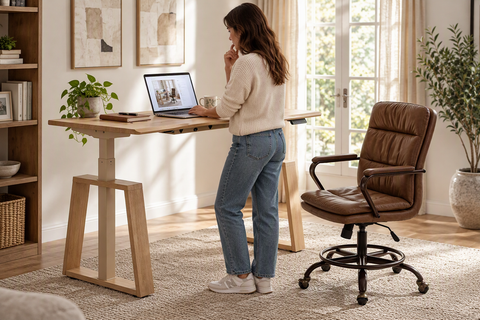
When selecting a desk like the Standing Desk with Drawers, Wood Finish (47'' /55''), the inclusion of programmable memory presets is a high-value feature. It allows the recipient to save their precise ergonomic heights once they have performed their initial "fitting," removing the guesswork from daily transitions.
Practical Recommendations: The Gift-Giver’s Checklist
If you are determined to keep the gift a surprise, use these proxy indicators to choose the right model:
- The "Armspan" Proxy: If you know the recipient's height, you can estimate their reach. However, height alone is insufficient for chair depth.
- Current Frustrations: Does the recipient complain of neck pain? (Look for a chair with a headrest or a desk with a monitor riser). Do they have lower back pain? (Prioritize 4-way adjustable lumbar support).
- The "Safety Net" Accessory: If you are unsure about a chair's fit, include an Adjustable Ergonomic Footrest. A footrest is the "universal adapter" of ergonomics. If a chair is slightly too high for a user to keep their feet flat, the footrest corrects the posture instantly, preventing pressure on the underside of the thighs.
Adjustable Ergonomic Footrest
Comparison of Adjustment Ranges for "Universal" Gifting
| Feature | Recommended Range for Gifting | Why it Matters |
|---|---|---|
| Seat Depth | 16" - 20" | Accommodates different femur lengths; prevents "perching." |
| Desk Height | 25" - 50" | Fits users from 5'0" to 6'5" in both sit and stand modes. |
| Armrest Height | 7" - 11" (above seat) | Relieves tension in the trapezius and shoulders. |
| Lumbar Height | 6" - 10" (above seat) | Must align with the L3-L5 vertebrae. |
Implementation and the "20-8-2" Rhythm
The most successful ergonomic gift is one that comes with a "user manual" for behavior. Simply owning a standing desk does not improve health; using it correctly does.
We recommend sharing the Cornell University Ergonomics Web "20-8-2" rule with the recipient:
- 20 minutes of sitting in a neutral posture.
- 8 minutes of standing (avoiding static standing for too long).
- 2 minutes of moving or stretching.
This rhythm prevents the risks associated with "prolonged static standing," which, according to EU-OSHA, can lead to lower limb disorders and varicose veins. The goal is movement, not just standing.
The Executive Choice: When Style Meets Science
For recipients who value a more traditional aesthetic, such as home office owners or managers, the Royal II, Silicone & Leather Executive Ergonomic Office Chair offers a blend of high-back support and premium materials. While executive chairs are often criticized for being "style over substance," a truly ergonomic executive chair must still adhere to the fundamental principles of spinal alignment and pressure distribution.
When gifting a high-back chair like the Royal II, ensure the recipient understands how to adjust the tilt tension. A common mistake is leaving the tilt too loose (causing a lack of support) or too tight (causing the user to fight the chair). The chair should feel like an extension of the body, moving with the user as they shift between focused work and contemplative reclining.

Final Guidance for the Thoughtful Giver
Gifting ergonomics is an investment in someone's long-term well-being. By focusing on high-adjustability models and understanding the basic mechanics of the human body, you can mitigate the risks of a poor fit.
Key Takeaways for Your Gift Selection:
- Prioritize Seat Depth: Look for at least 4 inches of adjustment.
- Check Desk Ranges: Ensure the desk goes low enough (25") and high enough (50").
- Value the Footrest: It is the most effective way to fix a "near-miss" in chair sizing.
- Empower the Recipient: Provide them with a setup guide or a link to authoritative adjustment instructions.
Ultimately, the most "thoughtful" ergonomic gift is one that acknowledges the recipient's agency—giving them the tools to achieve their own perfect fit.
Disclaimer: This article is for informational purposes only and does not constitute professional medical advice. Individuals with pre-existing musculoskeletal conditions or chronic pain should consult a qualified physiotherapist or medical professional before making significant changes to their workstation setup.




Leave a comment