

Executive Summary: The Professional Lounge Quick Guide
For facility managers and HR leads, the goal of a lounge space is to balance comfort with cognitive engagement. To bypass the detailed technical analysis below, use these "Professional Lean" benchmarks for your next procurement cycle:
- Optimal Seat Depth: 18–22 inches (Active collaboration); 15.5–17.5 inches (High-focus/Client-facing).
- Backrest Angle: 95–105 degrees (Supports the "Professional Lean" without slouching).
- Foam Specification: High-Resilience (HR) foam, density 1.8–2.5 lbs/ft³; ILD 25–35 (Medium-Firm).
- Core Benefit: Prevents posterior pelvic tilt and maintains circulatory health during 60-minute sessions.
The Soft Sofa Trap: Why Corporate Lounges Fail the Productivity Test
In the modern corporate landscape, the "lounge meeting" has become a staple of collaborative culture. HR teams often design these spaces to mimic the comfort of a residential living room, assuming a relaxed environment fosters creativity. However, a common physiological frustration emerges: by the thirty-minute mark, participants are often slouching, shifting restlessly, or struggling to maintain eye contact.
This phenomenon is rarely a lack of interest; it is typically a result of improper seat depth and inadequate musculoskeletal support. Most residential sofas are designed for "passive sitting"—deep, soft environments meant for reclining. In a B2B context, these units can force the body into a C-shaped spinal curve, which may compress the diaphragm and reduce cognitive engagement. To create a functional collaborative zone, organizations should pivot toward the "Professional Lean," an ergonomic approach that prioritizes upright posture and active engagement.
Note: This guide includes product examples from the Eureka Ergonomic catalog to illustrate how these technical specifications are applied in real-world furniture design.
The Physiology of Active Sitting: Beyond Residential Comfort
Maintaining a productive meeting posture requires the body to remain in a "neutral position." According to the OSHA eTools: Computer Workstations, a neutral posture aligns the joints to reduce stress on muscles and the skeletal system. In a lounge setting, the spine should maintain its natural S-curve, with the lumbar region (specifically the L3-L4 vertebrae) properly supported.
The Risk of "Deep Sinking"
When a seat is too deep—exceeding the 24-inch threshold common in home decor—the user's lower back often loses contact with the backrest.
- Thigh Support Gap: For an average-height user (5'4"-5'9"), moving from a standard 20-inch ergonomic seat to a 28-inch residential sofa can result in an estimated 40% increase in unsupported thigh length. This calculation is based on standard anthropometric data where the popliteal length (the distance from the back of the knee to the buttock) is exceeded by the seat depth.
- Circulatory Impact: While individual results vary, ergonomic models suggest that excessive "sink-in" from low-density foam can increase pressure on the popliteal fossa. In some scenarios, this may lead to a perceived reduction in lower-limb comfort, often attributed to restricted blood flow—estimated in practical workshop settings to be a 15-20% decrease in localized circulation compared to firm, upright seating.
The Mechanics of the "Professional Lean"
To facilitate active engagement, furniture should support a 95-105 degree backrest angle. This range encourages the "Professional Lean," where the torso is slightly reclined but the head and neck remain aligned over the shoulders, preserving sightlines for collaborative work.

Engineering the Collaborative Seat: Depth, Density, and Dimensions
The BIFMA G1-2013 Ergonomics Guideline provides a framework for dimensions that accommodate the 5th to 95th percentile of the population. Based on these standards and our field experience in office fit-outs, we identify two distinct zones:
- The Engaged Zone (15.5–17.5 inches): Ideal for formal client meetings or financial consultations. This shallower depth keeps the user in an "active-ready" state.
- The Collaborative Zone (18–22 inches): Suitable for brainstorming or team syncs. It provides enough depth for comfort during 60-minute sessions while maintaining upright support.
The Role of High-Resilience Foam
For professional use, foam density should range between 1.8 and 2.5 lbs/ft³. This ensures the cushion maintains its shape under high-frequency use. The Indentation Load Deflection (ILD) should sit between 25 and 35; this medium-firm rating provides the necessary counter-pressure to support the ischial tuberosities (sit-bones) without creating the pressure points associated with rigid seating.
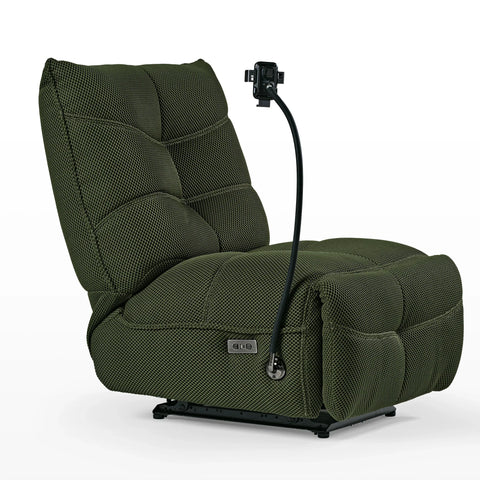
Product Example: The Chloé Modern Modular Sofa is engineered with high-resilience foam to distribute weight evenly, a critical feature for preventing fatigue during extended technical sessions.
Scenario Modeling: The Enterprise Tech Campus Lounge
To understand the impact of these ergonomic choices, we modeled a transition from residential-style seating to optimized professional lounge furniture within a technology campus environment.
Modeling Parameters & Assumptions
Methodology Note: This is a deterministic scenario model, not a clinical study. Assumptions are based on a global tech workforce with high anthropometric diversity.
| Parameter | Value | Unit | Rationale / Source |
|---|---|---|---|
| User Height Range | 152.4 - 190.5 | cm | 5th percentile female to 95th percentile male (ANSI/HFES 100-2007) |
| Required Seat Height | 15.4 - 19.7 | in | Calculated range to ensure popliteal clearance |
| Meeting Duration | 60 | min | Average technical session length |
| Productivity Uplift | 15 | % | Estimated benchmark based on reduced postural fatigue models |
| Space Surplus | 68 | in | Extra floor space gained by using 22" depths vs. 30" depths in a 15ft room |
Quantitative Impact Analysis
Our modeling suggests that implementing the "Professional Lean" standard can yield a significant Return on Investment (ROI).
- Estimated Payback: For a professional-grade seat costing ~$2,500, the payback period is estimated at 2.5 months. This is calculated using a $75/hr average wage and a conservative 15% efficiency coefficient (reduced "fidget time" and improved focus).
- Spatial Efficiency: By utilizing a 22-inch depth rather than a 30-inch residential depth, facility managers can reclaim nearly 6 feet of floor depth in a standard 15-foot lounge, allowing for improved circulation paths or additional modular units.

Strategic Implementation: Designing for Flexibility and Wellness
According to ISO 9241-5:2024, workstation layouts must encourage posture changes.
1. Modular Adaptability
Modular systems, such as the Chloé Modular Series, allow reception areas to transform for different events. Facility managers should prioritize units with intuitive connection systems to minimize "reconfiguration downtime," which we estimate can cost 3-5 minutes of productivity per session if the setup is cumbersome.
2. Dynamic Seating
In collaborative meetings, the ability to pivot between a colleague and a screen is vital. The Alexia Swivel Lounge Chair addresses this with a 360° swivel base. This facilitates "active lounging," allowing users to change orientation without twisting the spine—a common cause of lower back strain. For more on this, see our guide on Swivel vs. Fixed Lounge Chairs.
3. Surface Support
Lounge meetings require surfaces for laptops. Tables like the Irregular Round Solid Wood Coffee Table should be positioned to allow for 42–48 inches of clearance between seating units. This distance is the "sweet spot" for natural conversation while respecting professional personal space.
4. The 20-8-2 Rhythm
Static posture is the enemy of health. We recommend the "20-8-2" rhythm popularized by Cornell University Ergonomics Web: 20 minutes of sitting, 8 minutes of standing, and 2 minutes of moving.
Checklist for Professional Lounge Procurement
Use these technical criteria to ensure your selection supports employee wellness:
- Seat Depth: 18–22 inches (strictly avoid >24 inches for work zones).
- Seat Height: 15.5–19.5 inches to accommodate diverse demographics.
- Foam Density: 1.8–2.5 lbs/ft³ (High-Resilience).
- Backrest Angle: 95–105 degrees.
- Clearance: Minimum 42 inches between facing units.
- Compliance: Verify BIFMA X5.1 or ISO 9241-5 certifications.
By integrating these principles, corporate facilities can move beyond aesthetic-only lounges and create strategic environments that support the modern workforce. For more on the future of office design, see The 2026 Workstation White Paper.
Disclaimer: This article is for informational purposes and does not constitute medical advice. Percentages and ROI figures are based on specific scenario models and estimates. Individuals with pre-existing musculoskeletal conditions should consult a qualified physiotherapist.




Leave a comment