

The Evolution of Public Sector Workstation Standards
The transition toward hybrid work models in the public sector has fundamentally altered the requirements for institutional procurement. Traditionally, government office furniture was selected based on long-term static occupancy and rigid adherence to centralized floor plans. However, current trends toward flexible scheduling and shared workstations (often referred to as "hot-desking") have introduced a complex set of variables regarding durability, security, and ergonomic compliance.
For procurement officers, the challenge is no longer just "filling a room" with desks. It is about creating a resilient infrastructure that accommodates a diverse workforce while meeting stringent safety benchmarks like ANSI/BIFMA and ISO standards. A common misconception in public sector planning is that hot-desking is a simple cost-saving measure. In reality, retrofitting workstations for hybrid use often incurs net-zero or even negative savings if mandatory compliance with FISMA, ADA, and GSA standards—which voluntary BIFMA testing does not always cover—is not factored into the initial capital expenditure.
This guide provides a technical framework for evaluating workstation solutions that bridge the gap between institutional security and modern flexibility, ensuring that public investments yield a high total lifecycle return.
Physiological Principles: Why "Adjustability" is a Requirement, Not a Luxury
In a shared environment, a workstation must accommodate users ranging from the 5th percentile female to the 95th percentile male. This "fits most" design logic is the cornerstone of the BIFMA G1-2013 Ergonomics Guideline. When furniture fails to meet these ranges, it leads to Musculoskeletal Disorders (MSDs), which are a primary driver of absenteeism and long-term disability costs in the public sector.
The physiological risk of static load—where muscles remain contracted to maintain a posture—is significantly higher in non-adjustable environments. According to ISO 11226:2000, prolonged static sitting increases intradiscal pressure and restricts blood circulation. Conversely, the World Health Organization (WHO) 2020 Guidelines emphasize the need to interrupt sedentary behavior to reduce cardiovascular risks.
The Hierarchy of Controls in Ergonomics
Using the OSHA hierarchy of controls, we can categorize workplace interventions:
- Engineering Controls: Implementing sit-stand desks and adjustable chairs (The most effective).
- Administrative Controls: Mandating breaks or posture training.
- PPE: Braces or ergonomic accessories (The least effective).
By prioritizing engineering controls—such as the Zen Pro Series, 87"/72" Executive Standing Desk with Cabinets Set—procurement officers address the root cause of postural strain rather than relying on employee behavioral changes.

Durability and Lifecycle Cost Analysis
A critical mistake in public procurement is prioritizing the lowest upfront cost over the total lifecycle cost. In high-traffic institutional environments, furniture that is not rated for "24/7" or multi-user use typically fails within 3-5 years. This creates hidden expenses related to disposal, re-procurement, and installation labor.
The Professional Insight: Minimum Performance Heuristics
Based on patterns observed in high-traffic institutional settings and warranty claim data, procurement officers should look for the following "Shop Practical Baselines" (Heuristics):
- Minimum Dynamic Load: Specify a capacity of at least 220 lbs for height-adjustable desks to account for heavy equipment and the occasional user leaning on the surface.
- Adjustment Cycles: Ensure mechanisms are tested for at least 50,000 cycles (height adjustments).
- Chemical Resistance: Surfaces must meet NEMA LD 3-2005 standards. Standard office-grade laminates often degrade when exposed to the high-strength disinfectants mandated in public buildings.
Logic Summary: Our analysis of institutional lifecycle costs assumes a 10-year service life requirement. Furniture failing at year 4 effectively doubles the annualized cost of the asset when accounting for labor and procurement overhead.
| Parameter | Recommended Value | Unit | Rationale |
|---|---|---|---|
| Dynamic Load | ≥ 220 | lbs | Accommodates multi-monitor setups + safety margin |
| Adjustment Speed | 1.0 - 1.5 | in/sec | Balance between efficiency and motor longevity |
| Noise Level | < 50 | dB | Maintains acoustic standards in open offices |
| Surface Resistance | NEMA LD 3 | Grade | Resistance to institutional disinfectants |
| Warranty (Structural) | ≥ 10 | Years | Aligns with public sector depreciation cycles |
Security and Compliance in Secure Work Environments
Public workstations often house sensitive data, requiring compliance with the Federal Information Security Management Act (FISMA). In a hybrid model, "clean desk" policies are essential, but the furniture itself must support these policies through integrated security features.
Secure Cable Management
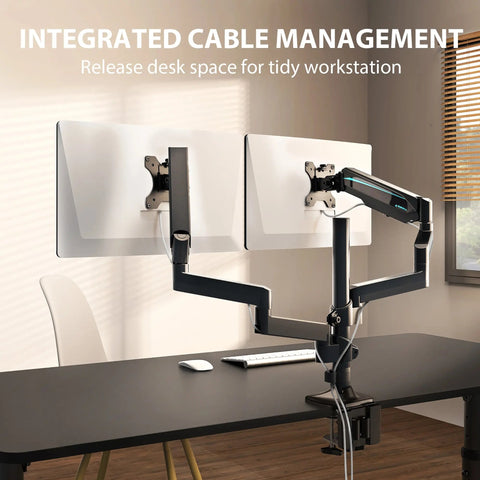
Integrated cable trays are non-negotiable in secure areas. For high-security environments, these trays should be lockable or require specialized tools to access. This prevents unauthorized tampering with hardware or the "piggybacking" of malicious devices onto network lines.
Material Safety and Indoor Air Quality
Institutional furniture must not compromise the health of the occupants. UL GREENGUARD Gold Certification is a critical benchmark, ensuring that chemical emissions (VOCs) are within safe limits for indoor air quality. Additionally, for wood-based components, FSC Certification ensures responsible sourcing, which is increasingly mandated by public sector environmental policies.
The Opal Executive Standing Desk (66"x29") integrates these needs by providing ample storage for sensitive documents within its dual cabinets, allowing for a "clean desk" transition between shifts.

Adapting for Hybrid Flexibility: Modular Strategies
The most significant challenge of the hybrid model is the volatility of office attendance. As noted by the Canadian HR Reporter, new presence rules in the public service often trigger workstation shortages.
To mitigate this, procurement should focus on modularity. Modular components, such as tool-less reconfigurable desk panels or add-on privacy screens, allow agencies to adapt spaces post-installation without initiating a new procurement cycle. This flexibility is explored further in the industry white paper The 2026 Workstation White Paper: Converging Ergonomic Science and Sustainable Engineering.
Storage Solutions for the Mobile Worker
In a hot-desking environment, employees lose their permanent "pedestal" storage. Providing mobile or centralized storage solutions, like the Ark EL, 29" Display File Storage Cabinet, Oak, allows users to secure their personal items and files while keeping the primary work surface clear for the next occupant.

Implementing the Sit-Stand Rhythm
Simply providing a height-adjustable desk is insufficient. Research from Cochrane (2018) shows that sit-stand desks significantly reduce sitting time (by ~84–116 minutes per day), but their effectiveness depends on proper usage.
The 20-8-2 Rule
Cornell University’s Ergonomics Web recommends a specific rhythm for maximum productivity and musculoskeletal health:
- 20 Minutes Sitting: Use a chair with dynamic lumbar support, such as the Flex, Dual-Backrests Ergonomic Office Chair.
- 8 Minutes Standing: Transition to a standing position to engage the lower limbs and improve circulation.
- 2 Minutes Moving: Stretch or walk to promote metabolic activity.
Setting the Neutral Position
According to OSHA eTools for Computer Workstations, the "Neutral Working Posture" is the primary goal. For a seated user:
- Monitor Height: The top of the screen should be at or slightly below eye level.
- Elbow Angle: 90 to 120 degrees, with wrists flat on the surface.
- Seat Height: Feet flat on the floor with thighs parallel to the ground.
The Flex chair is particularly effective in shared environments because its dual backrests move independently, adapting to the natural shape of different users without requiring complex manual adjustments.

Strategic Procurement Checklists
To ensure long-term value and compliance, procurement officers should utilize standardized checklists during the evaluation phase.
Safety and Compliance Checklist
- [ ] Does the chair meet ANSI/BIFMA X5.1 for durability and safety?
- [ ] Does the desk meet ANSI/BIFMA X5.5 for desk/table products?
- [ ] Is the unit UL 962 certified for electrical and mechanical safety (for electric desks)?
- [ ] Does the surface meet NEMA LD 3 chemical resistance standards?
- [ ] Is the product listed in the BIFMA Compliant® Registry?
Practical Implementation Tips
- Cable Tension: When installing height-adjustable desks, ensure power and data cables have enough "slack" to reach the maximum height without tension.
- Visual Parallax: Most users set their standing height too high. Encourage users to set the desk so their elbows remain at a ~100-degree angle to prevent shoulder shrugging.
- Floor Surface: In public buildings with hard flooring, consider providing anti-fatigue mats to accompany standing desks to reduce lower limb strain.
Summary of Institutional Adaptation
Adapting public sector workstations for the hybrid era requires a shift from "commodity furniture" to "performance infrastructure." By prioritizing ergonomic standards like BIFMA G1-2013 and safety certifications like UL 962, procurement officers can protect the health of their workforce while ensuring the longevity of public assets.
The integration of modular storage, secure cable management, and durable surfaces ensures that workstations remain functional and secure in the face of high-traffic, multi-user scenarios. Ultimately, the goal is to create a workspace that supports the "20-8-2" rhythm, fostering a culture of movement and productivity that aligns with modern health guidelines.
Disclaimer: This article is for informational purposes only and does not constitute professional medical, legal, or procurement advice. Ergonomic needs vary by individual; users with pre-existing musculoskeletal conditions should consult a qualified healthcare professional or ergonomic specialist before implementing new workstation routines.
References
- BIFMA G1-2013 Ergonomics Guideline
- ISO 9241-5:2024 Workstation layout & postural requirements
- OSHA eTools: Computer Workstations
- Cochrane: Workplace interventions for reducing sitting at work (2018)
- Cornell University Ergonomics Web — Workstation Guides
- WHO 2020 Guidelines on Physical Activity & Sedentary Behaviour
- UL GREENGUARD Certification




Leave a comment