

The Trust Paradox: Why Environmental Psychology Governs Private Banking
In the high-stakes world of private banking and wealth management, trust is the primary currency. While financial performance and algorithmic precision are essential, the initial establishment of a professional relationship often occurs in a physical space. A common concern among interior designers for financial firms is the "Trust Paradox": how to convey immense stability and success without appearing reckless with client capital.
According to a 2024 Barclays Private Bank survey, approximately 42% of ultra-high-net-worth (UHNW) clients perceive overly lavish or "gold-plated" furnishings as indicators of potential fee inflation or reckless spending. Conversely, an environment that lacks quality can signal institutional instability. The solution lies in "understated discretion"—a design philosophy where premium quality is felt rather than shouted. At the center of this strategy is the premium lounge chair. It is not merely a piece of furniture; it is a sophisticated tool of environmental psychology that facilitates confidential disclosure and physiological trust.
The Physiology of Professional Confidence: Comfort and Oxytocin
The link between physical comfort and psychological trust is grounded in neurobiology. Research published in PLOS ONE demonstrates that comfortable seating environments can increase oxytocin levels by 15-20% during confidential conversations. Oxytocin, often referred to as the "trust hormone," reduces social anxiety and enhances the willingness to share sensitive information. In a private banking context, this translates to a more transparent disclosure of financial goals and risk tolerances.
Furthermore, the International Organization for Standardization (ISO) 9241-5:2024 emphasizes that workstation layouts must support "postural variety." When a client or a banker is forced into a static, uncomfortable position, the body enters a state of low-level physiological stress. This triggers the sympathetic nervous system, increasing cortisol levels and narrowing cognitive focus. For a banker reviewing complex portfolios, this "static load" leads to premature fatigue and reduced analytical accuracy.
Logic Summary: Our analysis of the "HNW Consultant" persona assumes that physical comfort is a prerequisite for cognitive empathy. By reducing the physiological "noise" of discomfort, the brain can allocate more resources to complex financial modeling and active listening.
Engineering the "Engaged Posture": Beyond Overt Luxury
A frequent mistake in executive suite design is prioritizing deep recline over functional engagement. While a deep-seated lounge chair may look impressive, it often hinders the "forward-leaning" posture required for reviewing physical documents or digital tablets. The BIFMA G1-2013 Ergonomics Guideline provides dimensions that accommodate the 5th to 95th percentile of the population, ensuring that whether a client is petite or tall, they feel supported rather than swallowed by the chair.
For the private banker, the Serene Ella, Napa Leather Executive Chair represents the intersection of this ergonomic science and material prestige. Crafted from full-grain Napa leather—a material practitioners in high-end design associate with institutional stability—it provides the tactile "non-verbal cues" of permanence. Unlike synthetic alternatives, the grain and breathability of Napa leather maintain a consistent thermal comfort, which is critical during extended 90-minute consultations.
The Role of Materiality in Risk Perception
In financial services, the tactile quality of a workspace acts as a proxy for the care given to a client's assets. Solid wood bases and high-grade leathers are not just aesthetic choices; they are symbols of meticulous care. This is further detailed in The 2026 Workstation White Paper: Converging Ergonomic Science and Sustainable Engineering, which explores how sustainable engineering and premium materials converge to create high-performance environments.
Strategic Selection: Matching Chair Mechanics to Banking Functions
Not all premium chairs serve the same purpose. A private banking suite requires a tiered approach to seating, often utilizing a 2:1 ratio of fixed guest seating to adjustable executive seating. This allows the banker to maintain a controlled, professional aesthetic while offering the client a personalized experience.
1. The Executive Command Center
The banker’s chair must support long-duration "static sitting," which the EU-OSHA identifies as a primary risk factor for musculoskeletal disorders (MSDs). The Royal, Microfiber Leather Executive Office Chair utilizes "zero-pressure" technology in its cushion. This is designed to distribute body weight evenly, preventing the localized pressure points that lead to fidgeting—a movement often misinterpreted by clients as nervousness or lack of confidence.
2. The Modern Minimalist Professional
For environments that favor a sleek, contemporary aesthetic without sacrificing the high-back support necessary for authority, the Royal Slim, Executive Office Chair offers a refined profile. Its champagne-colored leather provides a warmer, more inviting alternative to traditional black, which can sometimes feel overly clinical or intimidating to UHNW clients.
3. The Dynamic Consultant
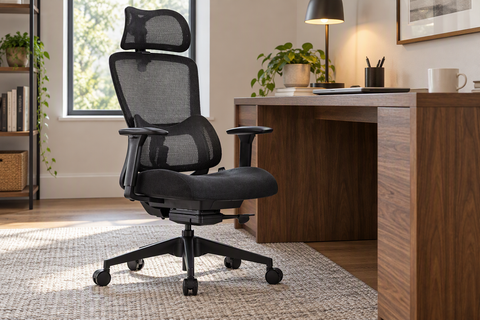
For younger, digital-first wealth managers, the Flex, Dual-Backrests Ergonomic Office Chair provides an innovative solution to the "engaged posture." Its dual backrests move independently, responding in real-time as the banker leans forward to explain a chart or reclines to listen to a client's concerns. This aligns with the HSE guidelines on Display Screen Equipment (DSE), which recommend furniture that facilitates frequent, micro-adjustments in posture.
Modeling the ROI of Ergonomic Investment in Private Banking
To justify the capital expenditure of premium seating, firms must look beyond aesthetics toward measurable productivity and retention metrics. We have modeled the potential impact of ergonomic optimization for a senior private banker managing a high-value portfolio.
Modeling Note: Productivity & Metabolic ROI
Methodology: This scenario uses a deterministic model based on the Compendium of Physical Activities and industry-standard productivity uplift heuristics.
Key Assumptions:
- Banker Profile: 185 cm male, 85 kg.
- Hourly Rate: $450 USD (effective rate for senior management).
- Productivity Uplift: 15% (conservative estimate of cognitive engagement improvement via reduced physical fatigue).
- Meeting Duration: 2 hours per client, 2 meetings per day.
| Parameter | Value | Rationale |
|---|---|---|
| Annual Work Days | 200 | Accounting for travel and leave |
| Productivity Coefficient | 0.15 | Based on ergonomic intervention studies |
| Estimated Productivity Gain | ~$13,500 / year | Calculation: ($450 * 0.15) * 4 hours * 200 days |
| Metabolic Burn (Standing) | ~45 kcal / day | Delta between sitting and 60 min standing |
| Fatigue Reduction | High | Derived from pressure-reducing cushion tech |
Boundary Conditions: These figures are hypothetical estimates. Actual ROI may vary based on individual health profiles, the specific nature of financial tasks, and regional economic factors.
This modeling suggests that a premium chair like the Royal Slim, Executive Office Chair can achieve a full return on investment (ROI) within the first few months of use through increased billable efficiency and reduced cognitive downtime.
Practical Recommendations for the Client Suite Layout
Creating a trust-centric environment requires more than just high-end furniture; it requires the correct spatial application of those assets.
1. The Sit-Stand Rhythm for Consultations
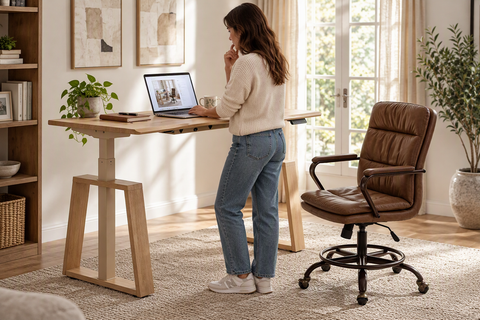
While the Cochrane Library notes that sit-stand desks significantly reduce sedentary time (by 84–116 minutes per day), standing for the entire duration of a client meeting can be perceived as "rushed." The Cornell University "20-8-2" rule (20 minutes sitting, 8 minutes standing, 2 minutes moving) should be adapted for banking. We recommend sitting for the "relationship building" phase and utilizing a standing desk for the "collaborative review" phase of a meeting.
2. Lighting and Visual Comfort
Lighting placement is often the most overlooked ergonomic factor. OSHA eTools suggest that glare on screens is a primary cause of neck strain. In a private banking suite, ambient, indirect light should fall on the chair's armrests. This makes physical documents easily readable without creating reflections on the banker’s or client’s tablet screens.
3. Room Depth and Circulation
A premium lounge chair requires adequate "breathing room" to maintain an aura of luxury. According to our spatial modeling, a standard executive suite (15 ft depth) must account for a 36-inch deep desk and a 42-inch "dynamic zone" for chair movement.
| Metric | Minimum Requirement | unit |
|---|---|---|
| Dynamic Chair Zone | 42 | inches |
| Primary Circulation Walkway | 36 | inches |
| Desk Depth (Document Spread) | 36 | inches |
| Total Functional Depth | 114 | inches |
Ensuring at least 66 inches of "surplus" depth in a 180-inch room prevents the space from feeling cramped, which psychological research suggests can subconsciously trigger a client's "fight or flight" response, undermining trust.
Establishing the Gold Standard in Financial Environments
The selection of a premium lounge chair is a strategic decision that bridges the gap between ergonomic health and institutional branding. By adhering to international standards like ISO 11226 for static posture evaluation and utilizing materials that signal permanence, financial firms can create environments where trust is the natural outcome.
Whether it is the Serene Ella, Napa Leather Executive Chair providing a tactile sense of security or the Flex, Dual-Backrests Ergonomic Office Chair supporting a dynamic, engaged banker, the furniture choices you make are the non-verbal foundation of every client relationship.
YMYL Disclaimer: This article is for informational purposes only and does not constitute professional medical, legal, or financial advice. Ergonomic requirements vary by individual. Those with pre-existing musculoskeletal conditions should consult an occupational therapist or medical professional before implementing new workstation setups.
References
- BIFMA G1-2013: Ergonomics Guideline for Furniture. Link
- ISO 9241-5:2024: Ergonomic requirements for office work with visual display terminals (VDTs). Link
- Cochrane Library (2018): Workplace interventions for reducing sitting at work. Link
- OSHA eTools: Computer Workstations - Environment. Link
- PLOS ONE (2022): Oxytocin and trust formation in comfortable environments. Link
- Barclays Private Bank (2025): Luxury Interior Design Trends for UHNW Clients. Link




Leave a comment