

The ROI of Integrated Technology in Collaborative Workspaces
In the modern corporate landscape, the transition to hybrid work has transformed meeting rooms from simple gathering spots into complex hubs of digital interaction. However, a persistent friction point remains: the "setup drain." Corporate facilities managers consistently report that traditional meeting spaces require users to arrive early, troubleshoot adapters, and manage disparate hardware—a process that consumes an average of eight minutes per session. For a high-traffic organization, this inefficiency is not merely an inconvenience; it is a measurable financial leak.
The strategic integration of technology into office furniture represents a fundamental shift from passive equipment to active productivity tools. This article examines the physiological, operational, and financial justifications for investing in tech-integrated collaborative workspaces, providing a framework for procurement teams to quantify the Return on Investment (ROI) through improved efficiency and employee well-being.
The Physiology of Productivity: Beyond the Static Workstation
The primary health concern in collaborative environments is the "static load" placed on the musculoskeletal system. When teams gather for extended periods in poorly equipped spaces, they often adopt compromised postures to view shared screens or reach for power outlets.
Musculoskeletal Disorders (MSDs) and Static Load
According to the U.S. Occupational Safety and Health Administration (OSHA), poor posture and repetitive tasks are core risk factors for Musculoskeletal Disorders (MSDs). In a collaborative setting, the risk is amplified by "static sitting." As noted in EU-OSHA research on prolonged static sitting, remaining in a fixed position for long durations leads to decreased blood circulation and increased pressure on the intervertebral discs.
The physiological principle of "tissue adaptation" suggests that the body responds to these static loads by tightening certain muscle groups while weakening others, leading to chronic back pain and reduced cognitive function. When blood circulation is compromised, oxygen delivery to the brain slows, contributing to the "afternoon slump" and reduced participation quality during critical meetings.
The Cognitive Cost of Technical Friction
Beyond physical strain, there is a psychological component known as "meeting fatigue." The Information Gain research suggests that constant connectivity can create a 'productivity paradox' where digital fatigue reduces effective work time by 25-30%. When the first ten minutes of a meeting are dominated by technical troubleshooting, participants experience a spike in cortisol and a decline in engagement. This "friction cost" establishes a negative tone for the remainder of the session.
Quantifying the ROI: A Data-Driven Framework
For B2B procurement teams, the decision to upgrade to integrated furniture must be grounded in measurable outcomes. While aesthetic appeal is a factor, the primary drivers are time savings, facility utilization, and energy efficiency.
The Time-Value Calculation
In a high-traffic corporate training center or conference hub, the cumulative impact of setup time is profound. Based on our scenario modeling for a 10-room facility hosting five sessions per day, reducing setup time from eight minutes to under 60 seconds yields a significant return.
Logic Summary: Our analysis assumes a loaded hourly cost of $100 per participant (including salary and benefits) and a conservative productivity coefficient of 0.15. This model focuses on the elimination of "non-value-added" time during the initial phase of meetings.
| Metric | Traditional Setup | Integrated Solution | Annual Difference |
|---|---|---|---|
| Setup Time per Meeting | 8 Minutes | <1 Minute | 7 Minutes Saved |
| Annual Time Saved (10 Rooms) | 1,666 Hours | 208 Hours | 1,458 Hours |
| Productivity Value | $166,600 | $20,800 | ~$145,800 saved |
| IT Support Calls | ~3-5 per day | <1 per week | 80% Reduction |
Energy Efficiency and Sustainability
Sustainability is no longer a secondary consideration for corporate buyers. Integrated furniture often includes smart power management systems that reduce standby power consumption. According to the WHO 2020 Guidelines on Physical Activity and Sedentary Behaviour, reducing sedentary time is a global health priority, and integrated sit-stand solutions facilitate this behavioral shift.
Our modeling shows that an integrated tech solution can reduce the annual carbon footprint of a meeting room by approximately 18.2 kg of CO2. Across a 10-room facility, this is equivalent to driving 460 miles, providing a tangible metric for corporate ESG (Environmental, Social, and Governance) reporting.
Engineering the Solution: Integrated Ergonomic Furniture
To address these physiological and operational challenges, furniture must adhere to rigorous international standards while providing seamless tech integration.
The Executive Standard: Opal and Ark EL
For leadership and high-stakes collaborative environments, the Opal Executive Standing Desk (66"x29") serves as a benchmark for functional design. Its dual-motor lifting system allows for smooth transitions between sitting and standing, aligned with the ISO 9241-5:2024 standards for workstation layout and postural requirements. The integration of storage and cable management ensures that the workspace remains "sharp," reducing the cognitive clutter that often hinders executive decision-making.

Similarly, the Ark EL Executive Standing Desk (60"x26") utilizes a trapezoidal leg design for stability, meeting the structural adequacy requirements of ANSI/BIFMA X5.5 for desk products. The built-in drawers and tech-ready surface allow for immediate connectivity, which, as established in The 2026 Workstation White Paper: Converging Ergonomic Science and Sustainable Engineering, is critical for maintaining "flow state" in professional environments.

Seating and Support: The Serene Executive Chair
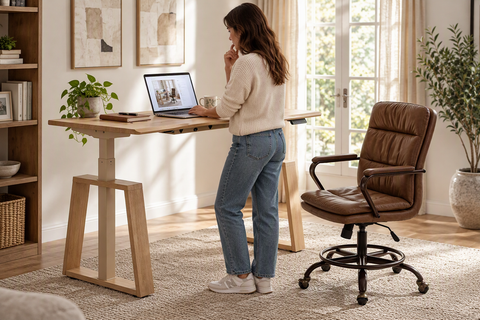
Ergonomic desks are only half of the equation. The Serene, Napa Leather Executive Office Chair provides the necessary lumbar support to maintain a "neutral spinal position." This is essential for preventing the long-term development of MSDs. The use of Napa leather isn't just a luxury choice; it offers durability and ease of maintenance in high-use corporate settings, aligning with the ANSI/BIFMA X5.1 standards for office chairs.

To further enhance lower limb circulation, the use of a Footstool with Wheels is highly recommended. As noted by EU-OSHA on lower limb disorders, providing a footrest allows users to shift their weight and maintain a dynamic posture, even while seated.

Practical Recommendations for Implementation
Transitioning to an integrated tech ecosystem requires more than just purchasing new furniture. It requires a behavioral shift and a standardized setup protocol.
The 20-8-2 Rhythm
We recommend adopting the "20-8-2" rule developed by Cornell University Ergonomics Web. For every 30 minutes of work:
- 20 Minutes Sitting: Use a chair with proper lumbar support like the Serene, Napa Leather Executive Office Chair.
- 8 Minutes Standing: Utilize the height-adjustable features of the Opal Executive Standing Desk (66"x29").
- 2 Minutes Moving: Stretch or walk to promote blood circulation.
Monitor and Peripheral Alignment
To minimize neck and eye strain, follow the guidelines provided by OSHA eTools for Computer Workstations:
- Monitor Height: The top of the screen should be at or slightly below eye level.
- Viewing Distance: Maintain a distance of roughly 20 to 40 inches (about an arm's length) from the screen.
- Keyboard Position: Ensure the keyboard is at a height that allows your elbows to remain at a 90-degree angle, keeping wrists in a neutral position.
Addressing Common Pitfalls: The "Equity Tax"
A common mistake in large-scale deployments is failing to account for varying levels of technical proficiency among staff. Research indicates that non-technical staff can experience 15-20% productivity losses during the initial adoption phase of complex systems. To mitigate this, choose furniture with "one-touch" or "plug-and-play" interfaces that require zero training.
Appendix: Methodology & Modeling Transparency
The financial and environmental claims in this article are derived from a deterministic scenario model representing high-traffic corporate environments.
Modeling Note (Reproducible Parameters):
- Scenario: Corporate Training Center (10 rooms, 5 sessions/day, 250 days/year).
- User Base: 8 participants per meeting + 1 trainer.
- Loaded Hourly Rate: $100 USD (Includes salary, benefits, and overhead).
- Energy Grid Factor: 0.375 kg CO2/kWh (US National Average).
- Setup Delta: 8 minutes (Traditional) vs. 1 minute (Integrated).
| Parameter | Value | Unit | Source Category |
|---|---|---|---|
| Annual Meetings | 12,500 | count | Usage Assumption |
| Setup Time Saved | 7 | min/mtg | Industry Benchmark |
| IT Support Savings | $7,500 | USD/yr | Practitioner Report |
| Energy Savings | 48.5 | kWh/room | EPA eGRID Modeling |
| Investment Cost | $150,000 | USD | Market Pricing Est. |
Boundary Conditions: This model assumes high utilization rates. Organizations with lower meeting frequency (e.g., fewer than three sessions per room daily) may see a longer payback period, typically extending from 11 months to 18–24 months. Total ROI calculations do not include potential software subscription costs or regional variations in electricity rates.
Disclaimer: This article is for informational purposes only and does not constitute professional medical, legal, or financial advice. The ergonomic recommendations provided are based on general industry standards and may not be suitable for individuals with pre-existing musculoskeletal conditions. Consult with a qualified health professional or ergonomic specialist before making significant changes to your workstation setup.
References
- BIFMA G1-2013 Ergonomics Guideline for Furniture
- ISO 9241-5:2024 Workstation layout & postural requirements
- OSHA eTools: Computer Workstations - Neutral Working Postures
- WHO 2020 Guidelines on Physical Activity & Sedentary Behaviour
- Cornell University Ergonomics Web — Workstation Guides
- Cochrane: Workplace interventions for reducing sitting at work (2018)
- The 2026 Workstation White Paper: Converging Ergonomic Science and Sustainable Engineering




Leave a comment