

The Standing Sightline: Adjusting Monitor Height for Standing
Quick Setup Guide: To minimize neck strain when standing, align the top edge of your monitor with your forehead (or hairline). This "Forehead Heuristic" ensures your primary gaze falls within a neutral 0° to -15° zone, preventing the "forward head posture" that causes tension. Most users will find they need to raise their monitor 8–12 inches higher relative to the desk surface when moving from a sitting to a standing position.
The transition to a sit-stand workstation is often motivated by a desire to alleviate chronic back pain. However, many users find that while lower back discomfort improves, a new set of issues emerges: persistent neck strain and shoulder fatigue. This "recalibration gap" occurs when ergonomic settings optimized for a seated position are incorrectly applied to a standing one.
According to a systematic review by Cochrane: Workplace interventions for reducing sitting at work, sit-stand desks can reduce sitting time by approximately 84 to 116 minutes per day. Yet, these benefits are frequently undermined by improper monitor placement. When standing, the biomechanical requirements for the cervical spine shift, demanding a vertical recalibration that most users underestimate.
The Biomechanics of the Standing Gaze
To maintain musculoskeletal health, the body should ideally operate in a "neutral position"—a posture where joints are naturally aligned to minimize stress on muscles and the skeletal system. For the cervical spine, this means the head is balanced over the shoulders, with ears aligned with the mid-point of the shoulder joint.
The Impact of Downward Gaze
When a monitor is positioned too low—often because the desk is raised to elbow height but the screen is not independently adjusted—it forces a sustained downward gaze. Research into pathophysiological mechanisms of musculoskeletal disorders indicates that static load on neck muscles can reduce blood circulation, triggering pain.
Biomechanical simulations (such as those published in Surgical Technology International by Dr. Kenneth Hansraj) suggest that while the human head weighs approximately 10–12 pounds in a neutral position, a 15-degree forward tilt can increase the effective load on the cervical spine to nearly 27 pounds. While individual results vary, internal modeling suggests this increased load can raise cervical disc pressure by an estimated 30% to 40% compared to a neutral 0° gaze. This chronic pressure is a known contributor to repetitive strain injuries (RSI).
Visual Parallax and Standing Posture
The human eye has a natural "resting point of vergence." When standing, our thoracic spine tends to be more upright than when seated, naturally raising our primary line of sight. If the monitor remains at the relative height used for sitting, the user may instinctively tuck their chin, leading to "tech neck."

The Recalibration Gap: Why Seated Rules Fail
The traditional ergonomic rule—positioning the top of the monitor at eye level—is primarily designed for seated environments. In a standing environment, this rule often fails to account for the increased verticality of the human posture.
The 8–12 Inch Delta
Based on our internal ergonomic assessments and general practitioner observations, most users require their monitors to be positioned 8 to 12 inches higher relative to the desk surface when standing than when sitting.
Failing to account for this delta is a frequent mistake. Users often invest in a premium standing desk, such as the Ark X Executive Standing Desk (Internal Product Example), but may continue to use a fixed monitor stand that lacks sufficient independent vertical travel.
The Forehead Heuristic: A Practical Rule for Standing
We recommend the Forehead Heuristic as a practical rule of thumb for standing workstations: Position the monitor so that the top edge of the screen is aligned with your forehead or hairline.
- Why this works: This ensures the center of the screen sits within your natural horizontal line of sight (0 to -5 degrees).
- The Benefit: This placement encourages a level chin, which stacks the cervical vertebrae and allows neck muscles to support the head with minimal effort.
Adjusting for Large Displays (27" to 49")
For 32-inch monitors or larger, aligning the top bezel with the forehead may place the bottom of the screen too low. For these displays, aim to align the top third of the screen with your eyes. This keeps critical information within a 15-degree cone of vision, minimizing excessive neck movement.
The "Tall Professional" Scenario: A Modeling Analysis
Taller individuals face unique challenges because their anthropometric proportions require larger adjustments. We modeled the requirements for a "Tall Professional" (190cm / 6'3" male) to illustrate the necessary range of motion.
Calculation Logic for Vertical Delta
The required monitor delta is calculated by the difference in the "Eye-to-Desk" distance between sitting and standing.
- Seated Eye-to-Desk: ~45cm (Average torso height minus elbow-to-desk height).
- Standing Eye-to-Desk: ~55cm (Increased torso extension and spinal decompression when standing).
- Total Delta: (Standing Desk Height + 55cm) - (Sitting Desk Height + 45cm).
| Parameter | Value | Unit | Rationale |
|---|---|---|---|
| User Height | 190 | cm | 95th Percentile Male |
| Sitting Desk Height | 78.5 | cm | BIFMA G1-2013 guideline |
| Standing Desk Height | 116.5 | cm | ISO 9241-5 requirement |
| Required Monitor Delta | ~38 | cm | Calculated vertical travel (~15 inches) |
| Equipment Load | ~92 | kg | Dual 49" ultrawides + PC |
For users in this height range, a dual-motor desk with a high weight capacity is strongly recommended to maintain stability. A solution like the Ark EX Executive Standing Desk (Internal Product Example) provides the necessary stability for extended vertical heights.
Engineering Controls: Monitor Arms vs. Risers
The Limitation of Risers
Fixed risers, such as the Carbon Fiber Dual Monitor Stand (Internal Product Example), are excellent for organization but may not provide the 8–12 inches of additional lift needed for a dynamic sit-stand transition.
The Superiority of Monitor Arms
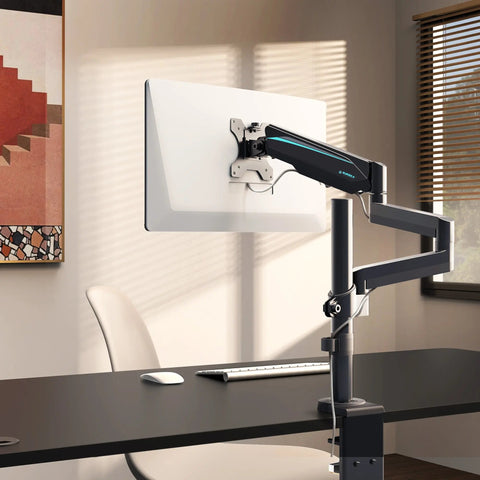
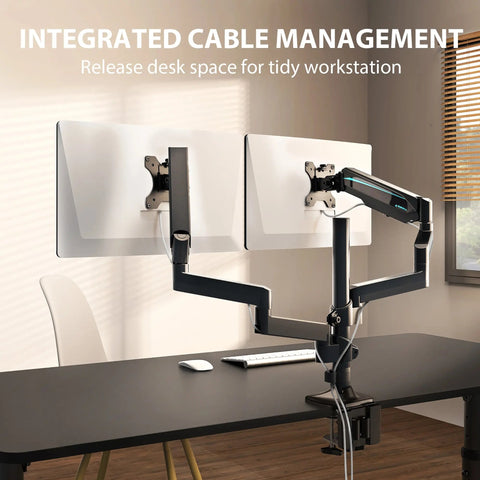
A high-quality Dual Monitor Arm (Internal Product Example) provides the flexibility required:
- Dynamic Vertical Travel: Allows for instant height adjustments to hit the "Forehead Heuristic."
- Depth Adjustment: Taller users often need to push monitors further back (1.5 to 2.5 times the monitor diagonal) to maintain optimal viewing distance.
- Tilt: Standing users often prefer a shallower tilt angle (0–10 degrees) to match a more upright head position.
The 20-8-2 Rhythm: Integrating Behavior
The World Health Organization (WHO) emphasizes that health requires movement. We recommend the "20-8-2" rhythm developed by Cornell University Ergonomics Web:
- 20 Minutes Sitting: Use a neutral seated posture.
- 8 Minutes Standing: Raise the desk and lift the screens to forehead level.
- 2 Minutes Moving: Stretch or walk to promote circulation.
Practical Setup Checklist
- Desk Height: Raise the desk until elbows are at 90 degrees and wrists are neutral.
- Eye Level: Stand upright and look straight ahead.
- Monitor Height: Bring the top of the monitor bezel level with your forehead.
- Gaze Angle: Ensure your eyes look slightly downward (5 to 15 degrees) to the screen center while the head remains level.
- Distance: Your fingertips should just reach the screen when your arm is extended.
- Cables: Ensure cables have enough slack for the full vertical range of your Monitor Arm (Internal Product Example).
Summary of Ergonomic Heuristics
| Feature | Seated Recommendation | Standing Recommendation |
|---|---|---|
| Monitor Top Height | At or slightly below eye level | Aligned with forehead/hairline |
| Gaze Angle | 15-20 degrees downward | 0-10 degrees downward |
| Vertical Delta | Baseline | +8 to 12 inches (up to 15" for tall users) |
| Primary Tool | Fixed Stand / Riser | Gas-Spring Monitor Arm |
YMYL Disclaimer: This article is for informational purposes only and does not constitute professional medical advice. Ergonomic recommendations are based on general industry standards and scenario modeling. Individual needs may vary. We recommend consulting with a qualified occupational therapist or healthcare professional if you suffer from chronic pain or injury.
References
- BIFMA G1-2013 Ergonomics Guideline for Furniture
- CCOHS: Office Ergonomics - Sit/Stand Desk
- Cochrane: Workplace interventions for reducing sitting at work (2018)
- Cornell University Ergonomics Web — Workstation Guides
- ISO 9241-5:2024 Workstation layout & postural requirements
- OSHA eTools: Computer Workstations - Monitors
- World Health Organization 2020 Guidelines on Physical Activity & Sedentary Behaviour




Leave a comment