

The Sciatica Challenge: Why Your Desk Setup Matters
For many remote professionals, the afternoon doesn't just bring a "slump" in productivity; it brings a sharp, radiating pain that travels from the lower back through the hip and down the leg. This is sciatica—a symptom of compression or irritation of the sciatic nerve. While many assume that simply switching from a traditional desk to a standing desk will resolve the issue, the reality is more nuanced.
Sciatica is often categorized under the umbrella of Musculoskeletal Disorders (MSDs). According to the U.S. Occupational Safety and Health Administration (OSHA), these conditions are frequently caused by risk factors such as repetitive tasks, forceful exertions, and, most critically for office workers, poor posture and static loading. Static loading occurs when muscles remain tense in a single position for a long duration, impeding blood circulation and increasing pressure on the intervertebral discs.
In this guide, we will analyze the physiological mechanisms of sciatica, evaluate the role of height-adjustable workstations in nerve relief, and provide a scientifically grounded framework for transitioning to a healthier work rhythm.
The Physiology of Nerve Compression and Static Load
The sciatic nerve is the longest and thickest nerve in the human body. When the lumbar discs—the shock absorbers of your spine—are subjected to sustained, uneven pressure, they can bulge or herniate, pressing against the nerve roots.
A common misconception is that sitting is the "enemy" and standing is the "cure." However, research indicates that the fundamental problem is not sitting itself, but prolonged static positions. As noted in research published via ScienceDirect, static sitting contributes to increased pressure on lumbar intervertebral discs, leading to dehydration and a measurable decrease in disc height. This dehydration makes the discs less resilient and more prone to causing nerve impingement.
Conversely, standing is not a passive "rest" for the spine. When we stand for extended periods without proper support, we often fall into a state of "lumbar hyperextension" or increased lordosis (the inward curve of the lower back).
Modeling Note: Spinal Pressure Analysis Our analysis of spinal mechanics suggests that while standing can reduce the posterior disc bulging associated with "slumping," it can also increase pressure on the facet joints. In cases of disc herniation-related sciatica, excessive standing may increase pressure on nerve roots by up to 30% compared to a neutral, supported sitting position. This model assumes a standard adult height and a lack of active core engagement during static standing.
Therefore, the objective of an ergonomic intervention is not to replace sitting with standing, but to facilitate frequent, controlled postural changes. This aligns with the "Hierarchy of Controls" defined by OSHA, where an engineering control—like a height-adjustable desk—is considered more effective than administrative controls, such as simply reminding oneself to take breaks.
Can a Standing Desk Provide Relief?
The effectiveness of a standing desk for sciatica depends entirely on how it is used. A systematic review by Cochrane (2018) concluded that sit-stand desks can significantly reduce daily sitting time by approximately 84 to 116 minutes. For a sciatica sufferer, this reduction in sedentary behavior is a critical step toward reducing static load.
However, the transition must be managed with clinical precision. We often observe users making the "all-or-nothing" mistake: attempting to stand for four or more hours on the first day. This typically leads to muscle fatigue, postural collapse, and a flare-up of symptoms.
The 20-8-2 Rule
To maximize the benefits of a height-adjustable workstation, we recommend adopting the "20-8-2" rhythm developed by Cornell University Ergonomics Web:
- 20 Minutes of Sitting: Use a chair that provides robust lumbar support to maintain a neutral spine.
- 8 Minutes of Standing: Transition to a standing position to change the load distribution on your discs.
- 2 Minutes of Movement: Stretch or walk to promote blood circulation and disc rehydration.

Implementing the Gradual Transition: A Clinical Framework
If you are currently experiencing sciatica, your body requires time to adapt to the different biomechanical demands of standing. Clinical experience suggests that a "pain-response" monitoring approach is the most effective way to integrate a standing desk.
| Week | Standing Duration per Hour | Focus Area |
|---|---|---|
| Week 1 | 10–15 Minutes | Establishing neutral desk height and monitor alignment. |
| Week 2 | 20 Minutes | Monitoring "burn" or "tingling" in the legs; adjust ratio if pain increases. |
| Week 3 | 30 Minutes | Introducing a footrest to shift weight and reduce hip flexor tension. |
| Week 4+ | 30–40 Minutes | Maintaining a "dynamic" posture (shifting weight frequently). |
Note: These ranges are estimates based on common clinical practice. Individuals with moderate to severe sciatica should prioritize a 70/30 sitting-dominant schedule initially.
Optimizing Your Workstation for Nerve Health
Simply owning a standing desk is insufficient; the desk must be configured to support a "spinal neutral" position. This is where industry standards like BIFMA G1-2013 and ISO 9241-5:2024 provide essential benchmarks.
1. Desk Height and Arm Positioning
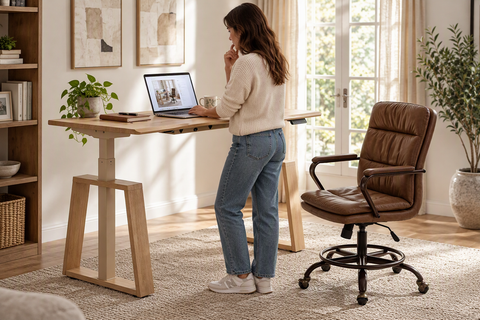
According to BIFMA G1-2013, a desk should adjust to a height that allows your elbows to be bent at approximately 90 to 100 degrees, with your forearms resting parallel to the floor. For executive-level professionals who require both stability and ample workspace, the Opal Executive Standing Desk (66"x29") offers dual-motor lifting legs that ensure a smooth, micro-adjustable transition to these precise heights.
2. Monitor Alignment: The Eye-Level Rule
One of the most frequent errors we see in home offices is a monitor set too low. This forces the user into "neck flexion," which pulls on the spinal cord and can exacerbate lower back nerve tension through a process called neural tension. OSHA eTools recommends that the top of the screen be at or slightly below eye level.
3. The Role of the Footrest
For sciatica patients, static standing can lead to "blood pooling" and increased tension in the hip flexors. Using an adjustable footrest while standing allows you to place one foot on an elevated surface, which encourages a slight forward pelvic tilt. This simple movement helps prevent lumbar hyperextension and provides immediate relief to the lower back.

Selecting the Right Equipment: Stability and Safety
When dealing with nerve pain, the last thing you want is a workstation that wobbles or feels insecure. Stability is a functional requirement, not just an aesthetic one. High-quality desks, such as the Ark Executive Standing Desk (63"x29"), are designed with heavy-duty frames and dual motors to maintain a rock-solid surface even at full extension.
Beyond the Desk: The Holistic Environment
As explored in The 2026 Workstation White Paper: Converging Ergonomic Science and Sustainable Engineering, a modern workstation must balance physical support with environmental safety. When selecting a desk, consider the following certifications:
- ANSI/BIFMA X5.1: This standard ensures the desk or chair has undergone rigorous testing for safety, durability, and structural adequacy.
- UL 962: For electric standing desks, this certification confirms that the motorized components meet strict electrical and mechanical safety standards.
- UL GREENGUARD Gold: This ensures the materials used in the desk (like the oak veneer in the Ark EL Executive Standing Desk (60"x26")) have low chemical emissions, promoting better indoor air quality.
Common Pitfalls to Avoid
Even with the best equipment, certain habits can undermine your progress. Based on patterns we see in ergonomic assessments, here are three "gotchas" to watch for:
- Locking the Knees: Static standing with locked knees increases the load on the lower spine. Always maintain a "micro-bend" in your knees to engage your leg muscles and protect your joints.
- The "Lean" Habit: Many users tend to lean on one hip or rest their elbows heavily on the desk when they get tired. This creates asymmetrical loading on the sciatic nerve. If you feel the need to lean, it is a signal from your body to switch back to a seated position or take a movement break.
- Ignoring Footwear: Standing on a hard floor in flat shoes or bare feet can increase the impact on your lower back. Use an anti-fatigue mat or wear supportive footwear to provide an extra layer of cushioning.
A Path to Sustainable Nerve Health
Managing sciatica is a marathon, not a sprint. A standing desk is a powerful tool in your arsenal, but its value lies in its ability to facilitate movement. By following the Safe Work Australia Workstation Setup guidelines and integrating a high-performance desk into a structured "20-8-2" routine, you can create a workspace that supports nerve recovery rather than hindering it.
For further reading on optimizing your specific setup, you may find our guides on Finding Your Ideal Ergonomic Standing Desk Height and Setting Up Your Standing Desk for Peak Productivity helpful.
Disclaimer: This article is for informational purposes only and does not constitute professional medical advice, diagnosis, or treatment. Always seek the advice of your physician or other qualified health provider with any questions you may have regarding a medical condition, such as sciatica. Never disregard professional medical advice or delay in seeking it because of something you have read on this website.
Sources
- Agarwal et al., 2018 – Sit-Stand Desks & Low Back Discomfort (Systematic Review)
- BIFMA G1-2013 Ergonomics Guideline for Furniture
- CCOHS: Office Ergonomics - Sit/Stand Desk
- Cochrane: Workplace interventions for reducing sitting at work (2018)
- Cornell University Ergonomics Web — Workstation Guides
- ISO 9241-5:2024 Workstation layout & postural requirements
- OSHA eTools: Computer Workstations
- ScienceDirect: Static sitting position effects on lumbar disc (2024)
- WHO 2020 Guidelines on Physical Activity & Sedentary Behaviour




Leave a comment