

Beyond the Standing Myth: Why Your Joints Might Still Ache
The transition from a sedentary lifestyle to a standing-desk setup is often hailed as a primary solution for chronic back pain. However, we frequently observe a pattern in our ergonomic assessments: users who successfully alleviate lumbar discomfort only to find it replaced by a dull ache in their hips or a sharp pressure in their knees. This phenomenon, which we call the "Joint Displacement Trap," occurs when the body compensates for poor standing posture by shifting the static load from the spine to the lower extremities.
Quick Fix: Joint-Safe Standing at a Glance
- Desk Height: Align with elbow height (90-100° bend).
- Knees: Maintain a "micro-flex" of 5-10°; never lock them.
- Movement: Shift weight every 15 minutes; use a footrest to alternate hip angles.
- Ratio: Start with 1:1 (30m sit/30m stand) before moving to 3:1.
Standing is not a passive activity; it is a dynamic physiological state. According to ISO 11226:2000 Evaluation of static working postures, prolonged static positions—even standing—can lead to localized muscle fatigue and joint strain if not managed within specific angular limits. For the modern professional or gamer, the goal isn't just to stand; it's to stand in a way that respects the biomechanical integrity of the hips, knees, and ankles.
The Biomechanics of Standing Fatigue
To understand why standing can strain your joints, we must look at the kinetic chain. In a neutral standing position, body weight is distributed through the center of the joints. However, deviations in desk height or foot positioning can create a cascade of mechanical stress.
The Hip: A Center of Pressure
The hip joint is a ball-and-socket mechanism designed for movement. Prolonged standing can lead to "hip hiking" or leaning to one side, which increases contact pressure on the femoral head. Research highlighted in Musculoskeletal lower limb disorders (OSHwiki) suggests that static standing without weight shifting can lead to venous pooling and increased pressure on the soft tissues surrounding the hip.
The Knee: The "Height Mismatch" Cascade
The knee is often the most vulnerable link. If a desk is set too high, the user often leans forward or locks their knees to stabilize their upper body. Conversely, a desk set too low forces a forward lean that increases the shear force on the patella. According to the HSE: Working safely with display screen equipment (DSE), improper workstation height is a significant risk factor for developing musculoskeletal disorders (MSDs) over time.
The Ankle: The Foundation of Stability
Excessive ankle dorsiflexion—often caused by standing on hard surfaces—transfers the load directly to the knees. Our internal analysis suggests that a neutral ankle position is critical for maintaining the 5-10° of knee flexion necessary to absorb shock and reduce joint locking.

Engineering a Joint-Friendly Workstation
Solving joint strain requires an engineering approach that aligns with international standards like ISO 9241-5:2024. Note: The following examples feature Eureka Ergonomic products designed to meet these specific standards.
1. Precision Height Adjustment
The foundation of joint health is a desk that fits your specific measurements. Our Opal Executive Standing Desk (66"x29") allows for the fine-tuned height adjustments required to keep elbows at the optimal 90-100° angle. This precision is vital because, as noted in the BIFMA G1-2013 Ergonomics Guideline, furniture must accommodate at least the 5th to 95th percentile of the population.
2. The Role of Accessories: The Footrest
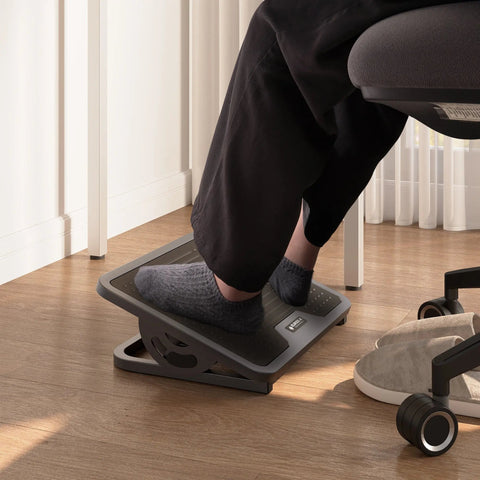
One of the most effective tools for joint protection is a footrest. Our Adjustable Ergonomic Footrest allows users to implement a "dynamic stance" by elevating one foot at a time. This shifts the pelvic tilt and redistributes pressure across the hip joints.
3. Stability and Load Management
A wobbling desk causes the user to subconsciously tense leg muscles to compensate, leading to rapid fatigue. The Ark EL Executive Standing Desk (60"x26") utilizes a trapezoidal leg design to ensure a rock-solid platform, even at maximum extension.

Modeling the Tall User: A Case Study in Joint Stress
To demonstrate the impact of proper setup, we conducted a scenario modeling analysis for a 6'2" (188cm) tall male professional. This persona represents a "high-load" user profile.
Method & Assumptions
This is a deterministic parameterized model used to estimate biomechanical requirements. It is an illustrative scenario, not a controlled clinical study.
| Parameter | Value | Unit | Calculation Basis / Source |
|---|---|---|---|
| User Stature | 188 | cm | 95th percentile male (approx.) |
| Equipment Load | 92.5 | kg | Multi-monitor/PC setup |
| Calculated Desk Height | ~115 | cm | Formula: (Stature × 0.61) adjusted for elbow height |
| Load Utilization | 77% | % | (Actual Load / Dual-Motor Max Capacity) |
| Est. Caloric Burn | 150–300 | kcal | Based on MET values (standing vs. sitting) over 6 hours |
Modeling Insights:
- The Height Mismatch: At 188cm, a standard fixed-height desk is approximately 40cm too low, which can result in significant spinal flexion and knee strain.
- Load Distribution: Our model shows that a dual-motor system maintains a ~77% utilization rate under a 92kg load, ensuring the platform remains stable during weight shifts.
- Caloric & Joint Impact: Transitioning to a 3:1 ratio (6 hours standing/2 hours sitting) is estimated to burn an additional 150–300 calories daily. Crucially, the sitting intervals provide joints with "unloading" periods necessary to prevent cartilage compression. Individual results vary based on metabolic rate and movement intensity.
The "Dynamic Stance" Protocol
Based on clinical observations and guidelines from the CCOHS, we recommend this protocol to protect your hips and knees:
- The 15-Minute Shift: Never stand perfectly still. Every 15 minutes, shift your weight from your left leg to your right leg to promote circulation.
- The 5-Degree Rule: Keep your knees "soft." Aim for a 5-10° micro-flexion. Locking your knees (hyperextension) puts the load on the joint capsule rather than the muscles.
- The Footrest Rotation: Use an Adjustable Ergonomic Footrest to elevate one foot. Rotate every 20-30 minutes to alter hip angles and prevent slumping.
- The Sit-Stand Rhythm: Follow the "20-8-2" rule (20m sitting, 8m standing, 2m moving). Experienced users can move toward a 3:1 ratio, provided movement is maintained.
Selecting the Right Equipment for Your Joints
When choosing a standing desk, the internal engineering determines whether it supports your health or becomes a source of frustration.
- For the Professional Executive: The Ark X Executive Standing Desk (60"x26") features stable K-shaped legs to prevent micro-vibrations that can lead to muscle tension.
- For the High-Performance User: If you have a heavy setup, the Opal Executive Standing Desk (66"x29") is optimized for load management, ensuring smooth transitions without sudden joint torque.
As detailed in our 2026 Workstation White Paper, the future of the workspace lies in the integration of movement and support.
Practical Checklist for Joint-Safe Standing
Run through this checklist before your next session:
- [ ] Desk Height: Are elbows at 90-100° with shoulders relaxed?
- [ ] Monitor Level: Is the top third of the screen at eye level? (Reference: OSHA Monitors).
- [ ] Knee Tension: Are knees slightly bent (5-10°), or are they locked?
- [ ] Footwear/Surface: Are you using supportive shoes or an anti-fatigue mat?
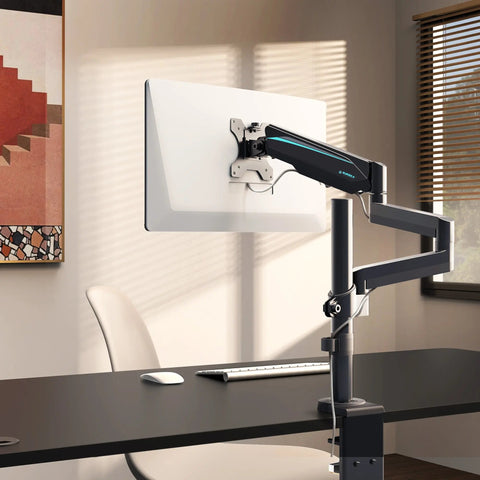
- [ ] Accessory Check: Is your footrest positioned for frequent height changes?
By focusing on these biomechanical details, you can ensure your transition to standing improves well-being without trading back pain for joint strain.
YMYL Disclaimer: This article is for informational purposes only and does not constitute professional medical advice. Always seek the advice of your physician regarding a medical condition, especially pre-existing joint or musculoskeletal issues.
Sources
- ISO 11226:2000 - Evaluation of static working postures
- BIFMA G1-2013 Ergonomics Guideline for Furniture
- Cornell University Ergonomics Web — Workstation Guides
- CCOHS: Office Ergonomics - Sit/Stand Desk
- HSE: Working safely with display screen equipment (DSE)
- OSHA eTools: Computer Workstations - Monitors
- The 2026 Workstation White Paper




Leave a comment