

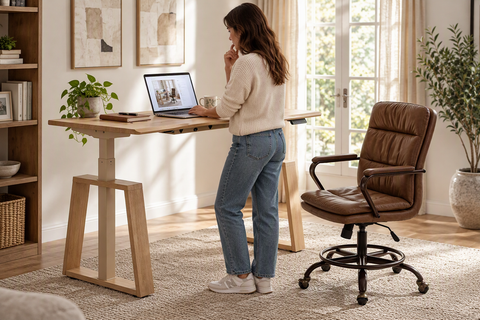
A standing desk for small home office spaces works best when you treat it as a room-planning decision, not just a furniture purchase. In apartments, the real question is whether the desk fits your floor plan, stays calm in shared spaces, and still leaves room for chairs, cables, and daily movement.

Why Apartment Desk Choices Feel So Limited
Apartment buyers are juggling more constraints than most home-office shoppers. A desk has to fit the footprint, leave a walking lane, avoid blocking storage, and still feel comfortable when you sit or stand all day.
Noise matters more too. In a studio, one-bedroom, or shared wall setup, small movements and frequent height changes are easier to hear and harder to ignore. That is why a compact standing desk should save space without feeling flimsy or stripped down.
Two decision sentences help narrow the field fast: if your room is shared with living space, prioritize footprint and cable control first. If you work beside roommates, a quieter lift feel matters more than flashy extras.
For apartment planning, the safest starting point is to think in zones rather than in furniture dimensions alone. UC Davis sit-stand guidance emphasizes clearance for chair movement, walking paths, and cable routing, which is exactly where small-room desk setups usually go wrong.

How to Size a Desk for Tight Spaces
Measure the Footprint First
Start with the desk's total footprint, not just the desktop width. Base depth, leg placement, and where the desk sits relative to a doorway or bed can matter as much as the top itself.
A slim electric standing desk under 48 inches wide can fit many studio and one-bedroom layouts, but that only helps if the surrounding zone stays usable. A narrow desk that blocks a closet door is still a bad fit.
Leave Room for Movement and Chairs
The chair pullout zone is easy to forget because it is invisible when you shop online. Once the desk arrives, that missing clearance is what makes a room feel crowded.
A practical check: if the desk sits against a wall, make sure you still have enough room to sit, stand, and step behind the chair without squeezing past corners or bed frames. That is the difference between "compact" and "annoying."
Match Surface Width to Your Setup
For most apartment users, 42 to 48 inches is the range that starts to feel workable without dominating the room. That is especially true if you use a laptop, one monitor, or a small accessory stack.
If you want a dual-monitor setup, be more conservative. A compact desk can support a lot, but it is not wise to assume every under-48-inch surface will comfortably handle two large displays plus speakers, a microphone, or a full-sized keyboard tray.
Plan for Corners, Nooks, and Windows
Corner placements often make the best use of small apartments because they turn an awkward patch of floor into a defined workstation. Window-side nooks can work too, as long as glare and cord routing stay manageable.
If you want help translating room size into usable zones, the studio layout math guide is a useful follow-up for thinking through the space before you buy.
For a structured sizing check, use this quick filter:
- Measure desk width, depth, and leg clearance.
- Add chair pullout space.
- Leave a walking lane.
- Confirm cable paths do not cross doors or storage.
That order matters more than the product photo does.
Quiet Operation Matters in Shared Spaces
In apartments, quiet is less about one perfect decibel number and more about how the desk feels in daily use. Smooth starts, smooth stops, and fewer unnecessary height changes are all easier on the room than jerky motion.
A bounded reference point can help. Yale's decibel chart puts common conversation around 60 to 70 dB, which is useful as a rough mental comparison when you are judging whether a desk movement seems likely to stand out in a shared room. That is a planning reference, not a universal motor rating.
What to look for:
- Stable lift behavior: A desk that feels composed in motion is usually easier to live with in a studio.
- Fewer adjustment cycles: If you change height many times a day, even small noises become more noticeable.
- Placement away from shared walls: Layout can matter as much as the motor itself.
If you are shopping for a quiet dual motor standing desk for apartment use, a sensible rule is to care more about movement quality than about marketing language. The quiet dual-motor desk guide is a good read when you want to think through shared-space friction rather than just specs.
For most renters, this is the key trade-off: if the room is used for sleep, work, or gaming, choose calmer motion over extra features you will rarely use. If the desk sits in a dedicated office room, noise becomes less critical than storage and layout.
Space-Saving Features That Still Pull Their Weight
A compact standing desk feels better when the accessories solve a real problem instead of adding clutter. The goal is to free surface area, keep cables in check, and avoid making the desk look like it was forced into the room.
A compact gaming desk can still feel feature-rich if the extras are chosen carefully. That usually means one or two high-value add-ons, not every available accessory.
Storage That Keeps the Surface Clear
Visible clutter is the fastest way to make a small workstation feel smaller. Built-in drawers or trays help, but only if they reduce the number of loose items on the desktop.
If you keep notebooks, chargers, controllers, or a microphone nearby, choose storage that gives those items a home without widening the desk visually.
Monitor Arms That Free Desk Space
A monitor arm is one of the best ways to reclaim space on a small standing desk for small home office use. It raises the screen off the surface, opens room for typing, and makes it easier to keep the desk tidy.
The monitor arm space guide is a practical follow-up if you want to compare layout benefits before adding hardware. For dual-screen users, the Dual Monitor Arm is a relevant check point, but only if your monitors, table thickness, and workspace geometry actually fit the mounting requirements.
Keyboard Placement That Protects Posture
A pull-out keyboard tray can be a smart space-saving move when desktop room is tight. It shifts typing off the main surface and can make a compact setup feel less cramped.
The pull-out keyboard tray is worth checking if you want more usable top space, while the Adjustable Keyboard Tray adds a more adjustable typing position for some setups. Just verify compatibility before buying, because accessory fit matters more in apartments where you do not have room to correct a bad purchase with extra furniture.
Cable Routing That Keeps the Room Tidy
Cable management is especially valuable in apartments because cords are harder to hide in open-plan or multi-use rooms. A cleaner cable path makes the desk feel lighter and reduces the visual mess that small spaces amplify.
The cable management system is a straightforward browsing stop if cable clutter is one of your main frustrations. For readers who want a broader decluttering mindset, the minimalist desk guide is a good context piece.
Full Desk or Converter for Apartments
| Option | Best For | Main Trade-Off | When It Breaks Down |
|---|---|---|---|
| Full standing desk | Buyers who want a permanent workstation and a cleaner long-term layout | Takes more floor commitment up front | Fails if the room is too shared or the footprint blocks walkways |
| Standing desk converter | Renters who want to upgrade an existing table or keep flexibility | Preserves the old surface, but usually offers less integrated workspace | Fails if you need more storage, monitor support, or a more unified setup |
A converter can be the smarter move if you are testing sit-stand habits in a rental or temporary space. A full desk is usually better when you need the whole setup to work together every day, especially if you are also adding monitors, storage, and cable management.
The choice flips when the room changes. If the desk sits in a shared living area, a converter may feel less intrusive. If the room is already a defined nook, a full desk often gives you a cleaner result.
If you want a permanent path into a more organized setup, browse the Modern Desks collection as the natural starting point when you are leaning toward a full desk rather than a topper.
One practical warning: do not buy the bigger-looking option just because it seems more flexible on paper. In apartments, the better choice is the one that fits your room and gets used every day.
Apartment-Friendly Setup Checklist
- Measure desk width, depth, and leg clearance before comparing styles.
- Confirm the height range fits both sitting and standing positions in your room.
- Check whether the desk leaves room for your chair, walking lane, and cable route.
- Add accessories only when they solve a real constraint, such as clutter, monitor crowding, or keyboard placement.
- Review shipping, returns, and assembly details before checkout so the purchase fits apartment logistics.
If you are still narrowing the field, the Home Office collection is a useful browse point for apartment-oriented workstation planning. The gaming desk guide also helps if your compact setup needs to support both work and play.
For buyers who want a compact but feature-rich model, the Wonder glass desk stays apartment-friendly while still offering dual-motor height adjustment and built-in storage. If you need more surface area and a corner-friendly footprint, the L-Shaped Standing Desk with Accessories Set (60"x23") is better treated as a larger-space option rather than a default apartment pick.
FAQs
Q1. How Wide Should a Standing Desk Be for an Apartment?
Many apartment-friendly desks stay under 48 inches wide, but width alone is not the whole decision. If you use a monitor arm, one laptop, or minimal accessories, a narrower desk can work well. If the room also needs to hold storage, cables, and a chair pullout zone, total footprint matters more than desktop width.
Q2. What Makes a Standing Desk Quiet Enough for Roommates?
Look for smooth lift motion, fewer abrupt starts and stops, and a setup that does not require constant height changes. Placement also matters. A desk that sits away from shared walls may be less noticeable than one placed directly against them, even when the hardware is similar.
Q3. Can a Compact Standing Desk Still Handle Dual Monitors?
Sometimes, but it depends on monitor size, arm use, and weight support. A compact desk can be fine for dual screens if the monitors are modest in size and the setup is planned carefully. If you want larger displays, speakers, or a heavy accessory stack, a slightly larger surface is safer.
Q4. What Storage Helps a Small Standing Desk Feel Less Cluttered?
The best storage reduces visible loose items without making the desk look bulky. Cable routing, keyboard trays, and small drawers or accessory holders usually do more for apartment setups than oversized add-ons. In a multi-use room, the cleanest solution is the one you do not have to keep rearranging.
Q5. Is a Standing Desk Converter Better Than a Full Desk for Apartments?
Converters are often better when you want a lower-commitment upgrade or need to keep an existing table. Full desks usually win when you want a more permanent workstation with cleaner integration for storage, movement, and accessories. The right choice depends on whether your apartment space is temporary, shared, or already dedicated.
A Compact Desk That Still Feels Like a Real Workspace
The right standing desk for small home office use is the one that fits the room first and the wishlist second. Measure the footprint, protect walking space, and treat noise, storage, and accessory fit as real constraints. Verify monitor arm and keyboard tray compatibility with your specific desk thickness before purchase. If the desk solves those problems, it will feel bigger in daily use than its dimensions suggest.




Leave a comment