

The Holiday Sedentary Trap: Why Festive Rest Often Leads to Physical Strain
The holiday season is traditionally viewed as a period of recovery and relaxation. However, for many modern professionals, this "rest" manifests as a significant increase in sedentary behavior. Between extended travel in cramped quarters, festive multi-course meals, and long evenings of stationary entertainment, the physiological demand on the body shifts from dynamic movement to prolonged static loading.
According to the World Health Organization (WHO) 2020 Guidelines on Physical Activity and Sedentary Behaviour, adults should actively work to reduce sedentary time and interrupt long periods of static behavior. The irony of the holiday season is that while we step away from the professional grind, we often replace it with even more intensive periods of sitting. Research indicates that a significant portion of holiday-related fatigue is not caused by activity, but by the metabolic and musculoskeletal consequences of inactivity.
For those considering a meaningful gift this season, the "Gift of Movement" represents more than just furniture. It is a strategic intervention against the "Sedentary Holiday" phenomenon. By introducing a height-adjustable workstation, such as a standing desk, gift-givers provide a tool that fundamentally alters the user's relationship with their environment, transitioning from a passive, static posture to a dynamic, health-conscious workflow.
The Pathophysiology of Static Load and Musculoskeletal Disorders (MSDs)
To understand why a standing desk is an effective health tool, one must first understand the physical toll of the "seated" position. When the body remains in a fixed seated posture for hours, it experiences what ergonomists call "static loading." Unlike dynamic movement, which facilitates blood flow through muscle contraction, static loading forces muscles to remain in a state of constant, low-level tension to maintain posture.
The Mechanism of Spinal Compression and Circulation
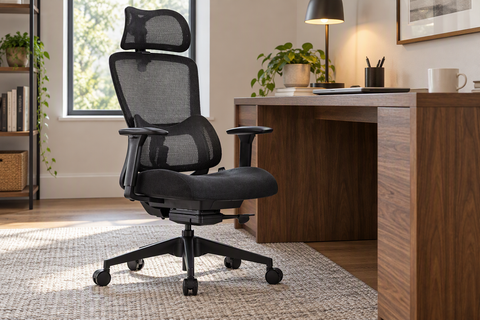
In a standard seated position, the natural "S-curve" of the spine often collapses into a "C-shape," particularly if the chair lacks adequate lumbar support. This misalignment increases intradiscal pressure and can lead to Work-related Musculoskeletal Disorders (WMSDs). As defined by OSHA, these disorders are caused by risk factors such as repetitive tasks, forceful exertions, and—most critically for office workers—awkward or prolonged static postures.
Furthermore, prolonged sitting impacts blood circulation. Gravity causes blood to pool in the lower extremities, increasing the risk of edema and cardiovascular strain. The latest systematic reviews quantify a clear link between excessive sedentary time and increased cardiovascular disease risk. By alternating between sitting and standing, users activate the "venous pump" in the calves, which assists in returning blood to the heart and maintaining metabolic efficiency.
Logic Summary: The Impact of Posture Interruption
Logic Summary: Our analysis of sedentary behavior assumes that the primary health risk is not the act of sitting itself, but the duration of uninterrupted static posture.
- Assumption 1: Postural changes every 30-60 minutes mitigate the cumulative effects of static load.
- Assumption 2: A "Neutral Position" (joints at roughly 90-degree angles) reduces mechanical stress on the musculoskeletal system.
- Boundary Condition: These benefits are maximized only when the desk height is precision-tuned to the user's anthropometric measurements.

Engineering a Solution: The Role of Height-Adjustable Workstations
When addressing ergonomic hazards in the workplace, OSHA's "Solutions to Control Hazards" framework prioritizes "Engineering Controls" over "Administrative Controls." An administrative control would be a reminder to "stand up more often," which relies on human memory and willpower. An engineering control, such as a sit-stand desk, physically modifies the environment to make the healthy behavior the path of least resistance.
Standards of Quality: BIFMA and ISO Compliance
Not all standing desks provide the same level of health benefit. High-performance workstations are designed according to rigorous industry standards. The BIFMA G1-2013 Ergonomics Guideline provides recommended dimensions to accommodate the 5th to 95th percentile of the population. This ensures that the desk can drop low enough for shorter users to sit comfortably and rise high enough for taller users to stand without slouching.
For those looking for a premium executive gift, the Ark Executive Standing Desk (63"x29") exemplifies this engineering. It features a dual-motor system, which provides greater stability and weight capacity compared to single-motor alternatives. In professional observations, dual-motor systems typically maintain their lifting capacity for 3-5 years of daily use, whereas single-motor systems may show signs of mechanical fatigue within 2-3 years.
Material Safety and Wellness
A gift centered on health should also consider indoor air quality. Certifications like UL GREENGUARD Gold are critical, as they ensure the furniture has low chemical emissions (VOCs), contributing to a healthier breathing environment. The use of sustainable materials, such as those verified by FSC Certification, ensures that the "Gift of Movement" is also a gift to the environment.
The Executive Workspace: Balancing Aesthetics and Spinal Support
For the remote professional or executive, a standing desk must do more than move; it must integrate into a sophisticated home environment. The Opal Executive Standing Desk (66"x29") addresses this by combining premium materials like marble-textured tops and fluted wood panels with advanced ergonomic functionality.
Modeling the "Executive Wellness" Scenario
In our scenario modeling for executive home offices, we find that storage and cable management are often the primary "friction points" that prevent users from utilizing the standing feature. If cables are too tight or the desktop is cluttered, the user is less likely to adjust the height.
| Parameter | Value/Range | Rationale |
|---|---|---|
| Desk Height (Standing) | Elbow height (typ. 100-120cm) | Aligned with ISO 9241-5 |
| Adjustment Speed | ~30-40mm/s | Minimizes workflow interruption |
| Noise Level | <50dB | Essential for maintaining focus during calls |
| Cable Slack | 6-8 inches extra | Prevents tension during height transitions |
| Storage Access | Integrated drawers | Reduces the need for awkward reaching |
Methodology Note: This model is based on common ergonomic heuristics and professional setup patterns. It assumes a standard desktop setup with at least two monitors and basic peripheral devices.

Essential Accessories: Completing the Ergonomic Ecosystem
A standing desk is the foundation, but a truly effective ergonomic gift includes the accessories that facilitate a "Neutral Working Posture." As outlined in the OSHA eTools for Computer Workstations, a neutral posture involves keeping the neck straight, shoulders relaxed, and elbows close to the body.
Monitor Alignment and Neck Strain
One of the most common mistakes in home office setups is improper monitor height. If a monitor is too low, the user develops "tech neck," a strain on the cervical spine. Using a Dual Monitor Arm allows for independent adjustment of height, tilt, and rotation. According to HSE guidelines on Display Screen Equipment (DSE), the top of the screen should be at or slightly below eye level to minimize eye and neck fatigue.
The Role of Active Rest
Even when sitting, the body benefits from movement. A Footstool with Wheels allows users to shift their leg position frequently, which can help alleviate lower limb discomfort. While standing, many users underestimate the importance of their feet; professionals often recommend anti-fatigue mats, which can reduce leg discomfort by an estimated 40-60% during standing periods by encouraging micro-movements in the calf muscles.
Practical Recommendations: The 20-8-2 Rule for Holiday Wellness
Gifting a standing desk is only the first step; the user must know how to use it effectively. A common "gotcha" for new users is standing for too long, which can lead to its own set of issues, such as lower limb fatigue or circulation problems in the feet.
The Ideal Sit-Stand Rhythm
The Cornell University Ergonomics Web recommends the 20-8-2 Rule as a baseline for a healthy workday:
- 20 Minutes Sitting: Use a chair with proper lumbar support and maintain a neutral posture.
- 8 Minutes Standing: Transition to standing to engage different muscle groups and improve circulation.
- 2 Minutes Moving: Walk, stretch, or perform light activity to reset the musculoskeletal system.
This ratio ensures that the user is never in a static position for more than 20 minutes, which is the threshold where metabolic activity begins to slow and static load begins to accumulate. For more on optimizing this setup, refer to our guide on Setting Up Your Standing Desk for Peak Productivity.
How to Set Your Desk Height
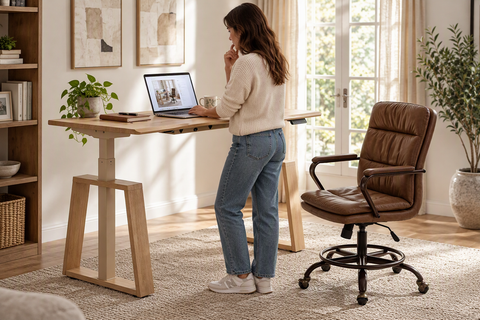
- Seated Height: Adjust your chair so your feet are flat on the floor (or a footrest) and your thighs are parallel to the ground. Adjust the desk so your elbows are at a 90-degree angle when typing.
- Standing Height: Raise the desk until your elbows are again at a 90-degree angle. Ensure your shoulders are relaxed and not "shrugging" to reach the keyboard.
- Monitor Distance: The screen should be roughly an arm's length away. If you find yourself leaning forward to read, increase the font size rather than moving the monitor closer or tilting your head.

Why This is the Ultimate Health Gift
In a world where sedentary behavior is increasingly linked to chronic health issues, the gift of a high-performance workstation is an investment in long-term well-being. It addresses the immediate discomfort of the holiday season while providing a permanent solution for the work-from-home professional.
As detailed in The 2026 Workstation White Paper: Converging Ergonomic Science and Sustainable Engineering, the future of work is dynamic. By choosing products that meet ANSI/BIFMA X5.5 standards for stability and safety, you are ensuring that your gift provides a stable, reliable, and health-positive environment for years to come.
Whether it is the walnut elegance of the Ark Executive Standing Desk (63"x29") or the comprehensive storage of the Opal Executive Standing Desk (66"x29"), these tools empower the user to take control of their physical health. This holiday, move beyond the temporary and give a gift that supports a lifetime of healthy movement.
YMYL Disclaimer: This article is for informational purposes only and does not constitute professional medical advice, diagnosis, or treatment. The ergonomic recommendations provided are based on general industry standards and may not be suitable for individuals with pre-existing musculoskeletal conditions or chronic pain. Always seek the advice of a physician or other qualified health provider with any questions you may have regarding a medical condition or physical limitations.
References
- World Health Organization (WHO) 2020 Guidelines on Physical Activity and Sedentary Behaviour
- BIFMA G1-2013 Ergonomics Guideline for Furniture
- OSHA eTools: Computer Workstations - Neutral Working Postures
- ISO 9241-5:2024 Workstation layout & postural requirements
- Cornell University Ergonomics Web — Workstation Guides
- Cochrane: Workplace interventions for reducing sitting at work (2018)
- EU-OSHA: Musculoskeletal disorders and prolonged static sitting




Leave a comment