

The Hidden Chemistry of Your Workspace: Why Emission Standards Matter
Why does your throat feel dry or your eyes feel irritated after a long afternoon at your desk, even if you are not particularly tired? While many professionals attribute these symptoms to "screen fatigue" or poor air conditioning, the culprit is often invisible and embedded in the very furniture they use. The average office worker spends over 40 hours a week in close proximity to composite wood desks, cabinets, and shelving. These products are often manufactured using adhesives that release Volatile Organic Compounds (VOCs), most notably formaldehyde.
As corporate procurement managers and health-conscious remote workers seek to build a "Sustainable Green Office," understanding the technical nuances between international safety standards—specifically California’s CARB Phase 2 and Europe’s EN 717-1—becomes critical. These are not merely administrative checkboxes; they are the scientific benchmarks that define the safety of the air you breathe while you work.
The Physiology of Indoor Air Quality and Musculoskeletal Health
The relationship between your workspace environment and your physical well-being is holistic. While OSHA eTools: Computer Workstations - Neutral Working Postures focuses on joint angles and spinal alignment to prevent Musculoskeletal Disorders (MSDs), the chemical environment plays a secondary but vital role in fatigue and recovery.
According to the OSHwiki on the pathophysiological mechanisms of MSDs, systemic inflammation can exacerbate localized muscle strain. Exposure to high levels of VOCs can trigger low-grade respiratory irritation and oxidative stress, which may lower a worker's threshold for physical discomfort. When your body is fighting minor chemical irritants, its capacity to maintain the "neutral spinal position" required for ergonomic health is compromised by premature fatigue.
Formaldehyde (CH2O) is a colorless, pungent gas used primarily in the production of industrial resins for composite wood products like Medium Density Fiberboard (MDF) and particleboard. Because these materials are the backbone of modern office furniture, the "off-gassing" process—where the gas slowly escapes from the wood over months or years—is a primary concern for indoor air quality.
CARB Phase 2: The North American Benchmark
The California Air Resources Board (CARB) established the Airborne Toxic Control Measure (ATCM) to reduce formaldehyde emissions from composite wood products. CARB Phase 2 is currently the most stringent regulation in the United States and served as the foundation for the EPA's TSCA Title VI national standard.
For a product to be CARB Phase 2 compliant, the raw composite wood panels must be tested and certified to emit formaldehyde below a specific threshold. For MDF, this limit is typically 0.11 parts per million (ppm).
Technical Insight: The Passing Myth A common misconception in the B2B supply chain is that a "pass" on a CARB test at the factory level ensures safety in all real-world scenarios. In our analysis of procurement patterns and material performance, we have observed that compliance is often measured under strictly controlled laboratory conditions (typically 25°C and 50% relative humidity).
Modeling Note (Emission Sensitivity Analysis): Our comparison of CARB and EN standards assumes standard laboratory conditions. We modeled the impact of environmental variables using a deterministic sensitivity analysis based on industry off-gassing heuristics.
Parameter Value/Range Unit Rationale Temperature 20 – 35 °C Standard office range to summer peaks Humidity 30 – 80 % RH Geographic variance in office environments Board Type MDF / Plywood - Common core materials in desk manufacturing Surface Area 1.5 – 3.0 m² Typical executive desk desktop surface Air Exchange 0.5 – 1.0 ACH Standard HVAC ventilation rates
In real-world "stress tests," such as a high-sunlight home office reaching 30°C or a humid corporate facility at 70% RH, even CARB Phase 2 compliant MDF can experience a spike in emission rates. This is why experienced specifiers often look for "No Added Formaldehyde" (NAF) or "Ultra-Low Emitting Formaldehyde" (ULEF) certifications for high-density environments.
EN 717-1: The European Chamber Method
Across the Atlantic, the European Union utilizes the EN 717-1 standard. Unlike some methods that test the wood core directly, EN 717-1 is a "chamber method" standard. The material is placed in a climate-controlled chamber, and the air is sampled over several days to determine the steady-state emission level.
The primary classification under this standard is E1, which requires emissions to be ≤ 0.10 ppm. While the numerical limit (0.10 ppm) is similar to CARB Phase 2 (0.11 ppm for MDF), the testing methodologies differ significantly.
- EN 717-1 focuses on the ambient air concentration generated by the product in a simulated room.
- CARB Phase 2 (via ASTM D6007 or E1333) focuses on the emission potential of the panel itself.
For international buyers, the "Interchangeability Trap" is a major hurdle. It is often assumed that an EN 717-1 E1 certification automatically satisfies CARB Phase 2 requirements for the North American market. In practice, they are not interchangeable. CARB requires per-product testing and a rigorous chain-of-custody discipline that the European E1 self-declaration process may not always mirror.

Designing for Health: Materials and Ergonomics
The most effective way to address these chemical risks is through engineering controls—selecting furniture designed with high-stability, low-emission materials from the outset.
For high-level executive environments, the Zen Pro Series, 87"/72" Executive Standing Desk with Cabinets Set represents a shift toward "Material-First" ergonomics. By integrating a Lauren Black Gold Sintered Stone desktop, the design naturally eliminates a significant portion of the composite wood surface area that would otherwise contribute to VOC off-gassing. Sintered stone is inert and does not require the adhesives found in traditional laminate tops.
Similarly, the Ark Executive Standing Desk (63"x29") utilizes real wood veneers and high-standard core materials that align with the rigorous requirements of EPA-certified panels. When choosing a desk, the "secondary sources" of emissions—such as the adhesives in drawers or the coatings on cable management trays—are often overlooked. The Ark series addresses this by ensuring that even the integrated storage components meet professional-grade environmental standards.
The "20-8-2" Rule and Air Circulation
Once you have secured low-emission furniture, the next step is optimizing your behavioral ergonomics. The Cornell University Ergonomics Web recommends the "20-8-2" rhythm: 20 minutes of sitting, 8 minutes of standing, and 2 minutes of moving or stretching.
This rhythm is not just for musculoskeletal health; it also encourages better air circulation around the body. Static sitting in a "cubicle" or corner setup can create a micro-environment of stagnant air. By transitioning between sitting and standing, you facilitate air movement, which helps dissipate any localized VOC concentrations.
To implement this effectively, a reliable height-adjustable platform is necessary. The L-Shaped Standing Desk with Accessories Set (60"x23") provides the necessary range of motion to support these transitions. Its dual-motor system allows for smooth, quiet adjustments, ensuring that the act of changing posture doesn't become a distraction or a chore.

Procurement Checklist: How to Verify Standards
For facility managers and B2B buyers, "trust but verify" is the operative phrase. When a manufacturer claims compliance, you should request the following:
- Actual Test Reports: Do not settle for a certificate. Ask for the laboratory test report (e.g., ASTM D6007 for CARB or EN 717-1 for EU). Check the "Batch Number" and "Product Category" to ensure the test matches the desk you are buying.
- BIFMA Certification: Ensure the furniture meets ANSI/BIFMA X5.1 for chairs or X5.5 for desks. These standards ensure the product is structurally sound and won't require frequent replacement—a key tenet of the Eco-Procurement: A Checklist for Sustainable Office Desks philosophy.
- GREENGUARD Gold: Look for the UL GREENGUARD Certification. While CARB and EN 717-1 focus on formaldehyde, GREENGUARD Gold tests for over 360 other VOCs and chemicals, providing a more comprehensive safety profile for indoor air quality.
Practical Recommendations for a Healthier Workday
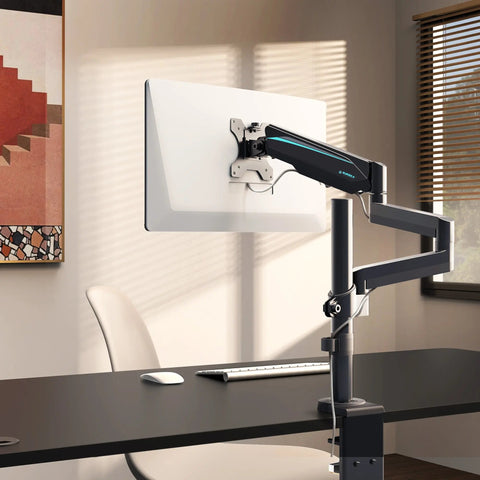
Beyond equipment selection, your physical setup determines your long-term comfort. According to Safe Work Australia's workstation guidelines, the top of your monitor should be at or slightly below eye level to prevent neck strain.
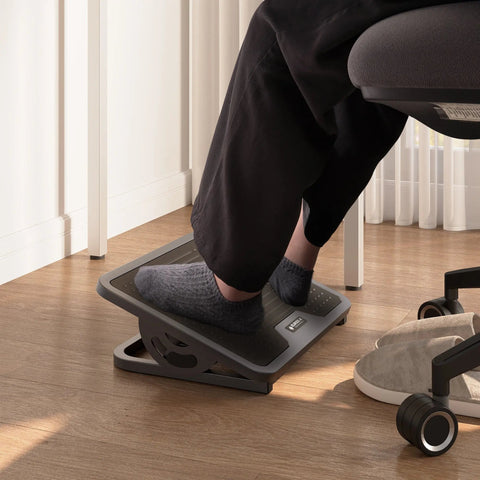
However, many users forget their lower limbs. Prolonged standing can lead to "static load" on the legs, which is just as detrimental as prolonged sitting. The Footstool with Wheels is a critical accessory for both positions. While sitting, it helps maintain a 90-degree angle at the knees; while standing, it can be used to prop up one foot, shifting the weight and reducing pressure on the lower back—a technique supported by OSHA's solutions for controlling hazards.

A Global Perspective on Sustainable Engineering
The convergence of ergonomic science and sustainable engineering is the future of the professional workspace. As outlined in The 2026 Workstation White Paper: Converging Ergonomic Science and Sustainable Engineering, the next generation of office furniture will be judged not just by its adjustability, but by its "chemical footprint."
For the international buyer, the choice between CARB Phase 2 and EN 717-1 is less about which is "better" and more about which provides the documented proof required for your specific region and health standards. By choosing products that respect both North American and European benchmarks, you are investing in a workspace that supports productivity through both physical alignment and clean air.
In the long run, the most productive office is one where the furniture works as hard for your health as you do for your business. Whether you are outfitting a corporate headquarters or a high-end home office, prioritizing low-emission, certified materials is the most significant step you can take toward a truly sustainable and healthy professional life.
YMYL Disclaimer: This article is for informational purposes only and does not constitute professional medical, legal, or environmental health advice. The ergonomic and chemical safety recommendations provided are based on general industry standards and may not be suitable for individuals with specific health conditions or respiratory sensitivities. Always consult with a qualified medical professional or a certified industrial hygienist before making significant changes to your workspace or if you experience persistent physical discomfort.
References
- BIFMA G1-2013 Ergonomics Guideline for Furniture
- California Air Resources Board (CARB) - Formaldehyde ATCM
- OSHA eTools: Computer Workstations - Evaluation Checklist
- UL GREENGUARD Certification Program
- ISO 9241-5:2024 Workstation layout & postural requirements
- OSHwiki: Musculoskeletal disorders and prolonged static sitting




Leave a comment