

An ergonomic chair helps most when it fits your body and your room, not just your shopping list. For 8-10 hour WFH days, the real payoff is fewer pressure points, less fidgeting, and a setup that lets you stay focused through calls and deep work. In a small home office, every inch matters, so start with fit before style.

Why Chair Fit Drives All-Day Focus
For remote work, comfort is not just a nice extra. A chair that supports neutral posture can help you stay settled through meetings and admin work instead of constantly shifting for relief, which is why OSHA's computer workstation chair guidance emphasizes neutral body positioning and the natural curve of the spine.
The practical test is simple: if the chair fights your body, your attention will drift. In real home-office use, the worst setups are often the ones that look polished but leave one pressure point, one awkward reach, or one cramped leg position unresolved.
That matters even more in compact rooms. In a corner office or a shared living space, chair width, swivel room, and desk clearance can decide whether the workspace feels workable or constantly cramped. Poor setup can also contribute to back, neck, or shoulder strain over time, so the fit check should happen before you worry about finish or color.
Here are two useful decision sentences: if you sit most of the day, prioritize adjustability over style; if the chair barely fits the room, a beautiful frame is still a bad buy. And if your desk setup is already tight, check footprint first because comfort features cannot fix a chair that blocks movement.
Choose a Chair That Fits Your Space
For a compact home office, footprint and adjustability matter together. A chair that fits under the desk but leaves no room to pivot or stand will still feel frustrating after a week.
| Decision Dimension | What To Check First | What It Means In Practice | Best For |
|---|---|---|---|
| Footprint | Overall width and armrest spread | The chair should slide in, swivel, and let you stand without bumping walls or furniture | Small apartments and shared rooms |
| Seat Height | Can your feet rest flat with relaxed knees? | If the seat is too high, your thighs may lose support; too low, and your desk may feel too tall | Long seated workdays |
| Seat Depth | Is there room behind your knees? | The backrest should support the torso without pressing into the back of the legs | Taller or shorter users with different leg lengths |
| Visual Style | Does it blend with nearby furniture? | A chair can look residential without giving up ergonomic support | Living-room offices and guest rooms |
The most common mistake in sub-100 sq ft spaces is buying on looks first. That is why browsing Office Chairs & Gaming Chairs is useful as a starting point, not a final answer. Once you know your room limits, a smaller chair can be the smarter fit than a heavier executive shape.
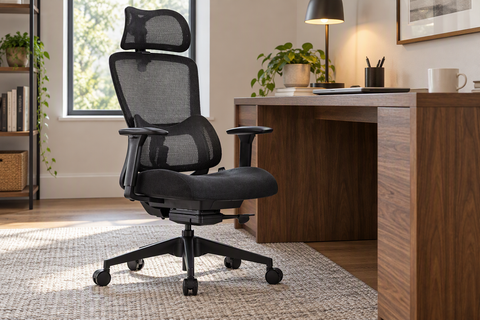
If you want a more compact, mesh-forward option, Nico, Mesh Ergonomic Office Chair is worth checking because its 27.16" D x 26.77" W footprint, 18.11"-21.25" seat height, and 3D armrests are designed for a more adjustable home-office fit. It is better suited when you need range and airflow, not when you want a fixed, lounge-like seat.
If your room is narrow but you still want a cleaner visual profile, Onyx, Ergonomic Office Chair can work as a space-conscious option to verify, since its overall dimensions are smaller than many executive chairs and its flip-up armrests help free up space. The trade-off is that you should still confirm the seat depth and chair width against your desk clearance before buying.

Set Your Chair in the Right Order
The fastest path to a good setup is to adjust in sequence instead of randomly twisting every lever. OSHA recommends starting with seat height so your feet rest flat, knees stay relaxed, and thighs sit roughly parallel to the floor, which gives you a stable base before you fine-tune the rest.
- Set seat height first. Your feet should rest flat on the floor or on a support surface, with no strain in the backs of the thighs.
- Set seat depth next. The backrest should support your torso without pressing behind the knees; the University of Pittsburgh's chair guidance suggests leaving a small 2-3 inch gap at the front edge.
- Adjust lumbar support. The lower-back support should line up with the natural inward curve of your spine, not push you forward aggressively.
- Set armrests last. They should let your shoulders stay relaxed instead of forcing the elbows upward or outward, which the CSU Stanislaus telecommuting ergonomics guide calls out as a key comfort check.
- Finish with recline and tension. Use just enough movement to change positions without turning the chair into a lounge seat.
This order matters because each step changes the next one. For example, a seat that is too high can make armrests feel wrong even if the armrests themselves are adjustable. That is why the adjustment sequence is more useful than guessing from a product page.
The point is not to hit a perfect posture and freeze there. It is to build a position you can return to quickly when your attention shifts from typing to calls to reading.
Chair setup order and when to revisit adjustments
Start with seat height, then check seat depth, lumbar support, and armrests. Revisit the setup after several workdays if comfort or posture still feels off.
View chart data
| Category | Adjust first | Then check | Then check | Then check | Review again |
|---|---|---|---|---|---|
| Seat height | 1 | ||||
| Seat depth | 2 | ||||
| Lumbar support | 3 | ||||
| Armrests | 4 | ||||
| Recheck after several workdays | 5 |
Dial in Support for Long Workdays
When you sit for long stretches, the support features that matter most are the ones you still notice after the first hour. Lumbar support should feel like it is meeting your lower back, not forcing you into one rigid pose, and armrests should reduce shoulder effort instead of creating it.
For long WFH sessions, this is where many chairs split into two groups. One group feels fine for an hour and then starts to annoy you with pressure or stiffness. The other stays usable because the support follows small changes in posture throughout the day.
If your lower back needs more active shaping, A Buyer's Guide to Fixed vs. Dynamic Lumbar Support is a useful next read because lumbar design can change how often you want to shift or stand. A dynamic system is usually more helpful when you sit through long, mixed-use workdays; a simpler backrest can still work if your desk time is shorter or your posture is already well supported.
For support-led product checking, Lark, Adjustable Lumbar Ergonomic Office Chair stands out because it combines 3D adaptive lumbar support, 3D armrests, and adjustable seat depth. That is a better fit when you want to fine-tune support across the day, not when you prefer a fixed chair with minimal adjustment.
If you want a different long-session option with more sculpted support, Royal Rowan,Microfiber Leather Executive Office Chair may suit a home office that leans more polished than technical. Its fixed armrests and executive styling make it a better boundary-case choice for users who value presentation and back-to-lumbar wraparound support more than maximum adjustability.
Make the Setup Work in a Small Room
Small rooms do not have to rule out a good ergonomic chair, but they do raise the cost of every extra inch. The chair should leave enough room to slide in, pivot, and stand up without scraping walls, beds, or side tables.
A few practical rules help here:
- Match the chair footprint to the room before you match the upholstery to the decor.
- Keep cables and under-desk items out of the chair's turning path.
- Use a footrest or keyboard tray only when desk height or leg position actually calls for it.
- Favor accessories that improve comfort without turning the workspace into clutter.
That is also where styling and ergonomics need to stay linked. A chair that blends into a bedroom or living room can be a good choice, but it still needs to support the workday. That is why browsing the Home Office collection is better used as a room-planning entry point than as a substitute for a fit check.
For accessory-level cleanup, the Desktop accessories collection can help when the real problem is clutter, cable drag, or a crowded desk surface rather than the chair itself. If the room already feels tight, solving the surrounding layout often makes the chair feel better without changing the chair at all.
A useful decision sentence here: if the chair blocks daily movement, it is too large even if the seat feels comfortable. If it fits the room but leaves your shoulders tense, the issue is probably the setup, not the footprint.
Finish With a Daily Comfort Check
After a few workdays, recheck the chair instead of assuming the first setup was final. Background ergonomics resources note that small fit issues often become obvious only with repeated use, which matches what people notice in real life.
Use this quick check:
- Feet stay flat without reaching.
- Knees feel relaxed, not crowded.
- The backrest supports the torso without digging behind the legs.
- Shoulders stay relaxed during typing and calls.
- You are not constantly sliding forward or fidgeting.
If any of those drift, revisit seat height, seat depth, lumbar position, and armrest height in that order. The best ergonomic chair for home office use is the one that still fits after your routine settles, not the one that only looked right on day one.
Related Resources
- How to Adjust Your Office Chair for Perfect Ergonomics
- Seat Depth Adjustment: The Key to Lower Back Relief
- Mastering Your Headrest: Adjustments for Neck Support
- A Remote Worker's Checklist for a New Desk Setup
FAQs
Q1. How Do I Know If My Ergonomic Chair Fits Me?
A good fit usually means your feet rest flat, your knees feel relaxed, your back is supported, and your shoulders are not lifted. If you feel pressure behind the knees or keep shifting around after short sessions, the chair likely needs a different setting or a different size class.
Q2. What Seat Height Works Best for Long WFH Hours?
A practical starting point is the height that lets your feet stay flat and your thighs stay supported without forcing your knees up. If your desk is fixed and the chair is low enough to feel comfortable but high enough to keep your wrists and shoulders neutral, you are usually in the right range.
Q3. Can a Mesh Chair Be Comfortable for All-Day Use?
Yes, if the mesh tension, lumbar shape, and seat depth are balanced for your body. Mesh often helps with airflow, which is useful in warm rooms or longer sessions, but comfort still depends on whether the chair supports your back and legs without creating pressure points.
Q4. Why Does My Chair Still Feel Uncomfortable After Adjustments?
The most common reasons are a mismatch between chair dimensions and body size, desk height that is too high or too low, or a seat depth that does not leave enough room behind the knees. If discomfort stays after a careful reset, the chair may simply be the wrong shape for your build.
Q5. Can a Small Home Office Still Use an Ergonomic Chair Well?
Yes, as long as you check chair width, swivel room, and the space needed to stand up without bumping nearby furniture. In small rooms, the best result usually comes from choosing a chair that fits the footprint first, then tuning the support features second.
Build a Chair Setup You Can Live With
A productive home-office chair setup is less about finding a universal winner and more about matching fit, support, and room size to your daily routine. Start with seat height, then check depth, lumbar, and armrests. If the chair still feels awkward after several workdays, keep adjusting or choose a better size match. The right ergonomic chair should support your work, not demand constant attention.




Leave a comment