

The Hidden Impact of Desk Instability on Performance and Health
A microscopic tremor in your monitor or a slight lateral sway during a high-stakes gaming session is more than a nuisance; it is a disruptor of physiological focus and mechanical precision. For gamers, a shaky desk can lead to inconsistent mouse tracking and missed headshots. For remote professionals, persistent micro-vibrations contribute to visual fatigue and cognitive load. Yet, the most common misconception is that a "wobble" is always a sign of a low-quality product. In reality, instability is often a complex interaction between frame geometry, floor conditions, and load distribution.
Understanding the physics of desk stability is essential for maintaining a Neutral Position, where the body is aligned to minimize stress on the musculoskeletal system. When a desk moves, the user instinctively tenses their shoulders and wrists to compensate for the shifting surface. This static load, if maintained over long periods, is a primary risk factor for Musculoskeletal Disorders (MSDs). By identifying the root causes of instability, users can transform a frustrating workstation into a rigid, high-performance platform.
The Physics of Sway: Torsional Rigidity and Center of Gravity
To solve desk wobble, one must first understand the structural forces at play. Desk stability is primarily governed by torsional rigidity—the ability of a structure to resist twisting—and the location of the center of gravity.
Torsional Rigidity in Frame Design
Most modern ergonomic desks utilize a T-leg or C-leg frame design. While these provide excellent legroom, they are inherently more susceptible to lateral sway compared to traditional 4-leg designs. Quantitative modeling suggests that 2-leg desks often exhibit higher deflection rates because the force applied at the desktop level is magnified by the height of the legs, acting as a lever arm. As detailed in The 2026 Workstation White Paper: Converging Ergonomic Science and Sustainable Engineering, the integration of reinforced steel cross-members and high-precision tolerances in the leg columns is critical for mitigating this effect.
The Pendulum Effect at Height
For users of height-adjustable desks, stability often decreases as the desk rises. This is due to the "pendulum effect." As the center of gravity moves further from the base, any small force applied to the top results in a larger oscillation at the base. High-quality systems address this through dual-motor synchronization. A dual-motor system ensures that the lift force is balanced across both legs, reducing the internal friction and structural "play" that leads to sway.
Logic Summary: Stability Modeling Our analysis of desk stability assumes a standard load of 50 lbs (approx. 24kg) and a height of 42 inches (approx. 107cm).
Parameter Standard Value Rationale Desktop Thickness 1 inch (25mm) Minimum for structural integrity Leg Overlap 6 inches (152mm) Necessary for lateral rigidity at max height Motor Count 2 (Synchronized) Balanced force distribution Floor Surface Level Hardwood Baseline for zero pitch Fastener Torque 10 Nm Standard for rigid steel-to-wood joints
Common Causes of Desk Wobble and How to Identify Them
Based on patterns observed in customer support and warranty handling, we have identified that instability is rarely caused by a single factor. It is typically a combination of environmental and assembly issues.
1. The Overlooked Culprit: Uneven Floors
In practice, the single most common cause of persistent wobble is an uneven floor, not the desk itself. Even a deviation of 2-3 millimeters across the width of the desk can create a "rocking" motion.
- The Diagnosis: Place a spirit level on the desktop. If the bubble is off-center, your floor is likely pitched.
- The Fix: Most professional desks, such as the Standing Desk with Drawers, Wood Finish (47'' /55''), feature adjustable leveling feet. Adjust these in small increments, checking the spirit level after each turn until the desk is perfectly horizontal.
2. Assembly Errors and Fastener Fatigue
During assembly, the sequence in which you tighten bolts matters. Overtightening a single bolt before others are seated can warp the connector plates, creating permanent weak points.
- The Diagnosis: Check for "creaking" sounds when you lean on the desk. This indicates metal-on-metal friction from loose joints.
- The Fix: Use a cross-pattern tightening sequence (similar to tightening lug nuts on a car tire). Ensure all bolts are snug and the joint is rigid, but stop before you require excessive force, which could strip the threads.
Update your home office setup with the 47" Electric Standing Desk, Gray. The smart sit stand desk with a sleek wood finish completes your home office setup.
3. High Center of Gravity from Monitor Stands
A heavily loaded desk with multiple monitors sitting on stock stands creates a high, shifting center of gravity. This setup is particularly prone to "monitor shake" during typing or gaming.
- The Diagnosis: If the desk frame feels solid but the screens are vibrating, the issue is load distribution.
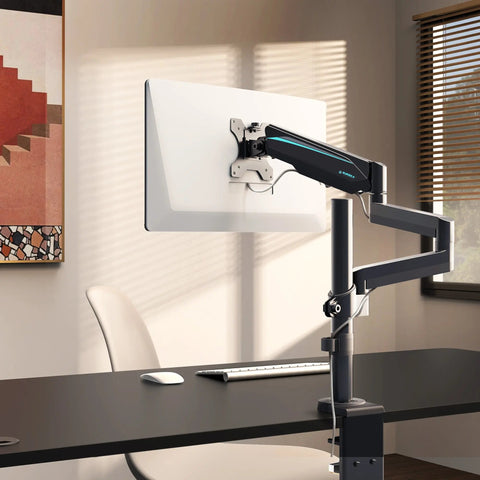
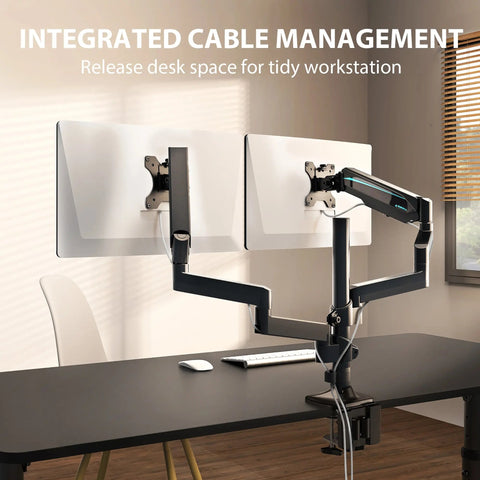
- The Fix: Shifting the load to a more stable point is key. Using a Single Monitor Arm or a dual-arm bracket attached directly to the desk frame transfers that dynamic load to a central, rigid point, virtually eliminating independent screen movement.
Engineering a Stable Workstation: Professional Solutions
When selecting ergonomic furniture, stability should be viewed through the lens of industry standards. The BIFMA G1-2013 Ergonomics Guideline for Furniture provides the framework for dimensions and stability that accommodate the 5th to 95th percentile of the population.
The Role of Height-Adjustable Desks
A high-performance sit-stand desk is designed to handle the transition between postures without compromising rigidity. According to the Canadian Centre for Occupational Health and Safety (CCOHS), the ability to switch between sitting and standing is vital for reducing sedentary time. Research by Agarwal et al. (2018) supports the claim that these workstations significantly alleviate low back discomfort.
To maximize stability in a standing configuration, consider the following:
- Dual-Motor Systems: As mentioned, these provide a more balanced lift.
- Integrated Storage: Adding mass to the lower portion of the desk can lower the center of gravity. A 23" Rolling File Cabinet with Drawer placed under or near the desk frame provides necessary storage while keeping the area organized and stable.

Optimizing Input Device Stability
Stability isn't just about the desk surface; it extends to your interface with the computer. An Adjustable Keyboard Tray can help achieve a Neutral Working Posture by allowing you to position your wrists and elbows correctly, independent of the main desktop height. This reduces the amount of force you need to apply to the desktop itself, further minimizing potential sway.

Practical Recommendations for a Rock-Solid Setup
Achieving a stable setup requires a systematic approach to hardware and behavior. Referencing Cornell University's 20-8-2 Rule, users should aim for 20 minutes of sitting, 8 minutes of standing, and 2 minutes of movement. Stability is most critical during the 8 minutes of standing when the desk is at its highest point.
Step-by-Step Troubleshooting Checklist
- Clear the Surface: Remove all items to isolate the frame's movement.
- Level the Base: Use a spirit level and adjust the leveling feet until the frame is perfectly flat.
- Torque Check: Re-tighten all main frame bolts using the cross-pattern method.
- Load Management: Place heavier items (like a PC tower) closer to the legs rather than in the center of the desktop to reduce bowing.
- Monitor Mounting: Replace stock stands with a Single Monitor Arm to secure the screens to the desk's structural core.
The 1/3 Loading Heuristic
For optimal stability, we recommend the 1/3 Loading Rule: try to keep at least 1/3 of the total desk weight (including the desktop itself) concentrated in the lower half of the assembly or directly over the support columns. This lowers the center of gravity and dampens vibrations.
| Feature | Impact on Stability | Recommended Action |
|---|---|---|
| Leveling Feet | High | Adjust until the spirit level is centered. |
| Bolt Tightness | Medium | Check every 6 months for fastener fatigue. |
| Monitor Arm | High | Use to move weight from the edge to the center. |
| Floor Type | High | Use a hard chair mat on top of deep-pile carpet. |
| Leg Gauge | High | Choose desks with heavy-duty steel columns. |
Designing for Long-Term Health and Precision
A stable desk is the foundation of a healthy, productive workspace. By adhering to international standards such as ISO 9241-5:2024, which specifies layout and postural requirements, you ensure that your furniture supports your body rather than forcing it to adapt to instability.
While Cochrane (2018) notes that the long-term health outcomes of sit-stand desks are still being studied, the immediate benefits to comfort and posture are well-documented. For more in-depth strategies, explore our guides on Eliminating Micro-Wobble for Coders and What Makes an Ergonomic Desk Truly Stable?.
By combining high-quality engineering with proper assembly and environmental adjustments, you can eliminate the distractions of a shaky desk and focus entirely on the task at hand.
Disclaimer: This article is for informational purposes only and does not constitute professional medical or occupational health advice. Individuals with pre-existing musculoskeletal conditions should consult a qualified healthcare professional or ergonomist before making significant changes to their workstation setup or work habits.
References
- BIFMA G1-2013 Ergonomics Guideline for Furniture
- ISO 9241-5:2024 Workstation layout & postural requirements
- CCOHS: Office Ergonomics - Sit/Stand Desk
- OSHA eTools: Computer Workstations - Desks
- The 2026 Workstation White Paper: Converging Ergonomic Science and Sustainable Engineering
- Cochrane: Workplace interventions for reducing sitting at work (2018)
- Cornell University Ergonomics Web — Workstation Guides
- Agarwal et al., 2018 – Sit-Stand Desks & Low Back Discomfort
- Santos et al., 2025 – Ergonomic Interventions & Work-Related Musculoskeletal Pain




Leave a comment